The Magnificent Seven and Their Role as the Market’s Undisputed AI Leaders
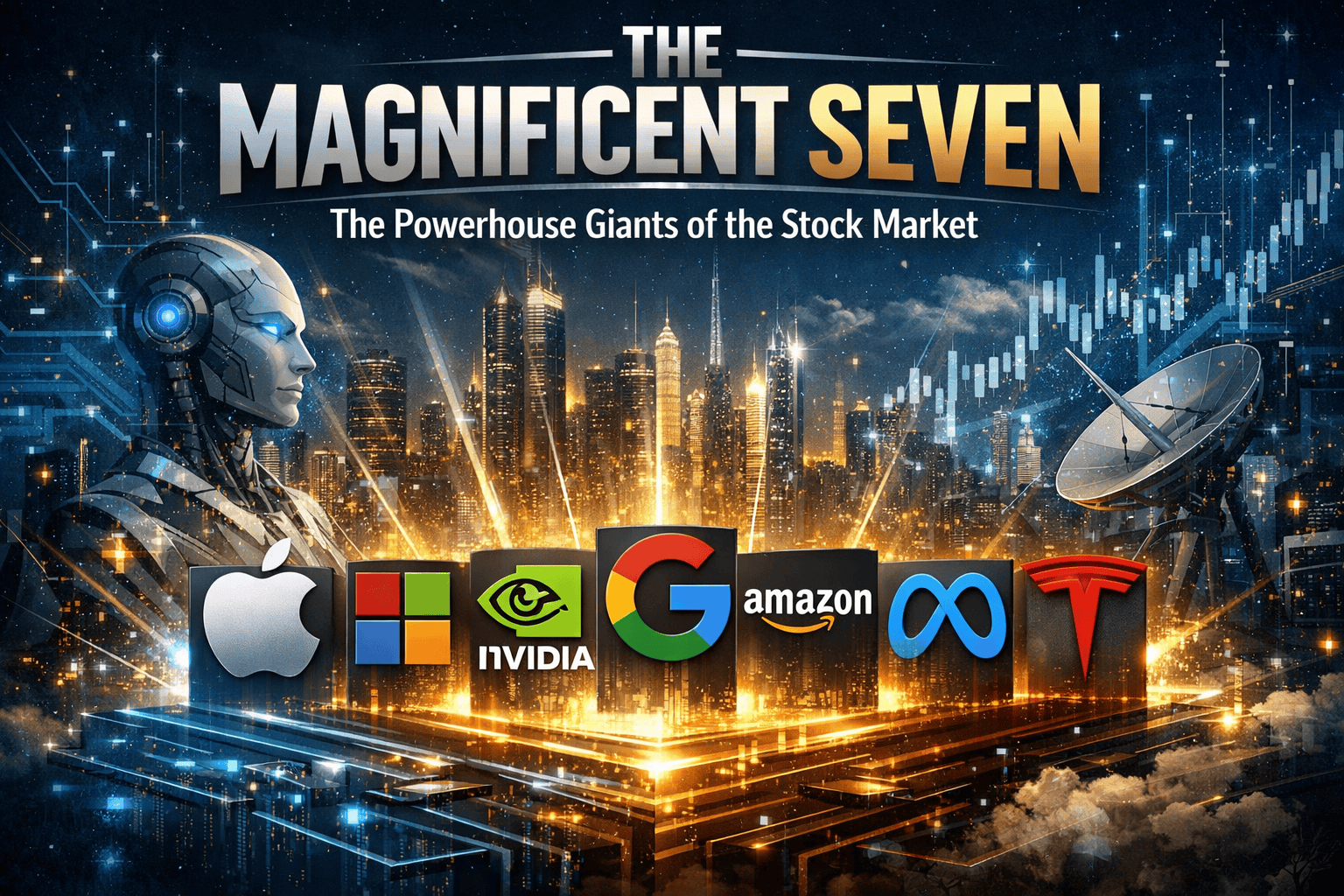
The Magnificent Seven, commonly referred to as the Mag 7, represent the most powerful group of companies in the modern global economy. This elite group includes Alphabet, Amazon, Apple, Meta, Microsoft, NVIDIA, and Tesla. Together, these companies dominate global technology, artificial intelligence, and digital infrastructure. Their immense market capitalization, consistent profitability, and relentless innovation have established them as the undisputed AI leaders of the contemporary market. If you are new to artificial intelligence, visit our AI Basics section to understand how AI technologies work.
In 2025, the Mag 7 continue to drive a significant share of overall stock market gains. As artificial intelligence becomes the primary force in business and investment, these companies play a defining role in shaping how AI is built, deployed, and monetized worldwide.
What Is the Magnificent Seven?
The term Magnificent Seven was coined in 2023 by Michael Hartnett, Chief Investment Strategist at Bank of America. The name is a nod to the classic 1960 Western film, illustrating how a small group of high performing companies saved the broader market from stagnation. The Mag 7 effectively replaced the older “FAANG” label as these corporations expanded beyond consumer internet services into deep tech, cloud computing, and advanced robotics.
As of late 2025, these seven stocks account for roughly one third of the total value of the S&P 500. Their financial health is so robust that they are often viewed as both offensive growth plays and defensive “safe havens” during periods of economic uncertainty.
Why the Mag 7 Are Undisputed AI Leaders
The Magnificent Seven dominate the AI economy because they control every critical layer of the technology stack. Their leadership is built on four core pillars:
- Platform Ownership: They own the ecosystems that serve as the gateway to AI. Apple and Google control mobile operating systems, while Microsoft dominates enterprise software.
- Infrastructure Dominance: NVIDIA provides the specialized hardware (GPUs) required to train AI, while Microsoft, Amazon, and Google operate the massive cloud networks necessary to run these models at scale.
- Capital and Cash Flow: Unlike smaller competitors, the Mag 7 generate enormous free cash flow. This allows them to invest tens of billions of dollars annually into research and data centers without compromising their balance sheets.
- Data Monopolies: AI requires vast amounts of high quality data. Alphabet (Search), Meta (Social), and Amazon (Consumer behavior) possess the world’s most comprehensive datasets for training advanced machine learning models.
The Magnificent Seven AI Comparison Table (Late 2025)
| Company | Primary AI Role | Core Monetization Strategy | Competitive Advantage |
| NVIDIA | AI compute hardware | Sale of Blackwell GPUs and AI software | Dominates 90% of the AI accelerator market |
| Microsoft | Enterprise AI platforms | Azure AI and Copilot subscriptions | Deep integration into corporate workflows |
| Alphabet | AI research and cloud | Search, YouTube, and Gemini AI services | Massive data and global distribution scale |
| Amazon | Cloud infrastructure | AWS and logistics optimization | World’s largest cloud provider for AI |
| Apple | Consumer AI interface | AI enabled hardware and services | Controls 2 billion+ high value devices |
| Meta | Open source AI models | AI driven ad targeting and Llama models | World leader in open source AI software |
| Tesla | Robotics and autonomy | Full Self Driving (FSD) and Optimus | Trained on billions of miles of real world data |
Challenges Facing the Magnificent Seven
Even as the undisputed leaders, the Magnificent Seven face evolving risks that investors must monitor closely as we head into 2026:
- Regulatory Pressure: Governments in the US and EU are aggressively reviewing antitrust and privacy concerns. Potential rulings regarding search monopolies or app store restrictions could force changes to their profitable “walled garden” business models.
- Infrastructure Costs: The “AI build out” is expensive. Investors are increasingly focused on whether the massive capital expenditure on data centers and energy will result in a clear return on investment (ROI).
- Energy and Supply Constraints: AI systems consume unprecedented amounts of power. Securing access to stable energy grids and advanced semiconductor manufacturing is now a significant operational bottleneck.
Potential Changes to the Group
Market leadership is never static. While the Magnificent Seven are dominant today, several companies are emerging as potential candidates to join or even replace certain members of the group:
- Broadcom (AVGO): Now often cited as a member of the “Elite Eight,” Broadcom provides the critical networking hardware that allows AI data centers to function.
- Oracle (ORCL): A major comeback story of 2025, Oracle has secured massive cloud partnerships with OpenAI and others, positioning it as a core AI infrastructure play.
- TSMC (TSM): As the sole manufacturer of the world’s most advanced AI chips, TSMC is the ultimate bottleneck for the entire industry.
Conclusion
The Magnificent Seven remain the foundation of the modern stock market and the primary drivers of the artificial intelligence revolution. Their control over data, cloud infrastructure, and proprietary hardware makes them central to the global economy. While new challengers are rising, the Mag 7’s combination of scale and capital ensures they will remain the leaders of the AI era for the foreseeable future.