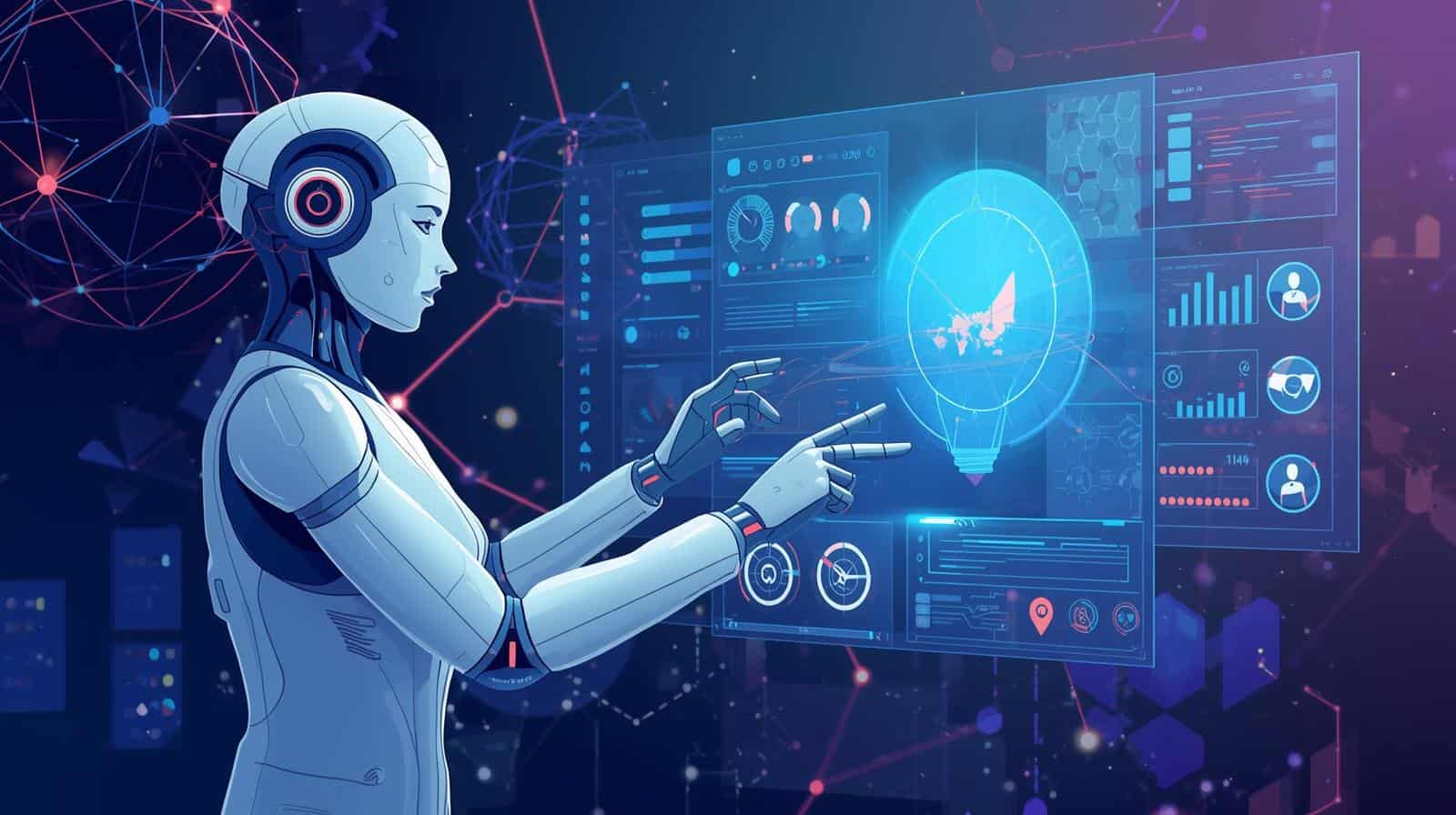
Are AI Agents Replacing Traditional Dashboards?
For more than two decades, business software has been built around a simple idea: users log into an application and interact with a dashboard. Every SaaS product — CRM, analytics, HR tools, finance platforms — follows the same pattern. A person opens the software, navigates menus, filters reports, and manually extracts information.
Artificial intelligence agents are now beginning to change that interaction model.
Instead of humans navigating software, software may soon navigate itself on behalf of humans.
This shift does not sound dramatic at first. However, it fundamentally changes what software actually is.
From “Using Software” to “Delegating Work”
Traditional dashboards exist because software historically required human interpretation. The system stored data, but a user still had to search, click, filter, export, and analyze.
An AI agent removes that requirement.
Rather than opening a CRM and checking pipeline status, a manager can simply ask:
“Which deals are at risk this week and what should I do?”
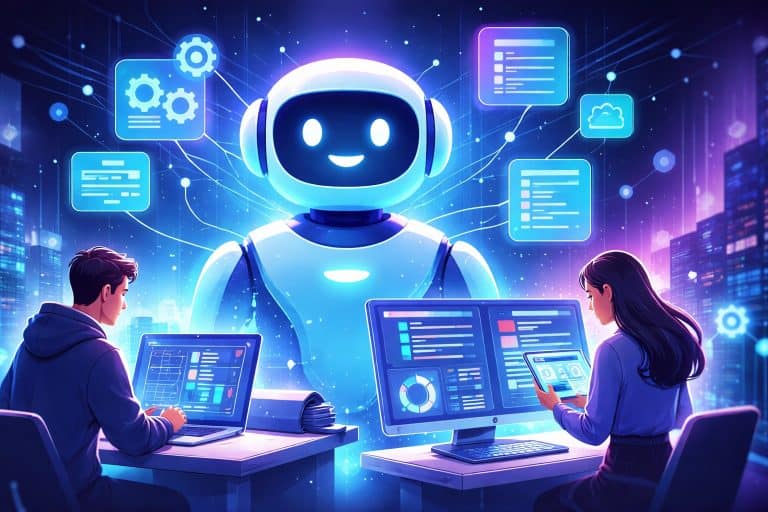
The agent can access the CRM, read customer notes, evaluate activity levels, and produce recommendations. The user no longer interacts with the interface — the agent interacts with the software. The dashboard becomes optional. This is the key idea: AI agents are not just features inside software. They are becoming the new interface to software.
Why Dashboards Exist in the First Place
Dashboards were created to solve a limitation: computers stored information but could not reason about it. Because of that limitation, analytics tools showed charts, HR systems showed employee records, finance software showed transactions and customer systems showed ticket queues.
Humans interpreted the meaning. Modern AI systems can now interpret patterns directly. They can summarize, compare, and even recommend actions. Once software can explain the data, the visualization layer becomes less necessary. The dashboard was a communication tool between data and people. Agents now serve as that communication layer.
Evidence the Shift Is Already Beginning
Businesses increasingly care less about features and more about outcomes. Executives do not want more dashboards; they want decisions.
Industry research consistently shows that companies struggle with software complexity. Organizations typically operate dozens or even hundreds of SaaS tools, and employees spend large portions of their time switching between applications rather than doing core work.
AI agents directly target this inefficiency. Instead of employees navigating multiple platforms, the agent gathers information across systems and returns a single answer.
This reduces operational friction.
Enterprise leaders are showing interest not because agents are impressive technology, but because they reduce coordination work — the hidden cost inside modern companies.
What This Means for SaaS Companies
The biggest impact is not automation. The biggest impact is interface disruption. SaaS companies today compete on UI design, workflow navigation and reporting dashbaords. Agents shift competition toward data access, integrations, automation capability and decision intelligence. In a dashboard-centric world, the application interface is the product. In an agent-centric world, the API becomes the product.
If a system exposes useful data and actions, an agent can operate it. If it does not, the software becomes invisible. This creates a new hierarchy among SaaS vendors: Platforms that expose programmable workflows become more valuable. Platforms that rely on manual navigation become less relevant.
Why This Matters for Investors
SaaS valuations historically depended on user engagement. More daily users meant stronger pricing power.
Agents challenge that logic.
A company may still pay for the software, but far fewer employees may need to log in. The number of human users becomes less important than the quality of machine integrations.
The value shifts from “seat-based software” to “automation infrastructure.”
Some SaaS companies may benefit significantly, especially those positioned as system-of-record platforms. Others, particularly workflow tools dependent on manual interaction, may face pressure.
This does not mean SaaS disappears. It means SaaS evolves into something closer to a service layer rather than an interface layer.
What the Future Likely Looks Like
The software industry appears to be moving through stages. First, computers stored information.Then, applications helped humans analyze it. Now, agents help humans act on it. The long-term role of software may no longer be presenting information. Instead, it may be executing intent. A future employee may not open ten applications in the morning. They may simply instruct an agent what outcome they want.The agent handles the rest. Dashboards will not vanish overnight, but they may slowly become administrative tools rather than primary workspaces.
Final Perspective
AI agents are not replacing software. They are replacing how humans interact with software.
The companies most prepared for this shift are not necessarily those with the best interfaces. They are the ones whose systems can be accessed, understood, and operated programmatically.
The SaaS industry is not ending. However, the age of the dashboard as the center of business computing may be approaching its peak. The next generation of enterprise software may be less visible, less interactive, and far more autonomous.