Upstart Holdings ($UPST): The AI Lending Powerhouse Entering a New Era
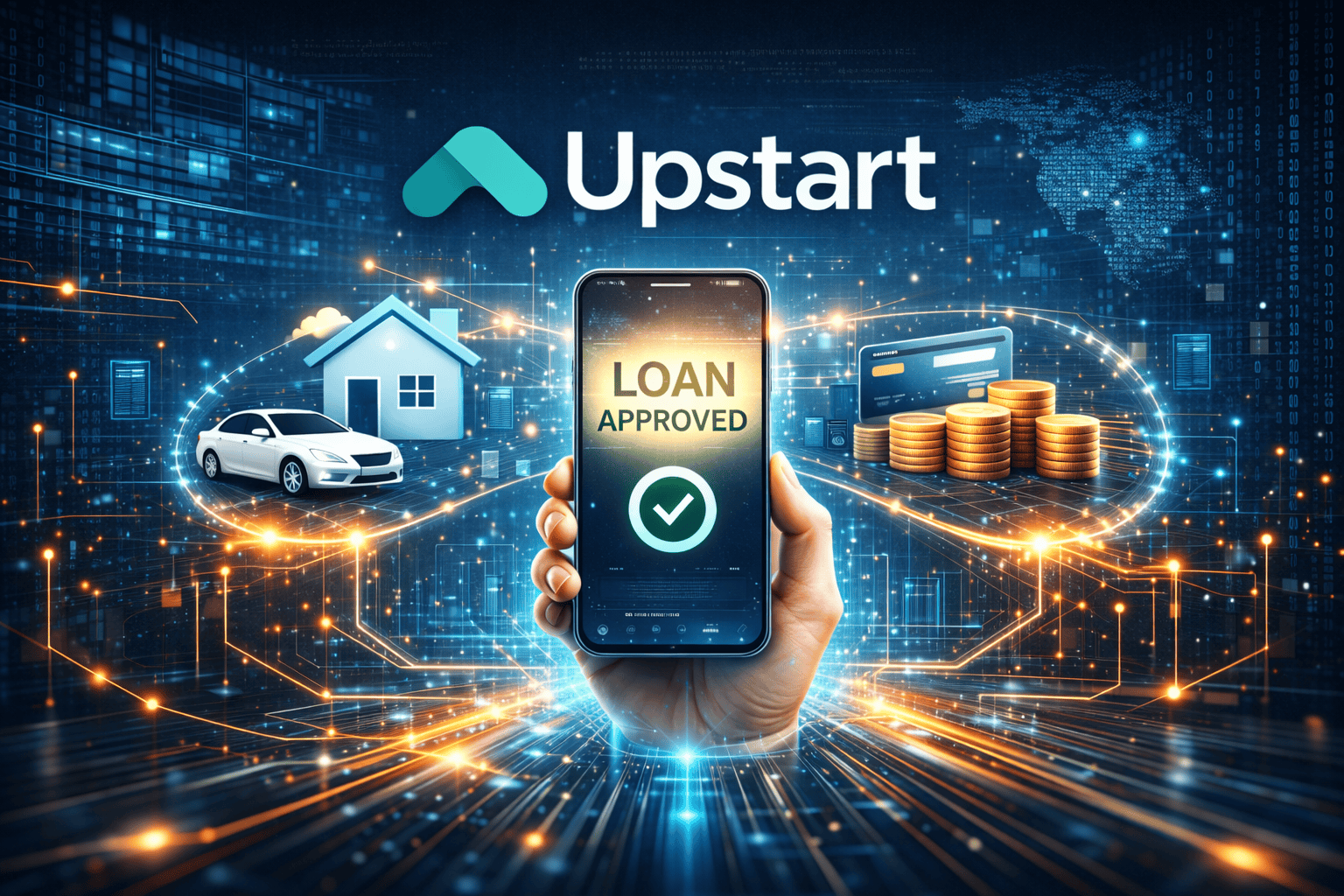
The rise of “Agentic AI” in 2026 has transformed the financial landscape from simple chatbots to autonomous systems capable of complex decision-making. At the forefront of this shift is Upstart Holdings ($UPST), a public fintech company that has moved beyond being a lending marketplace to becoming a diversified AI-driven credit engine. By leveraging machine learning to analyze over 1,500 variables, Upstart aims to replace the legacy FICO score with an automated, more accurate assessment of borrower risk.
Disclaimer: This article is for informational purposes only and does not constitute financial advice. Always conduct your own research before making investment decisions.
2025 Financial Performance: The Turnaround
Fiscal year 2025 was a milestone year for Upstart, characterized by a return to GAAP profitability and record-breaking revenue growth.
Key Annual Financial Metrics
| Metric | FY 2025 Actual | FY 2024 Actual | YoY Change |
| Total Revenue | $1.075 Billion | $676.9 Million | +58.9% |
| Net Income | $53.6 Million | ($128.6 Million) | N/A |
| Earnings Per Share (EPS) | $1.35 | ($0.28) | N/A |
| Total Assets | $2.97 Billion | $2.36 Billion | +25.8% |
The momentum culminated in a powerful Q4 2025, where revenue hit $296.1 million, a 35% year-over-year increase that surpassed most analyst expectations.
Leadership Transition: Co-Founder Paul Gu Takes the Helm
On May 1, 2026, Upstart will undergo a strategic leadership evolution designed to maintain its founder-led culture for decades.
- The New CEO: Co-founder Paul Gu, the Yale dropout and Thiel Fellow who architected Upstart’s original AI models, will succeed Dave Girouard as CEO.
- Dave Girouard transitions to Executive Chairman to focus on long-term strategy.
- Strengthening the C-Suite: Sanjay Datta (former CFO) becomes President and Chief Capital Officer, while Andrea Blankmeyer (formerly of SoFi) joins as the new CFO.
Gu’s appointment signals a shift toward deeper technical innovation, specifically focusing on the release of Model 25, which allows the system to learn from data on borrowers previously declined or lost to competitors.
Product Diversification: The 2026 Strategy
Upstart is aggressively expanding its AI into multi-trillion dollar markets to reduce its reliance on unsecured personal loans.
- Upstart Auto: Now partnered with 410 dealerships. In early 2026, Upstart secured over $500 million in capital from Bayview Asset Management and Wafra to fuel auto lending.
- Home Equity (HELOCs): Scaling rapidly to tap into the massive home equity market.
- Cash Line: A newly launched beta product offering an always-on revolving credit line (up to $5,000) as an affordable alternative to predatory short-term credit.
The 2026–2028 Financial Roadmap
Paul Gu inherits an ambitious growth plan that management calls a period of unprecedented strength.
| 2026 Target Category | Management Guidance |
| Total Revenue | ~$1.4 Billion |
| Revenue Growth Rate | ~35% |
| Adj. EBITDA Margin | 21% |
| Long-term Growth (to 2028) | 35% CAGR |
In 2025, Upstart successfully navigated a challenging macroeconomic landscape to emerge as a highly efficient AI lending platform. The company’s performance was marked by consistent sequential growth and a return to strong profitability by year-end.
Quarterly Revenue Performance (Last 4 Quarters)
| Quarter | Total Revenue ($M) | YoY Growth (%) | Primary Revenue Driver |
| Q4 2025 | $296.1M | +35% | Secured products (Auto/Home) and model enhancements |
| Q3 2025 | $277.0M | +71% | AI adaptability to evolving macro signals |
| Q2 2025 | $265.1M | +101% | GAAP profitability reached ahead of schedule |
| Q1 2025 | $220.4M | +66% | Re-established foundation for profitable growth |
Strategic Highlights of 2025
- Total Annual Revenue: Reached $1.075 billion in 2025, a 59% increase from the $676.9 million reported in 2024.
- Transaction Volume: Upstart originated approximately 1.5 million loans in 2025, an 86% increase over the prior year.
- Efficiency Gains: While revenue grew by 64% in 2025, headcount increased by only 18%, significantly improving operational leverage.
- Automation reached new heights: By Q4 2025, 91% of loans were fully automated with no human intervention, up from 69% in 2019.
Market Sentiment and Risk Analysis
Despite strong growth, $UPST remains a high-volatility “show-me” story for investors.
Opportunities
- Institutional Confidence: Management authorized a $400 million share buyback, executing $100 million in February 2026 at an average price of $31.31.
- Analyst Upside: While trading near $30, the average analyst price target sits at $49.50, representing a potential 60%+ upside.
Risks
- Guidance Blackout: Upstart discontinued quarterly guidance in favor of annual targets, which initially caused a 14% stock drop due to perceived uncertainty.
- Take-Rate Compression: As Upstart moves into secured products (Auto/Home), its take-rate on loans is expected to compress toward 4% (vs. ~8% for personal loans), requiring higher volume to maintain profitability.
Insider Transactions
Here are the Top 5 Insider Acquisitions for UPST by Total Value, aggregated from Upstart insider transactions.
| Insider | Title | Total Acquisition Value | Date Range |
| Paul Gu | Co-Founder / Incoming CEO | $4.23M | 2022-11-30 → 2025-11-11 |
| Scott Darling | Chief Legal Officer | $1.54M | 2022-12-31 → 2026-01-22 |
| Alison Nicoll | Chief People Officer | $1.40M | 2022-02-09 → 2022-06-24 |
| Natalia Mirgorodskaya | Executive | $1.33M | 2024-12-26 → 2025-11-20 |
| Paul Gu | Co-Founder / Incoming CEO (earlier grant period) | $1.28M | 2021-07-13 → 2022-03-01 |
- Paul Gu appears twice because he had two major acquisition periods.
- Most acquisitions occurred between 2022–2025, which aligns with equity compensation, retention grants, and leadership transition packages.
- The values are relatively small compared with historical insider selling during the 2021 fintech boom, indicating these are mostly compensation-based acquisitions rather than open-market purchase.
Real Insight From These Insider Transactions
| Period | Insider Behavior |
| 2020–2021 | Massive insider selling during IPO boom |
| 2022–2023 | Stock collapse, fewer insider trades |
| 2024–2025 | Mostly compensation-based acquisitions |
This is a classic IPO → hype → insider liquidity → normalization cycle.
Cash Flow (Annual) — Where the Cash Actually Moved
Key idea: Net income can be positive while operating cash flow is negative (and vice-versa). Cash flow shows real cash movement.
Annual cash flow snapshot (USD, $M)
| Fiscal year | Net Income | Operating Cash Flow (OCF) | Capex | Est. Free Cash Flow (OCF − Capex) | Investing CF | Financing CF |
| 2025 | +53.6 | -147.7 | 18.4 | -166.1 | -177.2 | +405.6 |
| 2024 | -128.6 | +186.3 | 10.0 | +176.3 | -237.7 | +559.9 |
| 2023 | -240.1 | -111.7 | 12.1 | -123.8 | -118.5 | +165.5 |
What this says in plain English
- 2025: Upstart reported positive net income (+$53.6M) but negative operating cash flow (-$147.7M). That usually means working-capital timing and/or balance-sheet movements were a cash drain, even if accounting profits looked better.
- Financing cash flow was strongly positive in both 2025 and 2024 (+$405.6M and +$559.9M). That means the company raised/used financing sources materially during these periods.
- Capex is relatively small (roughly $10M–$18M/year)—Upstart isn’t a heavy “factory/building” spender; cash swings are more about funding/loan/financing dynamics than equipment.
Balance Sheet — Financial Position & Leverage
Year-end balance sheet snapshot (USD, $M)
| Fiscal year | Total Assets | Cash | Current Assets | Current Liabilities | Current Ratio | Total Debt (ST+LT) | Net Debt (Debt − Cash) | Equity |
| 2025 | 2,974.8 | 657.4 | 1,199.1 | 401.0 | ~3.0x | 1,850.3 | ~1,192.8 | 798.8 |
| 2024 | 2,367.0 | 793.6 | 1,080.6 | 457.8 | ~2.4x | 1,452.4 | ~658.8 | 633.2 |
| 2023 | 2,017.1 | 377.3 | 450.6 | 458.3 | ~1.0x | 1,102.7 | ~725.4 | 635.3 |
What this means to investors
- Liquidity improved a lot by 2025: current ratio around ~3.0x (current assets far exceed current liabilities), suggesting the near-term balance sheet looks more comfortable than 2023.
- Leverage rose meaningfully in 2025: total debt increased to ~$1.85B and net debt (debt minus cash) rose to ~$1.19B, higher than 2024 and 2023.
- Equity increased from 2024 to 2025 (to ~$799M), but retained earnings are still negative at year-end 2025 (accumulated losses historically).
Upstart (UPST) Stock Performance Summary (2023–2026)
Upstart’s stock has experienced significant volatility over the past three years, reflecting shifts in credit markets, interest rates, and investor sentiment toward AI-enabled financial platforms.
Current Stock Snapshot
| Metric | Value |
| Latest Week | Mar 3, 2026 |
| Open | $26.02 |
| High | $29.09 |
| Low | $25.60 |
| Close | $28.24 |
| Weekly Volume | 11.8M shares |
12‑Month Price Range
| Metric | Price |
| 52‑Week High | ~$85 |
| 52‑Week Low | ~$23 |
| Current Price | ~$28 |
Major Price Trend Phases
Recovery Rally (2023 → Early 2025): The stock surged from roughly $13 to nearly $96 driven by optimism around AI‑driven fintech platforms and credit market recovery.
Market Correction (2025): Rising interest rates and uncertainty in loan demand triggered a pullback.
Recent Downtrend (Late 2025 → 2026): Prices declined toward $28 with periods of elevated trading volume.
Key Takeaways
Bullish Factors: AI‑driven lending technology, large addressable lending market, and potential upside if credit markets improve.
Risks: sensitivity to interest rates, lending demand volatility, and historically high stock price fluctuations.
Upstart (UPST) – Q4 2025 Earnings Call Summary
In the fourth quarter of 2025, Upstart’s management discussed the company’s strategy to expand lending through partner channels while increasing average loan sizes.
A key highlight from the discussion was that partner distribution channels help reduce customer acquisition costs, making loan origination more efficient. These channels are similar to those already used in Upstart’s personal loan business and provide a diversified source of borrowers.
Management also emphasized the opportunity from larger loan sizes. Even if contribution margins remain similar, larger loans generate higher absolute revenue per transaction, improving the overall unit economics of the platform.
Analysts questioned whether the mix of sales channels and delivery channels could increase contribution margins. Management responded that while percentage margins may remain stable, total profit dollars per loan could rise due to larger loan balances.
Overall, the tone of the discussion was moderately positive, with management expressing confidence that expanding loan sizes and partner channels could support future growth.
How Upstart’s AI Credit Models Work
Upstart’s platform uses machine learning models trained on large datasets of borrower characteristics. These models evaluate thousands of variables related to income stability, employment history, education, and credit behavior. The goal is to predict borrower risk more accurately than traditional credit scoring systems and allow lenders to approve more borrowers while controlling default risk.
Competitive Landscape in AI Lending
Upstart operates in a competitive fintech environment alongside companies such as SoFi, LendingClub, and traditional banks investing heavily in digital lending technology. However, Upstart differentiates itself by focusing heavily on machine-learning credit models rather than acting solely as a loan marketplace.
Why Investors View Upstart as an AI Company
While often categorized as a fintech company, many investors view Upstart as an AI platform. The company’s core intellectual property lies in its predictive models and automated decision systems. If these models continue improving, they could fundamentally reshape how credit risk is evaluated across the lending industry.
Conclusion
As of early 2026, Upstart has evolved from an experimental fintech startup into a more established AI-driven credit platform navigating complex lending cycles. The company’s growth strategy now centers on expanding its lending ecosystem across personal loans, auto financing, home equity, and new credit products while continuing to improve its machine-learning underwriting models.
Although macroeconomic conditions and lending demand will continue to influence performance, Upstart’s long-term thesis rests on whether its AI models can consistently evaluate borrower risk more accurately than traditional credit scoring systems. If the technology continues to improve and adoption grows across lending partners, Upstart could play an increasingly important role in the modernization of credit underwriting.