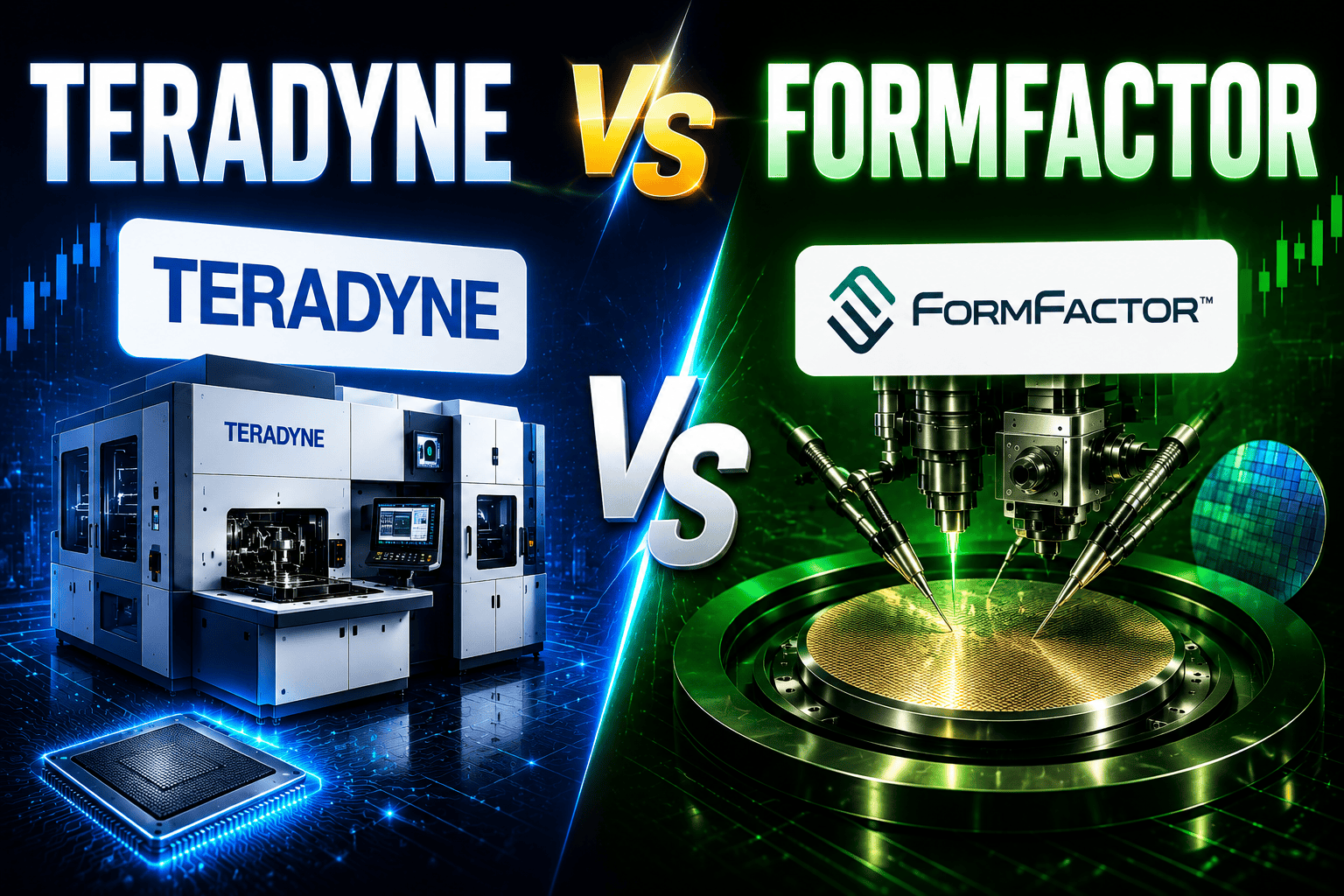
Teradyne vs. FormFactor: Evaluating the Mission-Critical Layer of AI Chip Testing
AI chip testing is emerging as a critical investment theme as semiconductor companies race to produce faster and more powerful processors for artificial intelligence. While much of the market’s attention remains focused on chip designers and manufacturers, every advanced processor must be carefully tested before it can be deployed inside an expensive AI server or data-center system.
This requirement creates an important opportunity for companies that supply semiconductor testing equipment and related technologies. Teradyne and FormFactor are two established participants in this layer of the semiconductor supply chain, but their roles are different. Teradyne provides automated test equipment used to verify whether chips operate correctly and meet performance specifications. FormFactor specializes in probe cards, test interfaces, and wafer-level testing technologies that help connect unfinished chips to testing systems during production.
The distinction gives investors two different forms of exposure to the growth of AI chip testing. Teradyne offers greater scale and broader participation across semiconductor test markets, while FormFactor provides more specialized exposure to wafer testing and advanced semiconductor architectures.
As AI chips become more complex and testing requirements increase, which company is better positioned to benefit? Comparing Teradyne and FormFactor across their business models, financial performance, growth opportunities, valuations, and risks can provide a clearer view of their respective positions within this mission-critical industry.
Why AI Chip Testing Is Becoming More Important
AI processors are significantly more difficult and expensive to produce than many traditional semiconductors. A modern AI accelerator may combine advanced logic chips, high-bandwidth memory, chiplets, and complex packaging within a single system. Each component must work correctly, and the connections between those components must continue operating reliably under intense computing workloads.
This complexity raises the cost of allowing defective chips to move further through the manufacturing process. A defect discovered early at the wafer level may result in the loss of an individual die. The same defect discovered only after advanced packaging and assembly can waste several valuable components and increase the total financial loss. Testing chips earlier and more thoroughly therefore helps manufacturers improve production yields and avoid spending additional money on defective devices.
The growing use of chiplets and advanced packaging is also expanding the number of testing points required during production. Manufacturers increasingly need to evaluate individual dies before packaging, test connections after multiple components are combined, and confirm that the completed device performs within strict power, speed, and thermal requirements.
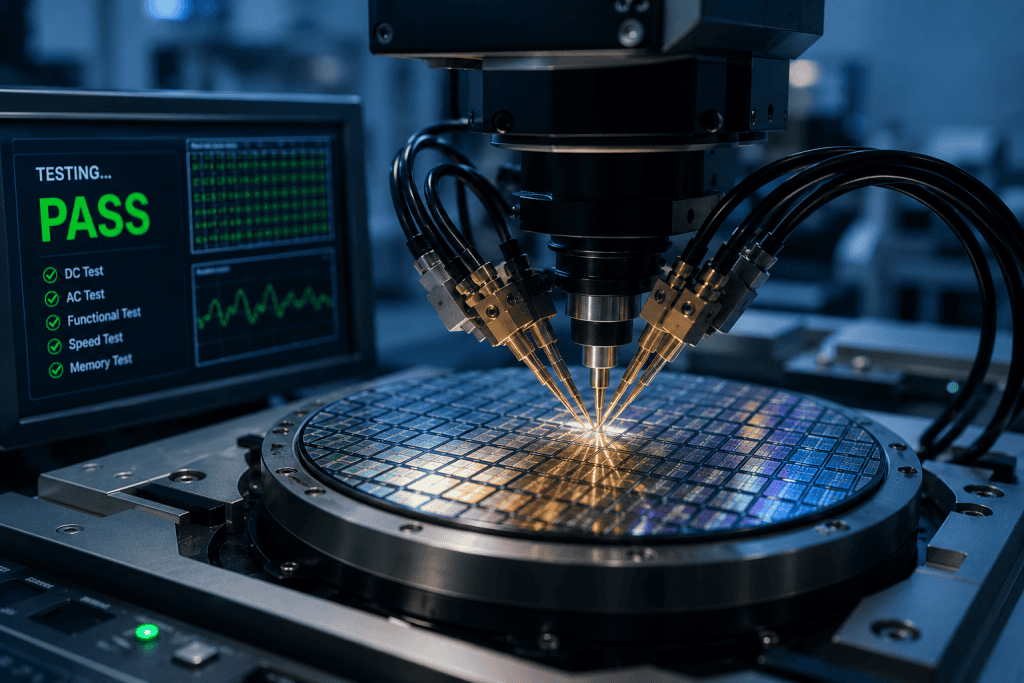
AI chip testing is therefore moving beyond a routine quality-control step. It is becoming an essential part of semiconductor manufacturing economics. As the value and complexity of each AI device increase, chipmakers have a stronger incentive to invest in more capable testing equipment, probe cards, and wafer-level test solutions.
This trend supports companies operating across different stages of the testing process. Teradyne benefits from demand for increasingly sophisticated automated test systems, while FormFactor benefits from the need to access and test advanced chips at the wafer level. Their products serve different functions, but both become more important as the cost of semiconductor failure rises.
Understanding the AI Chip Testing Ecosystem
AI chip testing spans multiple stages of semiconductor manufacturing, from wafer-level screening to final system validation. FormFactor focuses primarily on wafer testing and probe technologies, while Teradyne specializes in automated test equipment used to verify chip performance before deployment.
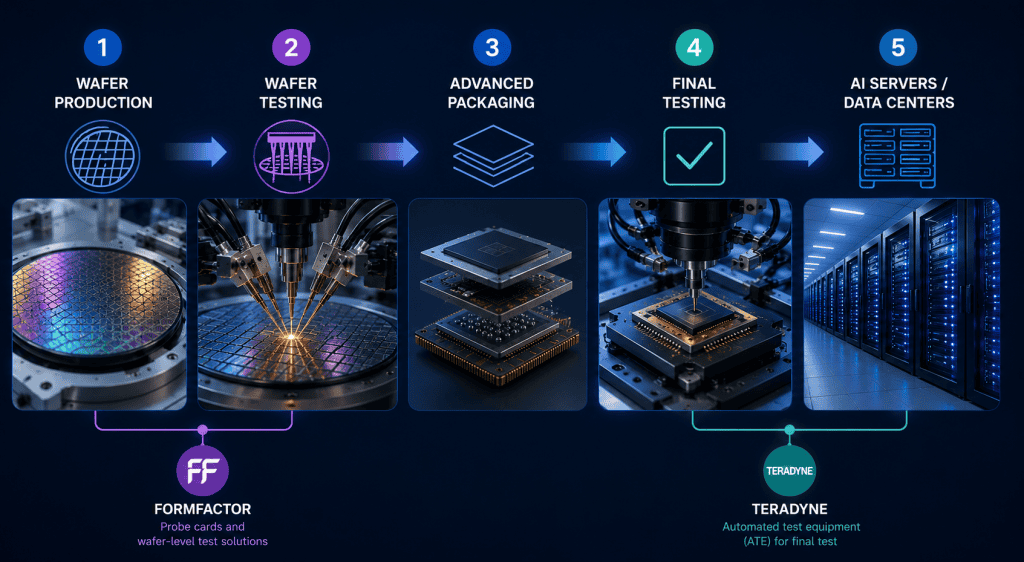
As AI chips become more complex and expensive, both stages of the testing process are becoming increasingly important.
Business Overview: Teradyne vs FormFactor
Teradyne and FormFactor both benefit from the growth of AI chip testing, but they serve different parts of the semiconductor production chain.
Teradyne is the larger company and is best known for automated test equipment used to test semiconductors after they are manufactured and packaged. Its systems help chipmakers verify performance, speed, power behavior, and functionality before chips are shipped to customers. This makes Teradyne a broader semiconductor test equipment company with exposure to AI processors, data-center chips, memory, automotive chips, and other advanced semiconductor markets.
FormFactor is more specialized. The company focuses heavily on probe cards, probe systems, and wafer-level testing technologies. Its products help semiconductor manufacturers test chips while they are still on the wafer, before they move into more expensive packaging and assembly steps. This gives FormFactor direct exposure to early defect detection, advanced packaging, high-bandwidth memory, and complex AI chip architectures.
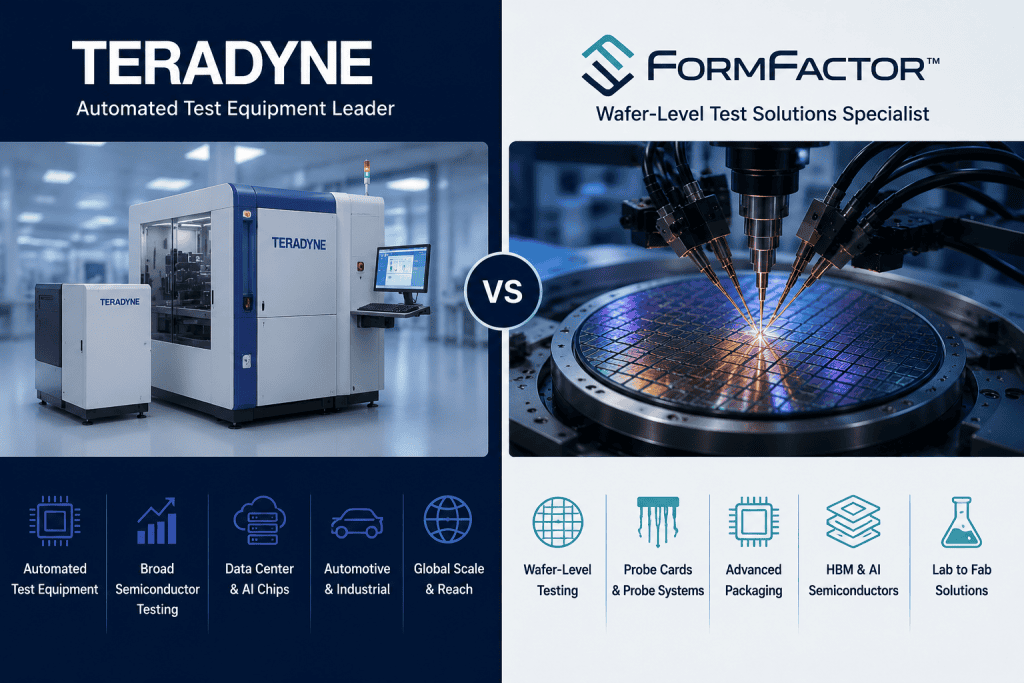
From an investment perspective, the difference is clear. Teradyne offers scale, broader market reach, and stronger exposure to automated test equipment. FormFactor offers a more focused way to invest in wafer-level testing, where increasing chip complexity can drive demand for more advanced probe cards and test interfaces.
In simple terms, FormFactor helps test chips earlier in the manufacturing process, while Teradyne helps validate chips through automated test systems. Both companies are important, but they give investors different types of exposure to the AI chip testing opportunity.
Financial Performance Comparison
Teradyne is much larger than FormFactor, but both companies are profitable and directly exposed to rising semiconductor test demand.
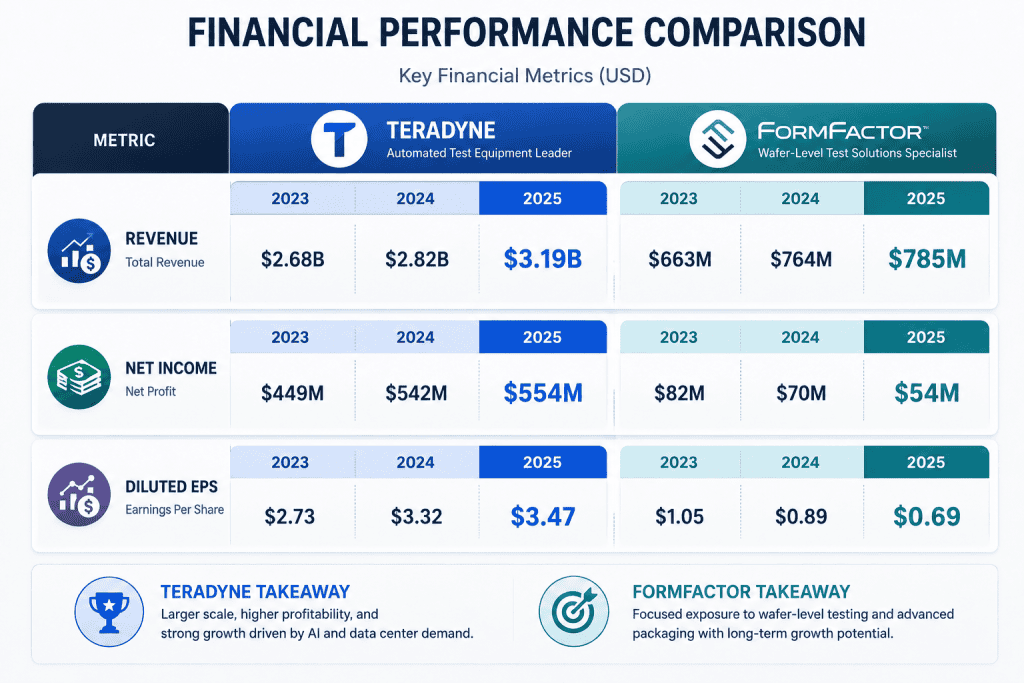
Teradyne clearly has the stronger financial scale. Its revenue is more than four times larger than FormFactor’s, and its profitability is also significantly higher. The company also showed stronger earnings momentum in 2025, helped by AI-related demand in compute, networking, and memory test.
FormFactor’s revenue continued to grow, reaching a record level in 2025, but GAAP net income declined from the prior year. This shows that while demand for wafer-level testing and high-bandwidth memory remains attractive, profitability can still be affected by product mix, investments, and operating costs.
From a financial perspective, Teradyne looks like the more established and profitable business. FormFactor, however, may offer more focused exposure to wafer-level testing and advanced packaging trends, which could become increasingly important as AI chips grow more complex.
Growth Drivers
Several long-term trends are increasing the need for semiconductor testing. These trends could support both Teradyne and FormFactor over the coming years.
| Growth Driver | Why It Matters | Advantage |
|---|---|---|
| AI Chip Complexity | More transistors, chiplets, and HBM require additional testing. | Benefits both companies |
| HBM Adoption | AI accelerators require large amounts of high-bandwidth memory. | Strong for FormFactor |
| Advanced Packaging | Multi-chip packages need testing at several stages. | Strong for FormFactor |
| Higher Cost of Failure | Expensive AI chips make early defect detection more valuable. | Benefits both companies |
| AI Data Center Growth | More AI servers increase semiconductor demand and testing volumes. | Strong for Teradyne |
Teradyne benefits from broader semiconductor test demand. FormFactor benefits from specialized trends such as wafer testing, HBM, and advanced packaging. Both companies stand to gain as AI chip production expands.
Risk and Challenges
Despite the attractive long-term outlook, investors should consider several risks. Semiconductor testing remains a cyclical industry, and both companies face challenges that could affect growth and profitability.
| Risk | Teradyne | FormFactor |
|---|---|---|
| Semiconductor Cyclicality | Revenue can fluctuate with chip demand and customer spending. | Similar exposure to semiconductor industry cycles. |
| Customer Concentration | Large customers can influence orders and quarterly results. | Dependence on a smaller group of leading chipmakers. |
| Technology Shifts | Must continue innovating as AI chips evolve. | Probe technologies must keep pace with advanced packaging and HBM. |
| Competition | Faces competition in automated test equipment markets. | Competes in specialized probe card and wafer test markets. |
The biggest risk for both companies is the cyclical nature of the semiconductor industry. Periods of strong AI demand can drive rapid growth, but slower spending cycles may lead to weaker results. Investors should also watch how quickly each company adapts to new technologies such as chiplets, advanced packaging, and next-generation AI accelerators.
Valuation Comparison
Teradyne and FormFactor trade at different valuations because investors assign different premiums to scale, profitability, and growth opportunities. Teradyne is the larger and more diversified company, while FormFactor offers more focused exposure to wafer-level AI chip testing.
| Metric | Teradyne | FormFactor |
|---|---|---|
| Stock Price (Jun. 19, 2026) | ~$419 | ~$150 |
| Market Capitalization | ~$64B | ~$11.7B |
| Trailing P/E | ~76x | ~172x |
| Price-to-Sales | ~14x | ~14x |
| Business Profile | Broad Test Leader | Wafer Test Specialist |
| AI Exposure | High | High |
| Revenue Diversification | High | Moderate |
Teradyne trades at a premium valuation, but investors receive a larger and more diversified business. The company generates higher revenue, stronger profits, and has exposure to multiple semiconductor end markets.
FormFactor appears more expensive based on earnings. The company’s P/E ratio is significantly higher because profits have grown more slowly than revenue in recent years. However, investors may be willing to pay a premium for its specialized position in wafer-level testing, high-bandwidth memory, and advanced packaging.
The valuation gap highlights an important tradeoff. Teradyne offers scale and diversification, while FormFactor offers more focused exposure to AI chip testing trends. Investors must decide whether FormFactor’s niche position justifies its higher earnings multiple.
Investment Scorecard
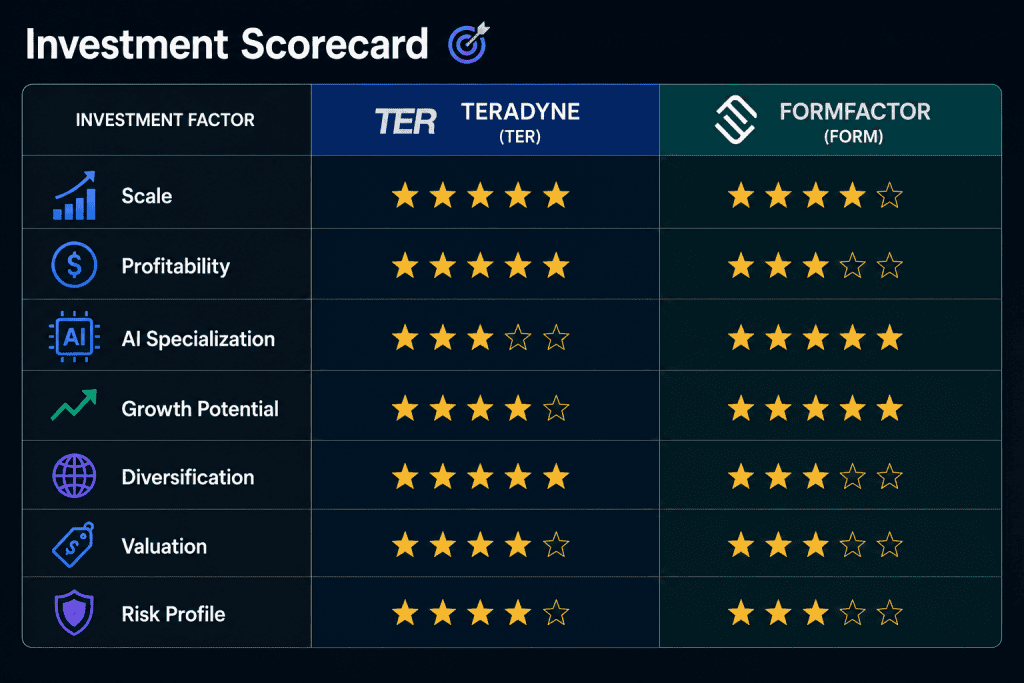
Now that we have compared the businesses and valuations, let’s evaluate Teradyne and FormFactor across the key factors that matter most to long term investors in the AI chip testing boom.
Final Verdict: Which Stock Is Better for AI Chip Testing Investors?
Teradyne and FormFactor are both positioned to benefit from the growth of AI chip testing, but they offer different investment profiles.
Teradyne is the larger and more diversified company. It has stronger revenue, higher profitability, and exposure to multiple semiconductor markets beyond AI. The company also benefits from a broader customer base and a more established position in automated test equipment. For investors seeking stability and long-term compounding, Teradyne presents a compelling investment case.
FormFactor is a more specialized company. Its strength lies in wafer-level testing, probe cards, high-bandwidth memory, and advanced packaging technologies. These areas are becoming increasingly important as AI chips grow more complex. While FormFactor may offer greater growth potential, it also carries higher valuation risk and less business diversification.
The choice ultimately depends on investment style. Investors looking for a larger, more established semiconductor testing leader may prefer Teradyne. Investors willing to accept more risk for potentially higher growth may find FormFactor attractive.