AMD Q2 FY2026 Earnings: AI Growth in Focus
Key Takeaway
AMD delivered a strong Q2 FY2026 revenue and adjusted-EPS beat, led by Data Center revenue more than doubling year over year. Its Q3 revenue outlook also exceeded market expectations. However, Gaming weakness, rising spending, flat gross-margin guidance, and limited standalone AI-revenue disclosure left investors focused on execution quality rather than headline growth alone.
Introduction and immediate market reaction
AMD released Q2 FY2026 results after the U.S. market closed on August 4, 2026. The company reported record quarterly revenue, higher margins, and guidance above the market-consensus reference.
Market-reaction reporting indicated that AMD shares sold off in after-hours trading following the release. However, the supplied dossier labels the price observations as provisional. This report therefore does not rely on unverified after-hours prices or closing-price changes. The reaction appeared disconnected from a simple earnings miss narrative. Instead, investors scrutinized the durability of AI-driven growth, gross-margin progression, and the spending required to support AMD’s infrastructure ambitions.
Educational disclaimer
This article is educational, informational research—not financial advice.
We strive to keep data accurate, but unavoidable errors or omissions may occur. Verify important information with primary sources.
What investors expected before earnings
Before AMD reported, market expectations called for approximately $11.32 billion of revenue and non-GAAP diluted EPS of $1.62. These figures represent consensus estimates, not AMD guidance or reported results.
AMD had previously guided for Q2 FY2026 revenue of $11.2 billion, plus or minus $300 million. It had also projected non-GAAP gross margin of about 56%. The central investor question was whether Data Center momentum could support a higher revenue base. Investors also watched gross margins, cash generation, Gaming trends, and evidence that AI infrastructure deployments were converting into financial results.
Reported versus expected scoreboard
AMD exceeded the cited market expectations for both revenue and non-GAAP diluted EPS. The reported comparisons below use the same consensus basis supplied in the research dossier.
| Metric | Reported | Expected | Surprise | Year-over-year |
|---|---|---|---|---|
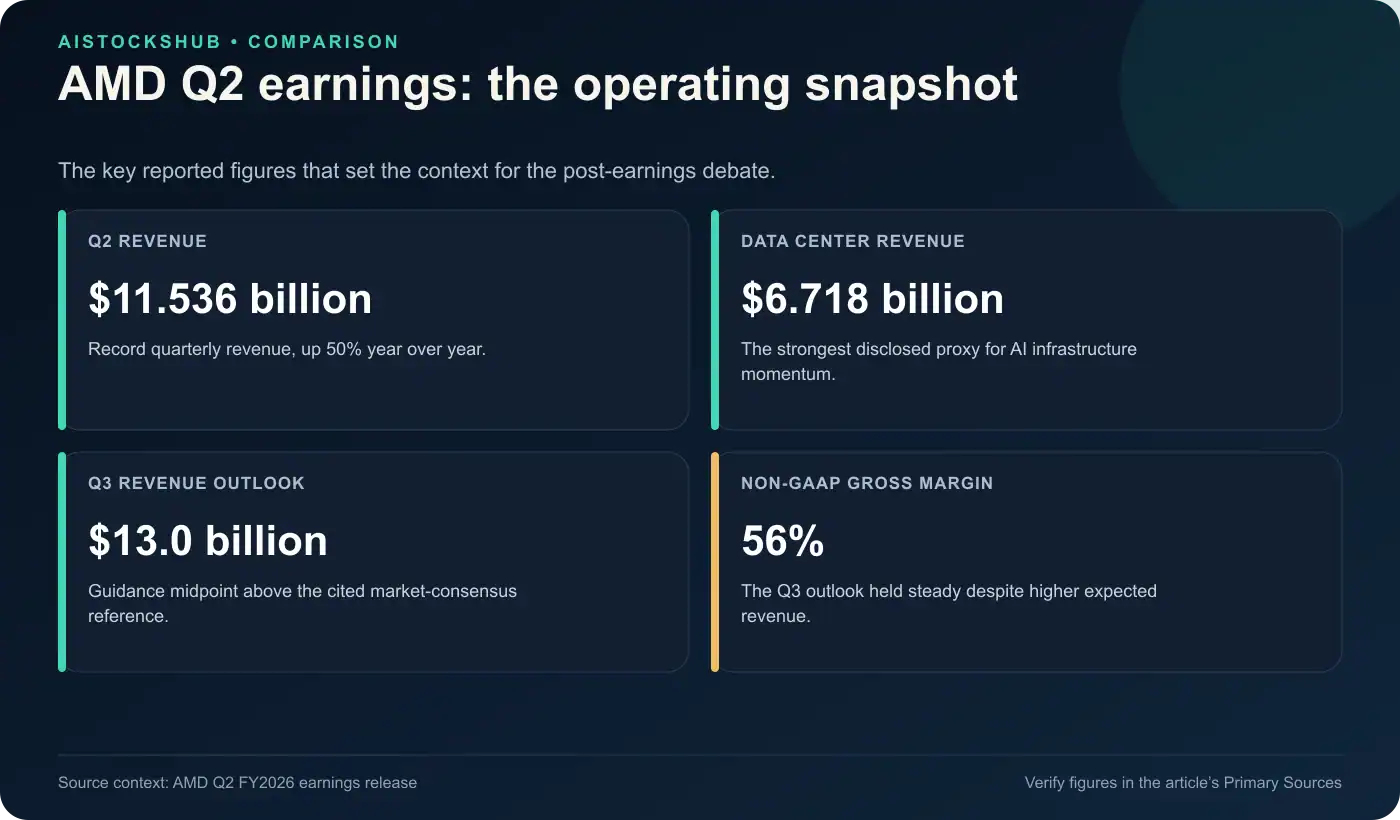
| Revenue | $11.536 billion | $11.320 billion | +$0.216 billion / +1.9% | +50% |
| Non-GAAP diluted EPS | $1.66 | $1.62 | +$0.04 / +2.5% | +246% |
AMD reported GAAP diluted EPS of $1.38 and non-GAAP diluted EPS of $1.66.
The year-over-year earnings comparison requires caution. Q2 FY2025 included $800 million of inventory and related charges tied to U.S. export controls affecting MI308 data-center GPU products. That charge amplified several reported year-over-year profit and margin improvements.
Revenue segments and AI performance
AMD did not disclose standalone AI revenue, AI-GPU revenue, or Instinct accelerator revenue. Therefore, investors cannot calculate a precise AI sales figure from the reported results. Data Center revenue remains the strongest disclosed proxy for AI infrastructure momentum.
| Segment or metric | Q2 FY2026 | Q2 FY2025 | Year-over-year change |
|---|---|---|---|
| Data Center revenue | $6.718 billion | $3.240 billion | +107% |
| Client revenue | $3.062 billion | $2.499 billion | +23% |
| Gaming revenue | $779 million | $1.122 billion | -31% |
| Embedded revenue | $977 million | $824 million | +19% |
Data Center generated about 58% of AMD’s total Q2 revenue. AMD attributed the segment’s growth to demand for EPYC server processors and Instinct MI350-series GPUs.
Client revenue benefited from a 34% increase in processor-unit shipments. However, average selling prices declined 6% year over year. Gaming revenue fell because semi-custom revenue declined.
Margins, cash flow, and capital spending
AMD expanded gross and operating margins from both the prior quarter and prior-year period. Still, prior-year export-control charges affected the scale of year-over-year improvement. Investors should therefore focus on sequential changes and future guidance as well.
| Metric | Q2 FY2026 | Q2 FY2025 | Change |
|---|---|---|---|
| GAAP gross margin | 54% | 40% | +14 percentage points |
| Non-GAAP gross margin | 56% | 43% | +13 percentage points |
| GAAP operating margin | 17% | (2)% | +19 percentage points |
| Non-GAAP operating margin | 27% | 12% | +15 percentage points |
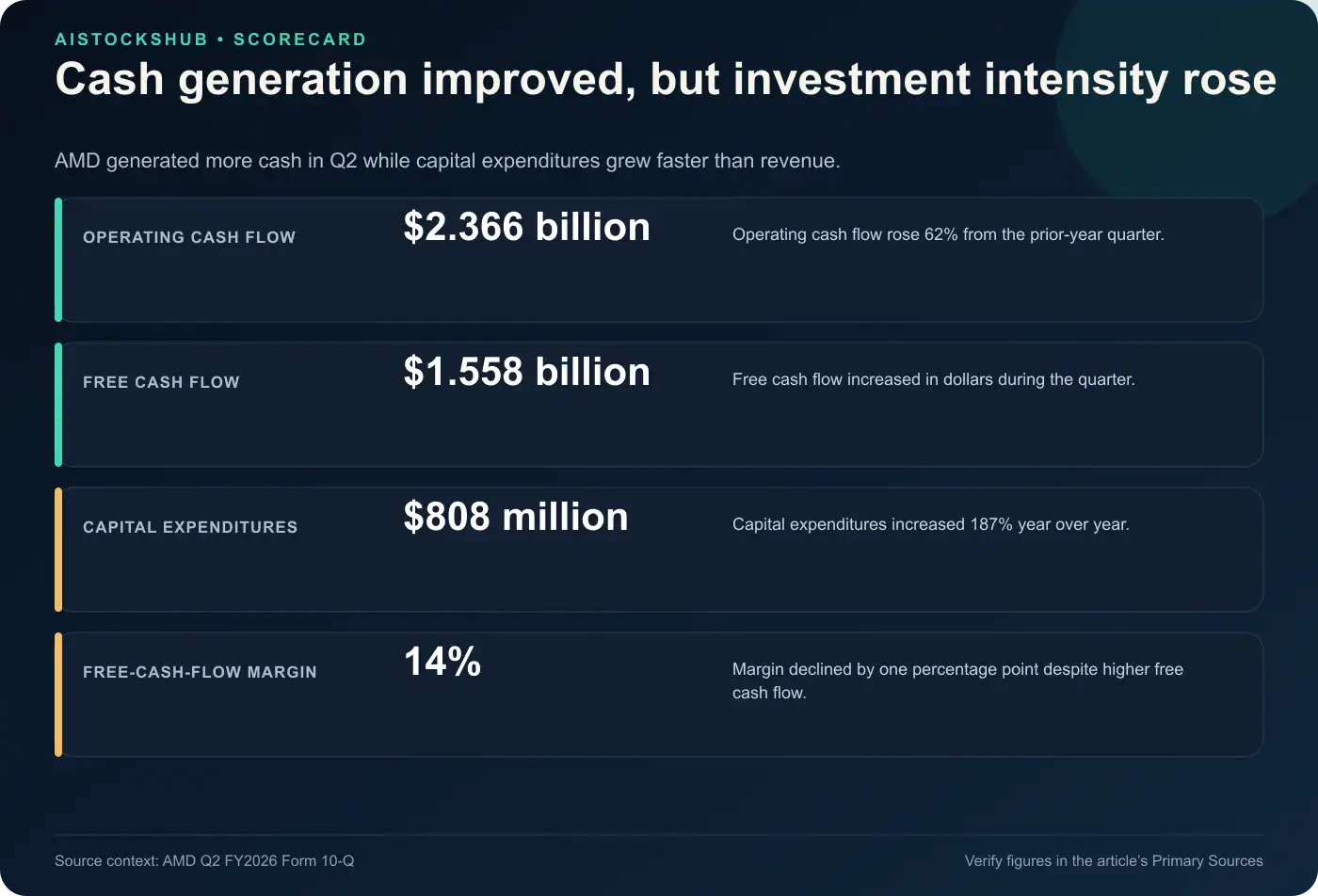
| Operating cash flow | $2.366 billion | $1.462 billion | +62% |
| Capital expenditures | $808 million | $282 million | +187% |
| Free cash flow | $1.558 billion | $1.180 billion | +32% |
| Free-cash-flow margin | 14% | 15% | -1 percentage point |
Capital expenditures grew faster than revenue during the quarter. As a result, free cash flow rose in dollars but declined modestly as a percentage of revenue.
AMD generated $5.321 billion of operating cash flow during the first six months of FY2026. It spent $1.197 billion on property and equipment during that period.
Updated guidance
AMD guided for Q3 FY2026 revenue of $13.0 billion, plus or minus $300 million. The midpoint implied about 13% sequential growth and roughly 41% year-over-year growth. AMD did not provide full-year FY2026 revenue or EPS guidance.
| Outlook item | Q3 FY2026 guidance | Market expectation reference |
|---|---|---|
| Revenue | $13.0 billion ± $0.3 billion | Approximately $12.52 billion |
| Revenue growth, midpoint | About 13% sequentially | unavailable |
| Revenue growth, midpoint | About 41% year over year | unavailable |
| Non-GAAP gross margin | Approximately 56% | unavailable |
The revenue midpoint stood about $480 million above the cited market-consensus reference. However, AMD’s non-GAAP gross-margin outlook remained at approximately 56%. That combination supports continued top-line momentum. Yet it also suggests investors may continue to monitor whether product mix can generate additional gross-margin expansion.
Management commentary
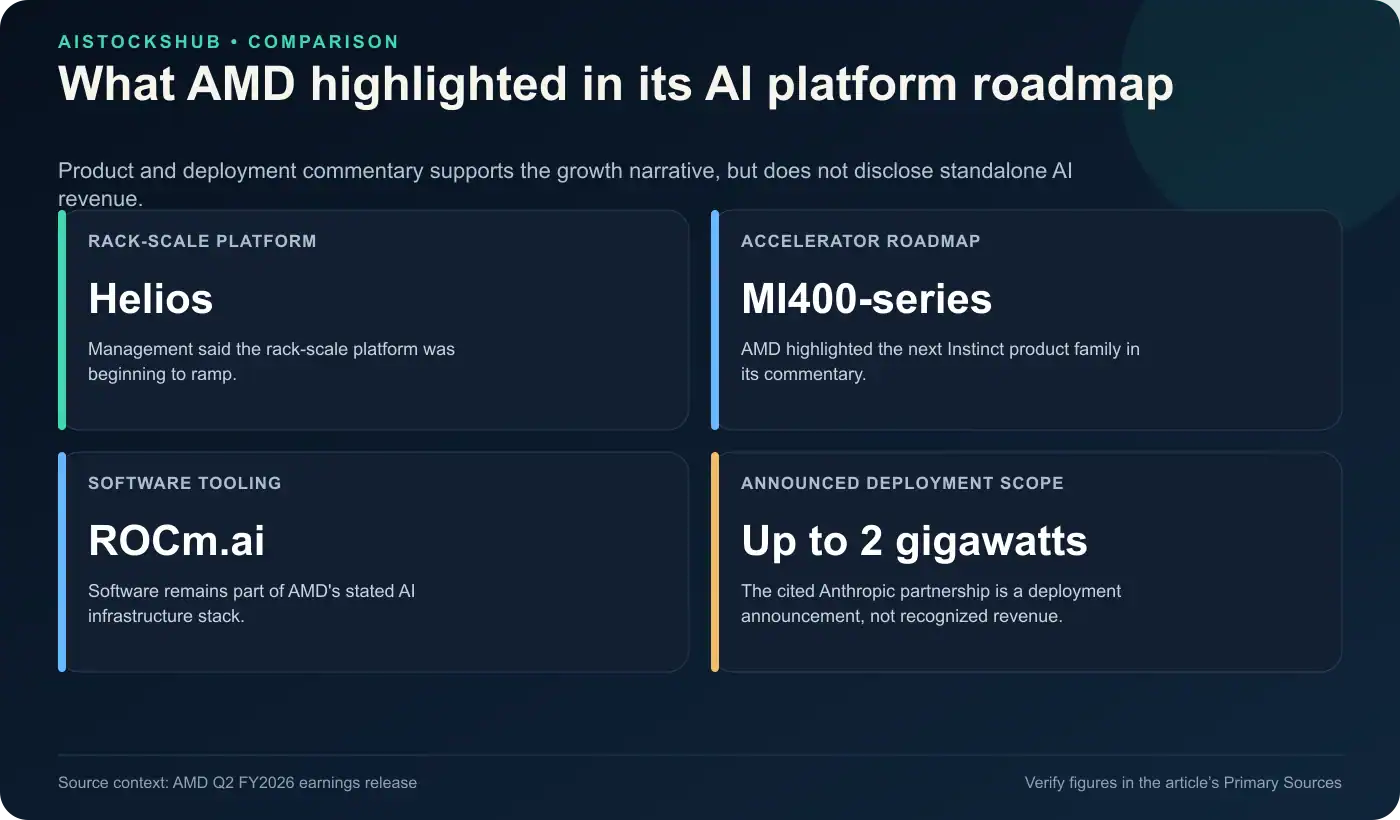
AMD highlighted accelerating demand for EPYC processors and expanding Instinct GPU deployments. Management also said the Helios rack-scale platform was beginning to ramp. These statements describe company activity and expectations, rather than separately disclosed revenue contributions.
The company highlighted Helios, Instinct MI400-series products, sixth-generation EPYC processors, and ROCm.ai software tooling. AMD also discussed deployments and relationships involving several large AI and cloud organizations.
AMD cited a partnership with Anthropic covering deployments of up to 2 gigawatts of MI450-series GPUs. It also referenced expanded collaboration with Microsoft Azure around Helios, EPYC, and Pensando products. These announcements do not disclose booked revenue or future recognized revenue.
What improved versus what disappointed
Several operating metrics improved materially. Data Center revenue more than doubled, total revenue reached a record, and non-GAAP operating margin rose to 27%. Operating cash flow and free cash flow also increased from the prior-year quarter.
Client revenue rose 23%, supported by stronger processor shipments. Embedded revenue increased 19%, showing broader demand beyond the Data Center segment.
Gaming remained the clearest weak point. Revenue fell 31% year over year, while Client and Gaming segment operating income declined to $582 million from $767 million. AMD attributed the profit decline primarily to higher operating expenses.
Research and development expense increased 33% to $2.528 billion. Marketing, general, and administrative expense increased 41% to $1.401 billion. These investments may support future AI products, but they also raise the execution threshold.
Why the stock moved
The available evidence does not establish a single confirmed reason for AMD’s post-release share-price decline. The reported results beat consensus, and the Q3 revenue outlook exceeded the cited expectation. Therefore, the market response likely reflected concerns beyond the headline earnings comparison.
Investors may have focused on the unchanged 56% non-GAAP gross-margin outlook. Revenue guidance rose, but the outlook did not point to sequential gross-margin expansion. That distinction can matter when expectations already assume stronger AI-related mix benefits.
The market also had limited visibility into standalone accelerator sales because AMD does not disclose AI revenue. In addition, rising operating expenses and capital expenditures may have reinforced concerns about the investment needed to support future growth. This explanation represents analysis, not a company-confirmed account of the market move.
Before-versus-after investment thesis
Before earnings, the AMD thesis centered on proving that its AI infrastructure strategy could scale beyond product announcements. Investors wanted evidence across server CPUs, accelerators, networking, software, and rack-scale deployments. They also sought signs that the company could convert this growth into durable profit and cash flow.
After Q2, the operational evidence improved. Data Center revenue exceeded $6.7 billion, total revenue reached $11.536 billion, and Q3 guidance pointed to another quarter of double-digit sequential growth.
However, the thesis still depends on forward execution. AMD has not disclosed standalone AI accelerator revenue, and its spending requirements increased. The next phase will require clearer evidence that infrastructure demand supports sustained margins and free-cash-flow conversion.
Post-earnings bull case
The bull case starts with Data Center scale. Revenue more than doubled year over year to $6.718 billion, and the segment represented the majority of AMD’s total quarterly revenue. This growth reflects demand across EPYC CPUs and Instinct GPUs rather than a single product line.
AMD also guided for $13.0 billion of Q3 revenue at the midpoint. That outlook indicates continued demand momentum after a record Q2. The guidance exceeded the cited market expectation before the release.
Margins improved sequentially as well. Non-GAAP operating margin increased to 27% from 25% in Q1 FY2026. If AMD maintains Data Center growth while controlling spending, the company could demonstrate stronger operating leverage over time.
Post-earnings bear case
The bear case centers on expectations, mix, and execution risk. AMD’s headline results were strong, but the Q3 non-GAAP gross-margin outlook remained at 56%. Investors expecting rapid AI-driven margin expansion may view that outlook as less compelling.
Gaming revenue declined 31% year over year. Client and Gaming operating income also fell despite higher Client revenue. These results show that AMD’s non-Data-Center businesses still face uneven demand and profitability trends.
Capital expenditures nearly tripled year over year, while free-cash-flow margin declined to 14%. AMD also reported approximately $30.3 billion of unconditional commitments as of June 27, 2026. These commitments primarily covered wafers, substrates, components, cloud-provider arrangements, and software or technology licenses.
Peer performance comparison
Recent peer results also showed that earnings beats may not satisfy investors when AI-related expectations are elevated. The available company-level comparison is limited to Broadcom’s fiscal Q2 FY2026 result before AMD’s release.
| Peer | Metric | Expected | Reported | Surprise | Market reaction |
|---|---|---|---|---|---|
| Broadcom | Total revenue | $22.04 billion | $22.2 billion | +$0.16 billion | Market-reaction reporting indicated an after-hours decline of about 11.4% |
Broadcom reported fiscal Q2 FY2026 revenue of $22.2 billion and adjusted diluted EPS of $2.44. Its official release confirms reported results, while the expectation and market-reaction figures represent market context. The comparison does not measure product parity or investment merit. Instead, it illustrates how elevated AI expectations can shift investor attention from headline beats toward guidance, margins, and future execution.
What to watch before the next quarter
Investors should watch Data Center revenue growth and management’s discussion of EPYC, Instinct, and Helios demand. Because AMD does not disclose standalone AI revenue, Data Center mix and qualitative deployment updates remain important indicators. Investors should also monitor whether the company provides more detail on accelerator shipments or customer adoption.
Gross margin deserves close attention. Q3 guidance held non-GAAP gross margin at approximately 56%, despite higher expected revenue. A future increase could suggest favorable mix or improved operating efficiency, while pressure could signal supply, pricing, or product-ramp costs.
Cash conversion is another key measure. Capital expenditures increased sharply in Q2, and free-cash-flow margin declined. Investors can also monitor Gaming stabilization, Client profitability, customer concentration, export-control risks, and AMD’s manufacturing and supply commitments.
Final earnings verdict
AMD delivered an operationally strong Q2 FY2026. The company beat the cited consensus revenue and non-GAAP EPS estimates, more than doubled Data Center revenue, and guided Q3 revenue above the market expectation reference.
Still, the earnings release did not resolve every investor question. Gaming declined sharply, spending rose, and the company maintained rather than expanded its gross-margin outlook. AMD also did not disclose standalone AI revenue. The evidence supports a stronger AI-infrastructure execution narrative than before the report. However, future results must show that higher revenue can sustain margin progress and cash generation.
Primary Sources
- AMD Q2 FY2026 earnings release
- AMD Q2 FY2026 Form 10-Q
- AMD Q2 FY2026 earnings event page
- AMD Q1 FY2026 filing and Q2 outlook
- Broadcom fiscal Q2 FY2026 earnings release
FAQ
When did AMD release Q2 FY2026 earnings?
AMD released Q2 FY2026 earnings after the U.S. market closed on August 4, 2026.
What revenue did AMD report?
AMD reported Q2 FY2026 revenue of $11.536 billion, up 50% year over year.
Did AMD beat earnings expectations?
Yes. AMD reported $1.66 in non-GAAP diluted EPS versus a cited consensus estimate of $1.62.
How fast did Data Center revenue grow?
Data Center revenue reached $6.718 billion, up 107% year over year.
Did AMD disclose standalone AI revenue?
No. AMD did not disclose standalone AI, Instinct, or accelerator revenue.
What was AMD’s Q3 FY2026 revenue outlook?
AMD guided for Q3 revenue of $13.0 billion, plus or minus $300 million.