
AI Technologies Explained: A Beginner’s Guide
Artificial Intelligence may feel complex, but understanding the core technologies behind it becomes much easier when the concepts are explained clearly and in the right order. Many newcomers are now exploring AI for the first time, and knowing how these technologies work helps make sense of current AI trends and the rapid progress happening across industries.
To build a strong foundation, it is helpful to start with the basic ideas behind AI and then gradually explore the technologies that power modern systems. Understanding these fundamentals will also make it easier to follow market developments and evaluate the companies driving the next wave of innovation.
Let’s explore the essential AI technologies that shape the systems we use every day.
1. What Is Artificial Intelligence? A Simple Starting Point
Artificial Intelligence refers to the ability of machines to perform tasks that typically require human intelligence. These tasks include learning from data, recognizing patterns, making decisions, generating content, and understanding language.
While AI today feels advanced, the core ideas began with simple questions such as whether machines can learn, whether they can reason, and whether they can observe and adapt. The technologies described below emerged as answers to these questions.
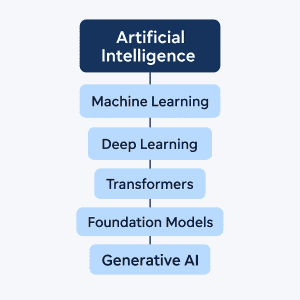
As these technologies continue to expand, it becomes helpful to understand how they fit together within the broader landscape of artificial intelligence. The diagram below presents a simple hierarchy that shows how core fields such as machine learning and deep learning relate to more advanced systems, including transformers, foundation models, and generative AI. By seeing how each layer builds upon the previous one, newcomers can more easily follow the structure of modern AI and understand why today’s breakthroughs are possible.
2. Machine Learning: Teaching Machines to Learn From Data
Machine learning is one of the most widely used AI technologies. Instead of telling a computer exactly what to do, we give it large amounts of data so it can learn patterns and make decisions.
How machine learning works
- A model is trained on data
- It learns relationships and patterns
- It uses those patterns to make predictions or decisions
Common examples
- Spam detection
- Product recommendations
- Credit scoring
- Fraud detection
Machine learning is the foundation that supports many current AI trends. It is the first major step toward creating systems that adapt and improve with experience.
3. Deep Learning: Learning Through Neural Networks
Deep learning is a more advanced form of machine learning that uses layers of neural networks inspired by how the human brain processes information. These networks can learn extremely complex patterns.
Why deep learning matters
It allows AI to understand:
- Images
- Speech
- Video
- Natural language
This technology is responsible for major breakthroughs such as self-driving cars, voice assistants, and advanced image recognition.
Deep learning also enabled the rise of large-scale models, which led to the recent explosion of generative AI.
4. Natural Language Processing: Teaching AI to Understand Human Language
Natural Language Processing, also known as NLP, helps machines understand and generate human language. It allows AI to read text, respond to questions, summarize content, translate languages, and hold natural conversations.
Examples of NLP technologies
- Chatbots
- Virtual assistants
- Translation tools
- Text summarizers
- Search engines
Current AI trends show rapid progress in this area, especially with foundation models that analyze and generate language more accurately than ever before.
5. Computer Vision: Helping Machines See and Interpret Images
Computer vision enables AI to understand visual information from the world. It allows machines to detect objects, analyze images, track movement, and interpret surroundings.
Real-world uses
- Medical imaging analysis
- Autonomous vehicles
- Security systems
- Quality checks in manufacturing
- Facial recognition
Computer vision continues to grow as cameras and sensors become more advanced and datasets become richer.
6. Robotics and Automation: Physical AI in the Real World
Robotics combines mechanical engineering with AI technologies like computer vision and reinforcement learning. As robots gain more autonomy, they can navigate environments, perform tasks, and adapt to changing conditions.
Where robotics is advancing
- Warehousing and logistics
- Healthcare assistance
- Agriculture
- Home automation
- Industrial manufacturing
AI trends show strong investment in robotics as industries look for safe, efficient automation.
7. Reinforcement Learning: Learning Through Trial and Error
Reinforcement learning is a technique where an AI system learns by interacting with its environment and receiving feedback. As it continues training, the system gradually discovers which actions lead to favorable outcomes and refines its strategy over time.
A well-known example of this technology is AlphaGo, the system that eventually defeated the world champion in the game of Go. Its success demonstrated how reinforcement learning can produce highly sophisticated decision-making abilities.
This approach is used in several areas, including robotics, game-playing AI, autonomous systems, and resource optimization. Because it focuses on learning through continuous improvement, reinforcement learning is essential for any technology that needs to adapt or make decisions across multiple steps.
8. Generative AI: Creating Text, Images, Code, and More
Generative AI refers to models that can produce content, including text, images, audio, code, and video. Models such as ChatGPT, Claude, Gemini, and Stable Diffusion represent the newest and most visible AI trends.
What generative AI can do
- Write articles
- Generate images
- Assist with coding
- Create marketing copy
- Summarize documents
- Analyze data
- Build multimodal content
Generative AI is now used across education, software development, design, research, and communication.
9. Foundation Models: Large-Scale Intelligence
Foundation models are very large neural networks trained on enormous datasets. Because they learn broad patterns, they can be adapted for many tasks. These models represent the most significant shift in the evolution of AI in recent years.
Why foundation models matter
They allow:
- Multimodal understanding
- Code generation
- Scientific reasoning
- Personalized AI agents
- Flexible problem solving
They also influence the stock market through demand for AI hardware, cloud infrastructure, and software platforms.
10. Emerging AI Technologies to Watch
AI continues to grow rapidly. Several emerging areas are shaping the next wave of AI trends:
Key areas to watch
- AI agents that perform multi-step tasks
- Edge AI running on small devices
- Autonomous robotics
- AI-enhanced scientific research
- AI-driven cybersecurity
- Real-time multimodal systems
Newcomers and investors benefit from understanding which technologies are advancing, as these trends often signal where future growth will appear.
Conclusion: Why Understanding AI Technologies Matters
AI technologies form the backbone of modern artificial intelligence. By learning how they work and how they differ, readers can better understand the evolution of AI, interpret market activity, and evaluate the companies driving innovation.
Understanding the core technologies also makes it easier to follow developments in AI-driven industries and recognize emerging opportunities. Whether exploring AI for education, career development, or investment decisions, a clear understanding of these technologies provides a strong foundation.