Palantir Technologies (PLTR): The AI Operating System Powering Governments and Enterprises
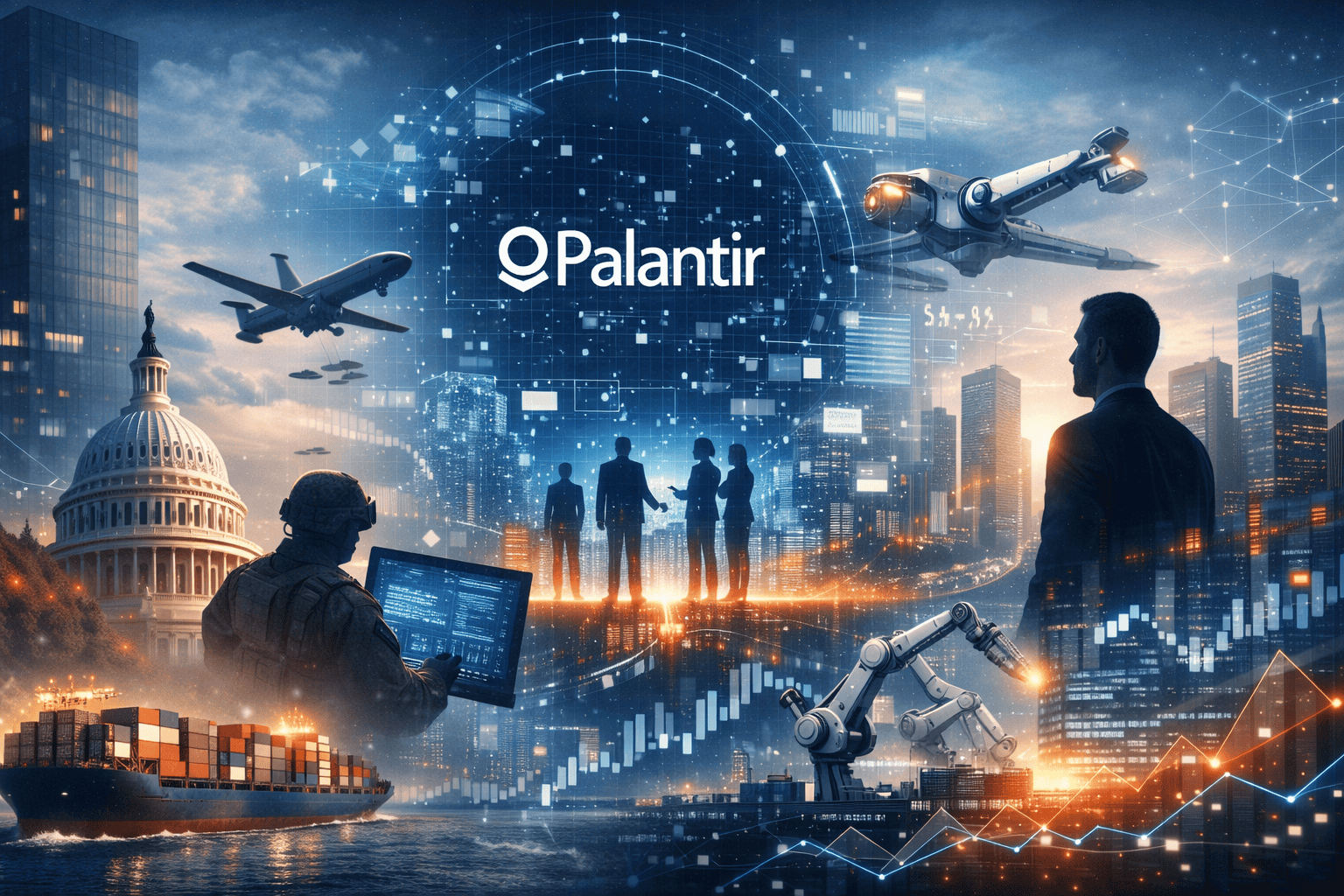
Artificial intelligence is entering a new phase. The first wave of AI excitement was driven by semiconductor companies and infrastructure providers. The next phase is expected to be dominated by software platforms that operationalize AI across entire organizations. One company attempting to lead this transition is Palantir Technologies.
Disclaimer: This article is for informational purposes only and does not constitute financial advice. Always conduct your own research before making investment decisions.
Originally known for its work with intelligence agencies, Palantir has evolved into a powerful AI-driven data platform serving both government agencies and commercial enterprises. With the introduction of its Artificial Intelligence Platform (AIP), Palantir is increasingly positioning itself as the “AI Operating System” for organizations.
In this report we analyze Palantir’s:
- AI platform ecosystem
- financial growth
- competitive advantages
- Key Growth Catalysts and Risks
- long-term investment thesis
- Investment Scorecard and Outlook
Palantir Technologies was founded in 2003 by Peter Thiel, Alex Karp and a group of Silicon Valley entrepreneurs with the goal of building software capable of analyzing large and complex datasets. The company initially focused on developing platforms for intelligence and national security agencies, enabling them to integrate data from multiple sources and uncover patterns that would otherwise remain hidden. These early deployments helped establish Palantir as a trusted provider of data analytics software within government and defense environments.
Company Overview
Over time, Palantir expanded its technology into the private sector, where its platforms are now used across industries such as healthcare, manufacturing, insurance, financial services, and energy. Today the company operates through two primary segments: government, which serves defense and intelligence agencies, and commercial, which provides enterprise software platforms that help organizations integrate data, optimize operations, and deploy artificial intelligence in real-world workflows. In recent years, the commercial segment has grown rapidly as companies increasingly adopt AI-driven decision systems.
Palantir’s Core Platforms
Palantir’s technology ecosystem is built around three primary platforms: Palantir Gotham, Palantir Foundry and the Palantir Artificial Intelligence Platform(AIP). Together these systems form the backbone of Palantir’s data and AI infrastructure, enabling organizations to integrate massive datasets, run advanced analytics, and increasingly automate operational decisions. While each platform serves different customers and use cases, they share a common architecture focused on turning complex data into actionable intelligence.
Rather than functioning purely as analytics tools, these platforms operate as operational systems that combine data pipelines, machine learning models, and decision workflows. Governments and enterprises use Palantir’s software to unify fragmented data environments and translate insights into real-world actions. As artificial intelligence becomes embedded in business and government processes, these platforms increasingly act as the foundation for deploying AI-driven decision systems.
Gotham
Gotham is Palantir’s original intelligence platform and remains widely used by defense, intelligence, and national security organizations. The system integrates large volumes of structured and unstructured data from sources such as intelligence reports, sensor feeds, communications data, and financial transactions. By linking these data sources together, Gotham allows analysts to uncover relationships and patterns that would otherwise remain hidden within disconnected systems.
The platform has been deployed in a wide range of security and defense applications, including counterterrorism investigations, battlefield intelligence analysis, and law-enforcement operations. By combining data integration, visualization tools, and advanced analytics, Gotham helps analysts and commanders develop a comprehensive operational picture that supports faster and more informed decision-making.
Foundry
Foundry extends Palantir’s data integration capabilities into the commercial sector by serving as a comprehensive enterprise data platform. Many large organizations operate with fragmented data systems across departments such as finance, operations, logistics, and customer management. Foundry brings these datasets together into a unified environment where companies can analyze their operations and build models that reflect how their businesses function in real time.
This integrated data foundation allows organizations to improve decision-making across a variety of business functions. Companies use Foundry to optimize supply chains, improve manufacturing efficiency, forecast financial performance, and detect operational risks before they escalate. By embedding analytics directly into business workflows, Foundry helps enterprises move beyond static reporting toward continuous operational optimization.
Artificial Intelligence Platform (AIP)
The Artificial Intelligence Platform, or AIP, represents Palantir’s expansion into enterprise AI and generative AI deployment. The platform allows organizations to run large language models and other AI systems directly on top of their internal data infrastructure while maintaining strict security and governance controls. This approach enables companies to leverage advanced AI capabilities without exposing sensitive data to external systems.
AIP also introduces AI-driven automation into enterprise workflows through the use of intelligent agents capable of analyzing data and executing complex operational tasks. Employees can interact with these systems using natural language queries, allowing business users to access insights without requiring specialized technical skills. Since its launch, AIP has become one of the fastest-growing components of Palantir’s platform ecosystem as organizations increasingly adopt AI to automate decision processes.
Competitive Advantages: The 2026 “Secret Weapon” Analysis
Palantir is increasingly positioning itself as a leading “AI Operating System of the West” by leveraging a multi-layered moat that traditional software vendors cannot replicate. Its competitive advantage is built on three definitive “secret weapons.”
The AIP Bootcamp: A High-Velocity Sales Engine
While legacy enterprise software companies struggle with sales cycles that span months, Palantir has industrialized a “Warp Speed” approach to customer acquisition.
- Sales Velocity: Through five-day intensive workshops, customers build functional AI use cases on their own live data in days rather than months.
- 75% Conversion Rate: These bootcamps have achieved a nearly 75% conversion rate, directly fueling the 137% year-over-year surge in U.S. Commercial revenue during Q4 2025.
- Rapid Scale: At one shipbuilder, Palantir’s bootcamp model took planning effort from 160 hours down to just 10 minutes.
The “Ontology” Moat: Inverting the AI Stack
Palantir has successfully positioned itself in the “Logic Layer” of the AI economy, sitting above commoditized large language models (LLMs).
- Digital Twin Architecture: The Ontology creates a real-time “Digital Twin” of an organization, allowing AI to interact directly with business workflows rather than producing disconnected insights.
- Co-opetition Mastery: Former rivals like Snowflake have been forced into strategic alliances, effectively conceding the “analytical brain” of the enterprise to Palantir while remaining relegated to the “Storage Layer”.
- Unrivaled Performance: This technical edge allowed Palantir to achieve a record Rule of 40 score of 127 in late 2025—a benchmark CEO Alex Karp describes as “unattainable by everyone besides us”.
Strategic “Sovereign AI” and Defense Dominance
Palantir’s deep-rooted history with intelligence agencies provides a level of security and reliability that is now a standard requirement for Fortune 500 logistics.
- Mission-Critical Infrastructure: The company is the primary beneficiary of the Federal AI Deployment Act of 2026, which earmarked over $1 billion for commercial AI integration into government workflows.
- Tactical Edge Capabilities: Recent wins like the $448 million Navy deal for shipbuilding supply chains and the Maven Edge Agent (MAGE) prove Palantir’s ability to operate in “high-stakes” environments where the data is messy and incomplete.
- Security Superiority: Its Impact Level 6 (IL6) security clearance remains a significant barrier to entry, allowing it to handle classified datasets that horizontal AI providers simply cannot access.
| Secret Weapon | Metric of Success | 2026 Competitive Impact |
| Bootcamp Strategy | 75% Conversion Rate | Collapses sales cycles from months to days. |
| Ontology Layer | 127 Rule of 40 Score | Renders AI models actionable within business logic. |
| Sovereign AI | $1.1B Federal Mandate | Captures “Western-first” government and defense spend |
2025 Financial Performance: A Breakout Year
While Palantir’s technology platforms form the foundation of its business, the company’s recent financial performance provides clearer insight into how rapidly these products are gaining adoption.
Fiscal year 2025 marked a major financial milestone for Palantir Technologies, as the company delivered record revenue growth while significantly expanding profitability. Strong demand for its Artificial Intelligence Platform (AIP) and accelerating commercial adoption helped drive one of the most impressive growth periods in the company’s history. The results highlight Palantir’s transition from a data analytics provider into a rapidly scaling enterprise AI platform.
Key Annual Financial Metrics
| Metric | FY 2025 Actual | FY 2024 Actual | YoY Change |
| Total Revenue | $4.48 Billion | $2.87 Billion | +56% |
| Net Income | $1.63 Billion | $462 Million | +253% |
| Earnings Per Share (EPS) | $0.74 | $0.41 | +80% |
| Total Assets | $8.90 Billion | $6.34 Billion | +40% |
The company’s operating leverage improved significantly as revenue scaled faster than operating expenses. Operating income increased to roughly $1.41 billion in 2025, compared with $310 million in 2024, reflecting stronger margins as Palantir’s software platforms gained wider adoption.
Profitability improvements were also supported by strong interest income generated from Palantir’s large balance of short-term investments and cash reserves. By the end of fiscal year 2025, the company reported total assets of approximately $8.9 billion and shareholder equity exceeding $7.3 billion, highlighting a strong balance sheet with relatively low financial leverage
Palantir’s financial trajectory has shifted from steady growth to compounding acceleration, driven by an “n of one” performance in the U.S. market.
- U.S. Commercial Explosion: This segment grew 137% year-over-year in Q4 2025, reaching $507 million as AIP adoption moves from experimentation to massive scale.
- Total Contract Value (TCV): Closed a record $4.3 billion in bookings in Q4 alone, a 138% increase year-over-year that provides massive revenue visibility.
- Elite Profitability: The company hit an unprecedented Rule of 40 score of 127 in Q4 2025, proving it can scale at high velocity while maintaining a 57% adjusted operating margin.
2026 Guidance Table
| Metric | 2026 Management Target | Growth / Margin Focus |
| Total Revenue | $7.18B – $7.19B | 61% YoY Growth |
| U.S. Commercial Revenue | $3.14B+ | 115% Min. Growth |
| Adj. Operating Income | $4.12B – $4.14B | Targeted Margin Expansion |
| Adj. Free Cash Flow | $3.92B – $4.12B | ~55% Cash Margin |
Revenue, Profitability, and Cash Flow Growth (2018–2025)
Over the past several years, Palantir Technologies has demonstrated a strong financial transformation marked by accelerating revenue growth and improving profitability. The company’s expansion reflects increasing adoption of its data integration and artificial intelligence platforms across both government and commercial customers. As enterprise demand for AI-driven operational systems has increased, Palantir’s revenue growth has accelerated, particularly in the last two years.
At the same time, Palantir has moved from a prolonged period of losses into sustained profitability while generating significant operating cash flow. Early investments in research, infrastructure, and platform development weighed heavily on profitability during the company’s growth phase. However, as the software platform scaled and customer adoption increased, operating leverage improved substantially. By 2025, Palantir was not only reporting strong profits but also generating substantial cash flow from operations, reflecting the scalability of its software business model.
The table below illustrates the company’s financial trajectory, showing how revenue expansion, profitability, and operating cash flow have evolved over time.
| Year | Revenue | Net Income | Operating Cash Flow |
|---|---|---|---|
| 2018 | $595 Million | ($580 Million) | ($39 Million) |
| 2019 | $742 Million | ($579 Million) | ($165 Million) |
| 2020 | $1.09 Billion | ($1.16 Billion) | ($296 Million) |
| 2021 | $1.54 Billion | ($520 Million) | $334 Million |
| 2022 | $1.91 Billion | ($371 Million) | $224 Million |
| 2023 | $2.23 Billion | $217 Million | $712 Million |
| 2024 | $2.87 Billion | $468 Million | $1.15 Billion |
| 2025 | $4.48 Billion | $1.63 Billion | $2.13 Billion |
This progression highlights the shift in Palantir’s financial profile. What began as a high-investment growth company has evolved into a profitable software platform with strong operating cash generation. The rapid increase in operating cash flow in recent years also provides the company with substantial financial flexibility to invest in AI development, expand its commercial presence, and pursue long-term strategic initiatives.
Government vs Commercial Revenue Mix
A defining characteristic of Palantir Technologies is its dual customer base spanning both government agencies and commercial enterprises. Historically, the company derived the majority of its revenue from government contracts with defense and intelligence organizations. These contracts provided stable long-term revenue but also created concerns among investors about the company’s reliance on public sector spending.
In recent years, however, Palantir’s commercial segment has grown rapidly as enterprises increasingly adopt AI-driven operational platforms. The launch of the Artificial Intelligence Platform (AIP) and the company’s AIP Bootcamp strategy significantly accelerated enterprise adoption. As a result, the commercial business has become the fastest-growing part of the company, helping diversify revenue and reduce dependence on government contracts.
Revenue Mix by Segment
| Segment | FY 2025 Revenue | Share of Total Revenue |
|---|---|---|
| Government | $2.48 Billion | ~55% |
| Commercial | $2.00 Billion | ~45% |
| Total | $4.48 Billion | 100% |
Government contracts still represent a large portion of Palantir’s business, particularly in defense, intelligence, and national security operations. However, the rapid growth of the commercial segment suggests that the company is evolving into a broader enterprise AI platform rather than remaining primarily a government contractor.
Valuation and Market Position
As Palantir’s growth and profitability improved, the market began valuing the company more like a high-growth AI platform than a traditional government software contractor. Investors increasingly view Palantir as a potential infrastructure layer for enterprise AI, similar to how cloud providers became foundational platforms for digital infrastructure.
This perception has led to premium valuation multiples relative to many traditional software companies. Investors are effectively pricing in expectations that Palantir will continue expanding its commercial AI platform while maintaining strong relationships with government agencies.
Key Valuation Metrics (Approximate)
| Metric | Value |
| Market Capitalization | ~$200 Billion |
| Price-to-Sales (P/S) | ~45x |
| Price-to-Earnings (P/E) | ~90x |
| Enterprise Value / Revenue | ~44x |
These valuation multiples are significantly higher than those of traditional enterprise software firms, reflecting investor expectations that Palantir could become a major long-term platform in the global AI ecosystem. However, the premium valuation also introduces risk if growth slows or if competition intensifies from major cloud providers and AI platform companies.
Key Growth Catalysts (2026–2030)
As Palantir Technologies continues expanding its AI platform ecosystem, several major catalysts could drive revenue growth and market adoption over the next decade. These catalysts span enterprise AI adoption, government AI modernization, and the broader shift toward AI-driven operational systems.
The following table summarizes the key factors that could influence Palantir’s long-term growth trajectory.
| Catalyst | Explanation |
| AIP Enterprise Adoption | Palantir’s Artificial Intelligence Platform (AIP) allows organizations to deploy large language models directly on top of internal data systems. As enterprises integrate AI into daily operations, demand for secure AI deployment platforms like AIP could grow significantly. |
| Commercial Segment Expansion | Historically dominated by government contracts, Palantir’s fastest growth is now coming from commercial customers. Increasing adoption across manufacturing, healthcare, and financial services could drive sustained revenue diversification. |
| AI Agent Automation | As AI agents begin automating complex operational workflows, software platforms capable of orchestrating data, models, and decision systems may become critical enterprise infrastructure. Palantir is positioning its platforms to serve as the operational layer for these AI systems. |
| Government AI Modernization | Governments around the world are investing heavily in artificial intelligence for defense, intelligence, and public sector operations. Palantir’s long-standing relationships with defense agencies and national security organizations position it well to benefit from these investments. |
| Data Integration at Enterprise Scale | Many organizations still struggle with fragmented data systems across departments. Palantir’s core strength in integrating complex datasets across operational systems gives it a structural advantage as companies seek unified data and AI platforms. |
| Operating Leverage and Margin Expansion | As Palantir’s software platforms scale, incremental revenue can translate into significantly higher margins. This operating leverage could continue driving profitability growth alongside revenue expansion. |
Key Risks to the Investment Thesis
While Palantir has strong growth potential driven by enterprise AI adoption and government modernization programs, investors should also consider several risks that could impact the company’s long-term performance. These risks range from valuation concerns to competitive pressures in the rapidly evolving AI software market.
The following table summarizes the primary risks associated with the investment thesis.
| Risk | Explanation |
| Premium Valuation | Palantir currently trades at significantly higher valuation multiples than many traditional software companies. If revenue growth slows or market sentiment toward AI stocks weakens, the stock could experience substantial volatility. |
| Government Revenue Dependence | A significant portion of Palantir’s revenue still comes from government contracts. Changes in government spending priorities, defense budgets, or procurement processes could impact revenue growth. |
| Competition from Big Tech | Major technology companies including Microsoft, Amazon, and Google are investing heavily in enterprise AI platforms. These firms have vast resources and existing cloud ecosystems that could intensify competition. |
| Enterprise Adoption Cycles | Large enterprise software deployments often involve long sales cycles and complex integration processes. Slower-than-expected adoption of Palantir’s AI platforms could impact growth projections. |
| Ethical and Regulatory Concerns | Palantir’s work with defense and intelligence agencies has occasionally drawn criticism related to privacy and surveillance. Increased regulatory scrutiny or public backlash could create reputational risks. |
| Rapid Technological Change | The artificial intelligence industry is evolving quickly. If new AI architectures or competing platforms emerge that reduce the need for Palantir’s data infrastructure, the company could face strategic challenges. |
Insider Transactions and Market Expectations
Recent regulatory filings show several share transactions by executives and directors at Palantir Technologies. Over the past few months, multiple insiders have sold shares following the strong rally in the company’s stock price during 2025 and early 2026. Most of these transactions appear to be related to stock-based compensation vesting and pre-scheduled trading plans rather than discretionary selling.
Market expectations for Palantir remain strongly tied to the continued adoption of enterprise artificial intelligence. Analysts broadly expect the company’s AI platform deployments and expanding commercial customer base to drive continued revenue growth over the coming years.
Key Metrics Investors Should Watch
As Palantir continues expanding its AI platform ecosystem, several key operating metrics will provide important signals about the company’s long-term growth trajectory. While revenue and profitability remain central to evaluating the business, investors increasingly focus on indicators that reveal how quickly Palantir’s AI platforms are gaining adoption across both government and commercial markets.
Tracking the following metrics can help investors better understand whether Palantir is successfully scaling its enterprise AI platform and sustaining its current growth momentum.
| Metric | Why It Matters |
| Commercial Revenue Growth | Indicates how quickly Palantir is expanding beyond government contracts and capturing enterprise AI demand. Strong commercial growth suggests broader adoption across industries. |
| AIP Customer Expansion | Measures the success of the Artificial Intelligence Platform (AIP). Growth in AIP deployments signals increasing enterprise integration of AI into operational workflows. |
| Operating Margin | Reflects the scalability of Palantir’s software model. Expanding margins indicate that revenue growth is translating into stronger profitability. |
| Government Contract Pipeline | Provides insight into long-term revenue visibility from defense and intelligence customers. Large government contracts often extend over multiple years. |
| Operating Cash Flow | Demonstrates the company’s ability to generate cash from its core business, supporting investment in AI development and platform expansion. |
These indicators will likely play a key role in shaping investor sentiment toward Palantir over the coming years as the company continues positioning itself as a foundational platform for enterprise AI.
Investment Scorecard
To summarize the current investment thesis, the following scorecard highlights the key factors influencing Palantir’s outlook. This provides a quick snapshot of strengths, potential risks, and neutral areas investors may want to monitor.
| Factor | Current Signal | Commentary |
| Revenue Growth | 👍 Positive | Revenue growth accelerated significantly in 2025 as enterprise AI adoption increased across both government and commercial customers. |
| Profitability | 👍 Positive | Palantir has transitioned from losses to strong profitability with expanding operating leverage. |
| Commercial Expansion | 👍 Positive | Rapid growth in the commercial segment indicates increasing enterprise adoption of Palantir’s platforms. |
| Government Contracts | 👍 Positive | Long-term defense and intelligence relationships provide stable multi-year revenue streams. |
| AI Platform Adoption | 👍 Positive | The Artificial Intelligence Platform (AIP) is becoming a major driver of enterprise deployments. |
| Valuation | ⚖️ Neutral | The stock trades at premium valuation multiples relative to many traditional software companies. |
| Competitive Pressure | ⚖️ Neutral | Competition from major cloud providers and enterprise AI platforms continues to intensify. |
| AI Technology Uncertainty | ⚖️ Neutral | Rapid advances in AI models and infrastructure could reshape the competitive landscape over time. |
| Regulatory & Ethical Governance Risks | ⚖️ Neutral | Palantir’s involvement in defense, intelligence, and surveillance-related projects may attract regulatory scrutiny and ethical debate. |
Investment Outlook: Is Palantir Still a Buy?
Palantir Technologies has undergone a significant transformation over the past several years. The company has evolved from a niche government analytics provider into a rapidly growing enterprise AI platform with expanding commercial adoption. Strong revenue growth, improving profitability, and rising operating cash flow suggest that the business model is entering a more scalable phase as organizations increasingly adopt AI-driven decision systems.
If Palantir successfully expands its commercial platform while maintaining strong government relationships, it could become a key infrastructure provider for enterprise AI. However, investors must balance this long-term opportunity against risks such as rising competition, valuation sensitivity, and the rapid pace of change in the artificial intelligence software market.
.