The Real Story Behind Anthropic and Claude
Over the past few years, artificial intelligence has largely been understood by the public through one concept: the chatbot. A user asks a question, the system responds in natural language, and the interaction ends.
However, recent developments around Anthropic’s Claude models in 2026 indicate that the industry is moving beyond this stage. The current transition is not about building a more entertaining conversational assistant. It is about building software that can independently perform tasks traditionally done by human workers.
This article explains, in practical terms, what Claude is, why companies are adopting it, and what this shift means for ordinary users and technology markets.
What Anthropic Is Trying to Build
Anthropic is an artificial intelligence research and product company founded by former AI safety and language-model researchers. Their core product, Claude, is technically a “large language model,” meaning it predicts text based on patterns learned from data.
However, the company’s research direction differs from traditional chatbot development.
Instead of focusing primarily on conversation quality, Anthropic has emphasized three engineering goals:
1. Reliable reasoning
The model should follow instructions step-by-step and not change its conclusions randomly.
2. Long-context understanding
The system should process large documents such as legal contracts, technical manuals, or codebases.
3. Controlled behavior (alignment)
The system should behave predictably and avoid unsafe or irrelevant responses.
The reason for this direction becomes clearer when we examine how businesses are actually using AI.
The Problem With Traditional Chatbots
Early AI assistants were useful but limited. They helped with writing emails, summarizing articles and generating text. But businesses discovered a fundamental limitation:
A chatbot only answers questions.
It does not complete tasks.
For example:
A company does not simply want a description of a financial report. It wants the report analyzed, key risks identified, and a decision recommendation produced. Similarly, a hiring manager does not want advice about resumes. They want resumes reviewed and ranked.
This gap between information assistance and task completion is what Anthropic is attempting to address.
What “AI Agents” Actually Are
The term AI agent is often used loosely, so it helps to define it carefully.
A chatbot interaction works like this:
User → Question → AI Response
An AI agent works like this:
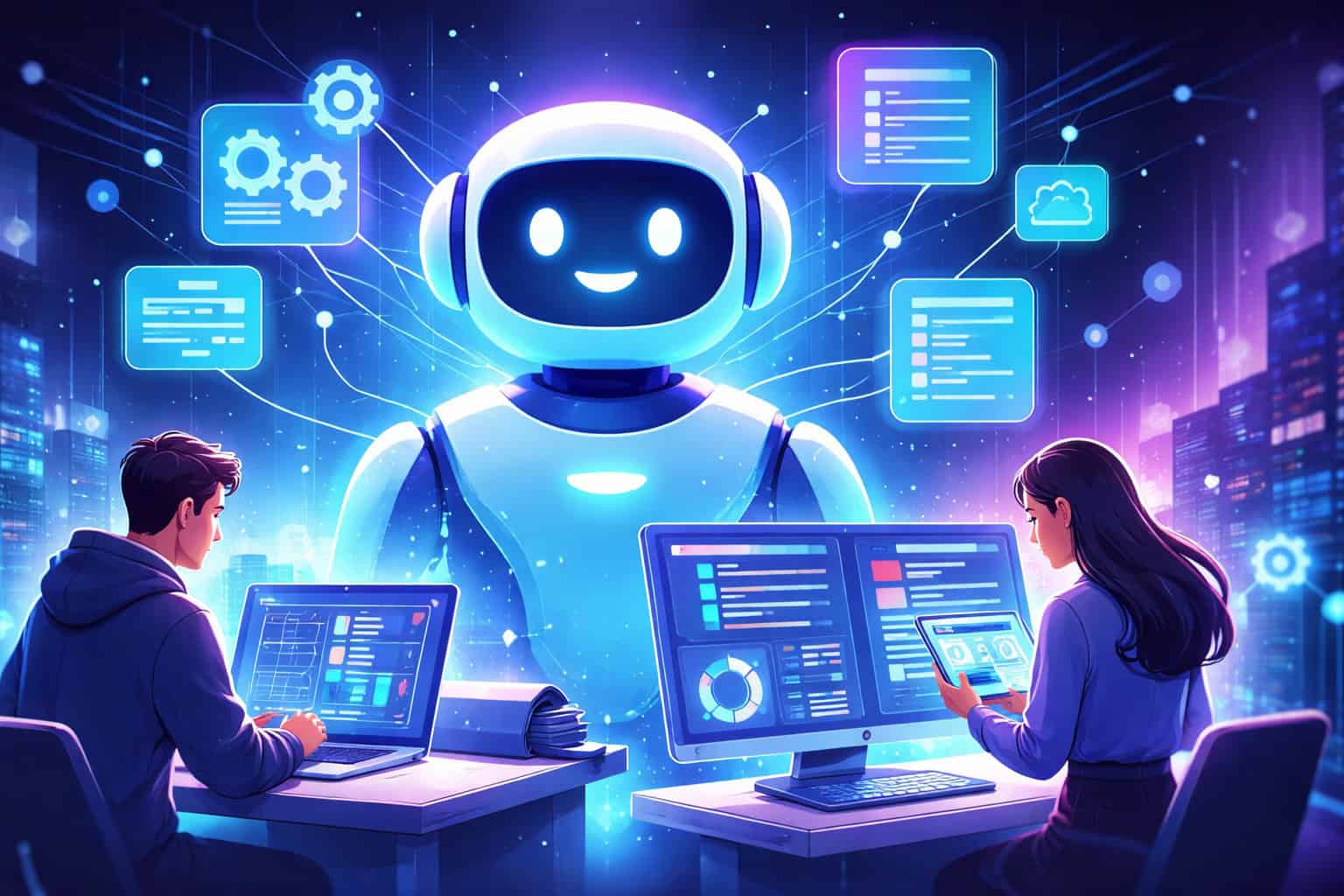
User → Goal → AI performs multiple steps → Final output
The difference is that the system plans actions internally.
An agent-style AI might:
- Read a set of documents
- Extract relevant information
- Compare it to a target objective
- Produce a structured result
The user does not guide every step. The system organizes the process itself. This is why Claude is becoming important — it is designed to support multi-step workflows rather than single responses.
Why Enterprises Are Interested
Businesses evaluate technology differently than consumers, focusing primarily on predictability, integration, and operational risk. While early AI tools were impressive, they were often inconsistent; a creative or slightly inaccurate answer might be acceptable in casual use, but it becomes a serious problem in areas such as financial analysis or customer service.
Anthropic’s models have gained attention because companies report that Claude behaves more reliably in structured environments — it tends to follow detailed instructions more consistently, stays coherent across long interactions, and can process large internal documents without losing context. Because of these characteristics, organizations are beginning to see it not simply as a conversational assistant, but as a system that can be trusted inside real workflows, making it suitable for practical business use cases.
This is why the technology is increasingly being used for practical, real-world work. In business environments it can assist with customer support automation, review contracts and policy documents, search through large technical documentation repositories, act as an internal knowledge assistant for employees, and even help developers with coding tasks. The real importance is not simply that the system can hold a conversation, but that it can function within an existing workflow and support how organizations already operate rather than replacing it entirely.
Why This Matters to Everyday Users
Most people think they will “use AI” by visiting an AI website. In reality, they will rarely open an AI app directly. Instead, AI will appear inside tools they already use.
For example:
A job seeker uploading a resume to a job portal
→ meaningfully analyzed automatically
A student submitting an assignment
→ feedback generated instantly
A developer opening a code editor
→ errors diagnosed automatically
A customer contacting support
→ responses generated and verified in real time
The user does not need to know Claude exists. They interact with a service that simply becomes faster and more responsive.
Why Investors Are Paying Attention
The economic importance of this shift is substantial. Consumer AI products generate attention, but enterprise productivity software generates revenue. If AI systems can reliably assist knowledge workers, companies gain faster operations, reduced staffing costs and improved decision speed.
AI assistants integrated into workflows may become the next infrastructure layer. Anthropic’s strategy appears aligned with this possibility. Instead of focusing on social engagement, the company is positioning Claude as a platform that other software systems embed.
Limitations and Risks
Despite progress, several challenges remain.
1. Accuracy
Even improved models can produce incorrect conclusions when data is ambiguous.
2. Oversight
Organizations must still verify outputs, especially in legal and financial contexts.
3. Dependence
If businesses rely heavily on automated reasoning, operational risk increases during system failures.
4. Regulation
Governments are beginning to evaluate how decision-assisting AI should be audited and documented.
These constraints mean adoption will be gradual rather than immediate replacement of workers.
Conclusion
The attention around Anthropic is not primarily about a better chatbot. It reflects a broader change in how software is expected to function.
AI systems like Claude are beginning to participate in those steps.
The significance is subtle but important.
The question is no longer “Can AI talk?”
The question is “Can AI help complete real work?”
If that transition continues, the future of computing may not be defined by applications we operate, but by systems we collaborate with.