An Unknown Startup Just Raised $140M to Build Ocean-Powered AI Data Centers
Artificial intelligence is rapidly transforming the global technology landscape, creating unprecedented demand for computing power, data centers, and electricity infrastructure. Over the past two years, much of the attention has focused on companies building AI chips, cloud infrastructure, and large language models.
However, a new wave of startups is now attempting to solve one of the biggest long-term challenges facing the AI industry: power and cooling constraints.
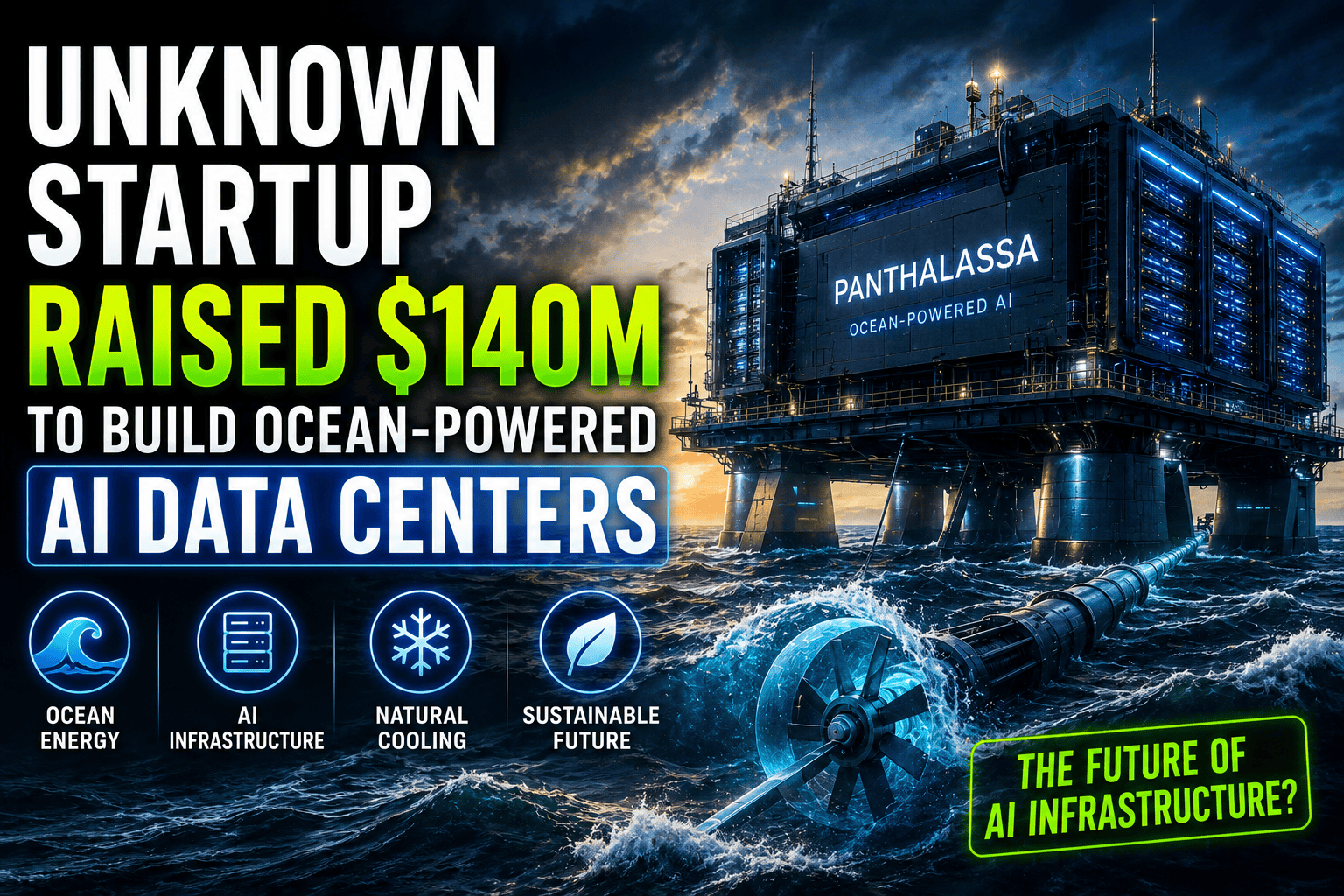
One company attracting growing attention is Panthalassa, a startup developing offshore AI data centers powered by ocean waves. The company recently raised approximately $140 million in funding, highlighting how investors are increasingly searching for unconventional solutions to support the next generation of AI infrastructure.
While Panthalassa itself is not publicly traded, the company reflects a much larger trend that could impact publicly listed AI infrastructure, energy, and data center companies over the coming years.
Disclaimer: This article is for informational purposes only and does not constitute financial advice. Always conduct your own research before making investment decisions.
Why AI Infrastructure Is Becoming the Next Big AI Investment Theme
The AI boom is no longer only about semiconductors and software models. Training and operating modern AI systems requires enormous amounts of:
- electricity,
- cooling infrastructure,
- networking capacity,
- and large-scale compute clusters.
Major technology companies are now competing aggressively for access to power and data center capacity. As hyperscalers expand AI deployments globally, energy availability is increasingly becoming a strategic bottleneck.
This is creating opportunities for a new category of AI infrastructure companies focused on:
- energy generation,
- cooling technologies,
- AI-ready power systems,
- and alternative data center models.
Panthalassa is positioning itself directly within this emerging AI infrastructure ecosystem.
What Is Panthalassa?
Panthalassa is a startup developing offshore floating AI data centers powered by renewable ocean energy. Instead of building traditional land-based AI facilities connected to crowded electrical grids, the company aims to deploy modular compute infrastructure offshore using wave-generated power systems.
The concept combines:
- renewable energy,
- floating infrastructure,
- advanced cooling advantages from ocean environments,
- and modular AI compute deployment.
The company recently raised approximately $140 million in funding, significantly increasing industry attention around its futuristic AI infrastructure concept.
While the company remains early-stage, the funding round highlights growing belief that AI infrastructure challenges could eventually require unconventional solutions beyond traditional land-based data centers.
Why Offshore AI Data Centers Could Matter
As AI models become larger and more computationally demanding, traditional infrastructure faces increasing pressure.
1. Electricity Constraints
Large AI clusters require enormous amounts of electricity. In some regions, utilities are already struggling to support rapid AI data center expansion.
Offshore energy generation could potentially reduce dependence on overloaded electrical grids.
2. Cooling Advantages
Cooling is one of the largest operational costs for AI infrastructure. Ocean environments may provide natural cooling advantages compared to traditional inland facilities.
Reducing cooling costs could significantly improve long-term AI infrastructure efficiency.
3. Faster Infrastructure Expansion
Building large land-based AI data centers often involves:
- permitting delays,
- land acquisition,
- transmission infrastructure,
- and environmental approvals.
Modular offshore infrastructure could potentially accelerate deployment timelines.
4. Renewable Energy Positioning
As governments and hyperscalers increasingly focus on sustainability, renewable-powered AI infrastructure may become strategically valuable.
Panthalassa’s wave-powered approach aligns closely with the growing push toward cleaner AI energy systems.
Why This AI Infrastructure Trend Matters
The growing interest surrounding Panthalassa reflects how rapidly the AI industry is searching for new ways to solve power, cooling, and scalability challenges associated with next-generation AI systems.
The startup is attracting attention because it addresses several issues becoming increasingly important across the AI sector, including:
- electricity shortages,
- cooling costs,
- data center scalability,
- and renewable energy integration.
Even though Panthalassa is still a private startup, the broader trend could have major implications for publicly traded companies involved in:
- AI infrastructure,
- power systems,
- cooling technologies,
- renewable energy,
- and large-scale data center expansion.
The market is increasingly recognizing that the long-term AI opportunity may extend far beyond semiconductors and software.
Public AI Infrastructure Companies Investors Are Watching
While Panthalassa is not currently a publicly traded company, the broader AI infrastructure trend is increasing investor interest in several public-market companies connected to:
- power infrastructure,
- AI-ready data centers,
- cooling systems,
- and energy-intensive compute expansion.
Some publicly traded companies investors are increasingly watching include:
| Company | AI Infrastructure Focus |
|---|---|
| Vertiv Holdings Co. | AI cooling and power infrastructure |
| Eaton Corporation | Electrical infrastructure and grid systems |
| Bloom Energy | Energy generation and fuel-cell systems |
| Applied Digital Corporation | AI-focused data center infrastructure |
| IREN Limited | AI infrastructure and GPU cloud expansion |
As AI compute demand accelerates globally, companies supporting the infrastructure layer of artificial intelligence may continue attracting investor attention.
The Bigger AI Infrastructure Trend
Panthalassa reflects a much larger shift happening inside the AI industry.
Over the past two years, investors primarily focused on:
- NVIDIA,
- OpenAI,
- Microsoft,
- and AI software companies.
But the next phase of AI growth may increasingly revolve around the infrastructure powering artificial intelligence itself.
That includes:
- data centers,
- energy systems,
- networking,
- optical infrastructure,
- cooling technologies,
- and compute deployment capacity.
This is one reason investors are increasingly watching companies involved in AI infrastructure expansion rather than focusing only on AI applications.
Key Risks Investors Should Watch
Despite the excitement surrounding futuristic AI infrastructure concepts, offshore AI data centers also face substantial challenges.
1. Early-Stage Technology Risk
Large-scale offshore AI infrastructure has not yet been proven commercially.
2. Massive Capital Requirements
Building offshore AI compute infrastructure could require enormous long-term capital investment.
3. Operational Complexity
Operating AI infrastructure offshore introduces significant engineering, maintenance, and reliability challenges.
4. Regulatory and Environmental Challenges
Offshore infrastructure projects may face:
- environmental approvals,
- maritime regulations,
- and geopolitical considerations.
Final Thoughts
Panthalassa’s recent funding round highlights how rapidly the AI infrastructure landscape is evolving. As AI demand accelerates globally, companies and investors are increasingly searching for new ways to solve power, cooling, and scalability challenges associated with next-generation AI systems.
Whether offshore AI data centers ultimately become commercially viable remains uncertain. However, the concept reflects a broader shift happening across the AI industry — one where infrastructure, energy availability, and compute scalability may become just as important as AI models themselves.
For investors, the bigger takeaway may not be Panthalassa specifically, but the growing importance of the broader AI infrastructure ecosystem supporting the future of artificial intelligence.