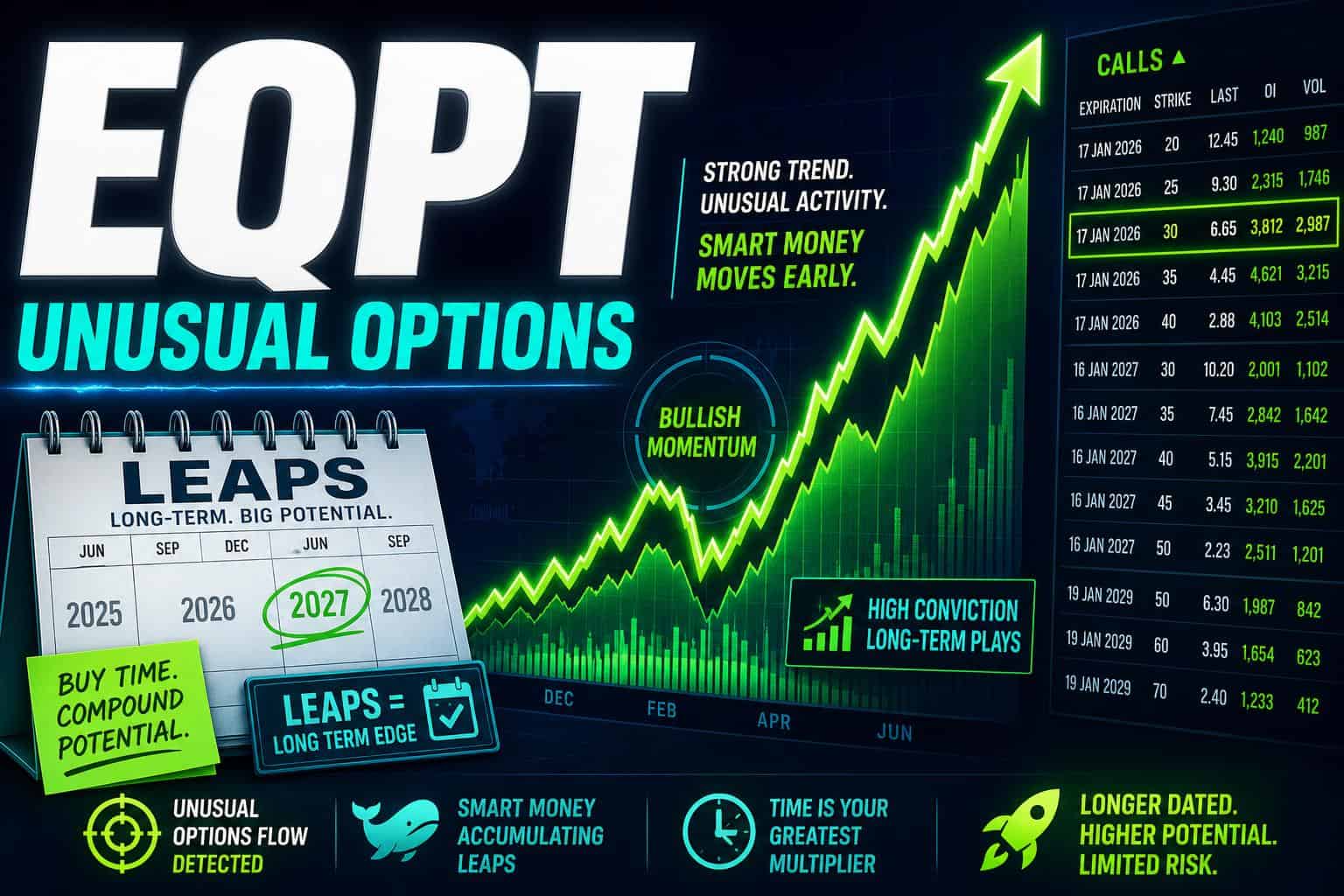
EQPT Unusual Options Alert: A $9.9M LEAPS Bull Call Spread Bets on a Near-Triple by January 2027
On July 14, 2026, one of the most lopsided single-name options prints of the week hit the tape on EQPT. In a single sweep at 11:10 AM ET, 18,727 January 15, 2027 $15 calls traded at the ask — against just 179 contracts of open interest. That’s a 105x volume-to-OI ratio and a $9.93 million premium check, all in one direction.
Seconds later, the same 18,727-lot size printed on the January 2027 $45 calls, this time hitting the bid for $655,000 in premium. The size, timing, and matched quantity make this unmistakable: a single trader opened a massive LEAPS bull call spread — long the deep-in-the-money $15 strike, short the far out-of-the-money $45 strike.
18,727 EQPT Jan 2027 $15/$45 call spreads went up for a net ~$4.95 debit — roughly $9.27M in risk with a maximum payoff near $56M if EQPT trades above $45 by January 2027. That’s a bet on the stock nearly tripling from $16.93 in the next six months.
What the Unusual Options Print Actually Shows
Here are the five most unusual EQPT contracts from the July 14 session, straight from the flow data:
- Jan 15 2027 $15 Call — Volume 18,727 · OI 179 · Vol/OI 104.6x · Premium $9.93M · BuyToOpen at ask · Delta 0.70
- Jan 15 2027 $45 Call — Volume 18,727 · OI 107 · Vol/OI 175.0x · Premium $655K · SellToOpen at bid · Delta 0.19
- Jan 15 2027 $20 Call — Volume 342 · OI 341 · Premium $25.8K · Mid-market · Delta 0.54
- Jan 15 2027 $30 Call — Volume 309 · OI 207 · Premium $12.3K · Mid-market · Delta 0.32
- Jan 15 2027 $25 Call — Volume 66 · OI 1,507 · Premium $10.7K · Mid-market · Delta 0.40
Every top print is a call. There is not a single put in the alert set. And of the two headline trades, both are in the same expiration, on the same size, executed within the same tick — the classic signature of a spread that was worked as one order and printed as two legs.
Disclaimer: This article is for informational purposes only and does not constitute financial advice. Always conduct your own research before making investment decisions.
Reading the Structure
Buying the $15 strike at $5.30 while simultaneously selling the $45 strike at $0.35 puts the net debit at roughly $4.95 per spread. Across 18,727 contracts, that’s about $9.27 million of capital at risk. The maximum value of the spread at January 2027 expiration is $30 (the $45 – $15 width), which caps the trade’s payoff near $56.2 million — a roughly 6x return on capital if EQPT is above $45 at expiration.
With EQPT trading at $16.93 during the print, that’s a directional bet the stock will nearly triple in the next six months. The trader gave up any upside above $45 in exchange for cutting the premium spend by about 7%. It’s not a lottery ticket — it’s a structured, cost-conscious long thesis with a defined maximum loss.
Why Vol/OI This High Is Different
Open interest is the number of contracts sitting on the books before the session starts. When a single strike trades more than 100x its resting OI, essentially all of the volume has to be new positions being opened — closing trades can’t exceed the contracts that already exist. A 105x print at the long leg and 175x at the short leg means both sides of this spread were newly created.
The delta on the $15 call was roughly 0.70, meaning the trader wasn’t reaching for a low-probability lottery ticket — they were buying calls that already behave like leveraged long stock, then financing part of the premium by selling a far out-of-the-money strike that only pays off in a runaway scenario. That’s how institutions build multi-year LEAPS positions when they want stock-like exposure with defined risk and less capital than owning the shares outright.
The Setup: Why EQPT, Why Now?
EQPT is a small-cap name trading around $17, with a volatility profile that has January 2027 implied volatility above 85% across the entire strike ladder. That IV level tells you two things: options are expensive, and market participants are already pricing in the possibility of a very large move.
Buying a debit call spread — rather than outright calls — is the textbook response to that setup. It caps the payoff, but it also caps the amount of premium you’re feeding to elevated implied volatility. In an 85%+ IV environment, that math matters a lot.
A few smaller mid-market prints across the $20, $25, and $30 January 2027 strikes rounded out the session — all calls, no matching put activity. The tape is one-sided.
What Would Confirm the Thesis
- Open interest on the Jan 2027 $15 and $45 strikes rising in the next session — confirming the trade was opened, not day-traded
- Follow-on call buying at nearby January 2027 strikes ($20, $25, $30) in size
- Continued absence of matching put volume
- EQPT holding above the $15 strike, which is the trade’s effective floor
What Would Invalidate It
- Matching put volume showing up on the same expiration — that would suggest the calls are a stock replacement inside a larger hedge, not a directional bet
- OI falling on the $15 or $45 strikes despite the huge volume — a sign the spread was closed before the day ended
- A sustained break below $15, which would mean the entire long leg is out of the money with only six months of time value left to bleed
How to Think About Trading Around This
Unusual options activity is a signal, not a trade recommendation. A few honest reminders before you act on it:
- You don’t know who’s on the other side of the flow. A $9M LEAPS trade in a small-cap name almost always comes from a fund with a real research view — but funds are wrong regularly, and their time horizon isn’t yours.
- This is a six-month trade. Copying the structure means committing capital that can’t move until January 2027 without paying up on the bid/ask spread of an illiquid LEAPS chain.
- The spread caps your upside. If EQPT does what the trader is betting on and rips past $45, the maximum payoff is still $30 per spread — no more.
- Size for the volatility. IV above 85% means every entry price is elevated. A defined-risk spread controls this, but position size still has to reflect that the underlying is a small-cap that can move 20% in a week.
The Bottom Line
The EQPT options tape on July 14 was unambiguous: a single participant with size opened a structured, defined-risk bullish bet that pays off if EQPT nearly triples by January 2027. The 105x volume-to-OI on the long leg, the matched 18,727-contract short leg at the $45 strike, and the total absence of matching puts all point to the same conclusion — this is a conviction trade, not a hedge.
That doesn’t guarantee they’re right. But a $9M LEAPS bull call spread in a $17 small-cap is the kind of print that belongs on your radar — either as an idea to size carefully with your own thesis, or as a warning to check your own exposure if you’re on the other side of the trade.
Frequently Asked Questions
What is a LEAPS bull call spread?
A LEAPS bull call spread combines buying a long-dated (typically 9+ month) in-the-money call and selling a further out-of-the-money call in the same expiration. It creates a defined-risk, defined-reward bullish position with less capital than owning the stock outright and less premium than buying calls outright.
Why would someone sell the $45 strike instead of just buying the $15 calls?
Selling the $45 call brought in $0.35 in premium per contract, cutting the net cost of the trade by about 7%. In exchange, the trader gave up all upside above $45. When you don’t expect the stock to double past your short strike inside your timeframe, that’s often a reasonable trade-off.
What’s the maximum loss on this trade?
The maximum loss on a debit spread is the net premium paid. For this trade that’s roughly $4.95 per spread × 18,727 contracts × 100 shares per contract, or about $9.27M — if EQPT closes at or below $15 on January 15, 2027.
Does unusual options activity always mean the stock will go up?
No. Traders open large call positions for many reasons — outright directional bets, stock replacement inside a larger portfolio, or one leg of a more complex structure. Unusual flow is a signal to investigate, not to blindly follow.