Bloom Energy Stock Report 2026: AI Data Center Power
Key Takeaway
Bloom Energy’s record second quarter and higher 2026 outlook show that its on-site power systems are gaining commercial traction as data-center developers seek faster access to electricity. However, the investment case still depends on execution: converting interest into delivered projects, sustaining margins, financing installations, and proving that AI-related demand can endure beyond a single buildout cycle.
Introduction and central investment question
AI data centers need far more than chips and servers. They also need dependable electricity, often before utility-scale grid connections are available. Bloom Energy sells solid-oxide fuel-cell systems that can generate power at a customer site, positioning the company as a potential beneficiary of that bottleneck.
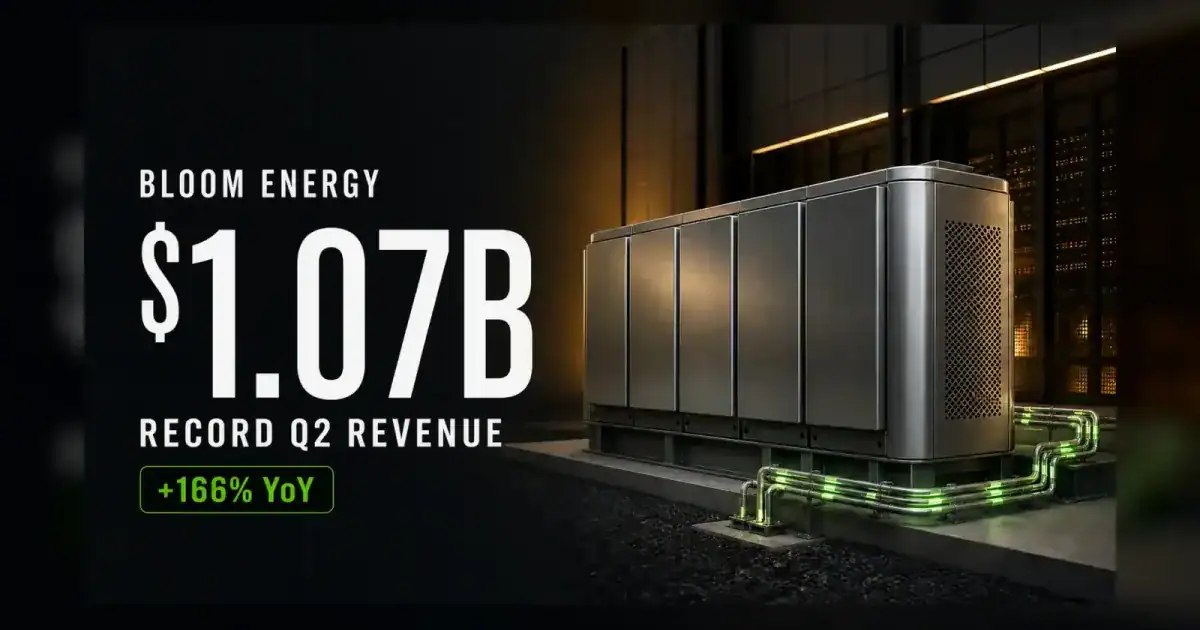
The central investment question is straightforward: can Bloom turn urgent demand for data-center power into durable revenue, cash generation, and repeatable returns? Q2 2026 was encouraging. Revenue reached a record $1.065 billion, up 165.5% year over year, and the company raised its 2026 revenue outlook to $3.9 billion–$4.2 billion. The higher outlook raises the standard for future execution.
Yet strong demand does not settle the question. The company faces long sales and installation cycles, financing requirements, deployment risk, and a valuation debate shaped by expectations for AI infrastructure rather than its mature reported earnings alone.
Investor disclaimer
This article is educational, informational research—not financial advice.
We strive to keep data accurate, but unavoidable errors or omissions may occur. Verify important information with primary sources.
Company overview
Bloom Energy develops and sells solid-oxide fuel-cell systems, marketed as Energy Servers, that provide on-site electricity for commercial and industrial customers. The company also earns from installation, service, and electricity-related arrangements. This combination makes it an energy-infrastructure supplier rather than a pure equipment vendor.
The company is not a data-center operator, a cloud provider, or a frontier-AI developer. Its AI connection is physical infrastructure: supplying power when utility interconnection queues, grid capacity, and construction schedules constrain new data-center capacity. That distinction matters when assessing the source and durability of its demand.
How the company makes money
Product sales are Bloom’s largest revenue source. The company also reports installation revenue, service revenue from maintenance arrangements, and electricity revenue. That mix means quarterly results can be influenced by the timing of equipment shipments and installation milestones, not only by recurring service activity.
In FY2025, revenue rose 37.3% to $2.024 billion. Product revenue increased 41.1%, while installation revenue increased 66.8%. Management attributed the improvement in part to time-to-power needs at key customer sites.
This business model creates an important trade-off. Large equipment deployments can create rapid top-line growth, but they can also make revenue and working capital more variable than a pure subscription business. Quarterly results therefore require attention to delivery timing as well as headline growth.
Why the company matters to AI
The AI infrastructure boom has elevated power availability from an operating detail to a gating constraint. Bloom’s systems aim to provide on-site generation without waiting for a traditional grid expansion to be completed.
In the Q2 release, Bloom said major U.S. hyperscalers and more than a dozen U.S. neoclouds, AI labs, and colocation operators had validated and approved its solutions for AI factories. That is meaningful commercial positioning. However, it is management commentary rather than disclosed customer-level orders, contract values, backlog, or AI-specific revenue.
Consequently, the more defensible thesis is that Bloom is exposed to AI-driven power demand—not that every dollar of its current revenue is AI revenue. Investors should keep that distinction in view when interpreting AI-related announcements.
Recent business developments
Bloom’s Q2 2026 revenue surpassed $1 billion for the first time. GAAP gross margin rose to 33.4% from 26.7% a year earlier, and GAAP operating income was $182.2 million, versus a $3.5 million operating loss in Q2 2025. Operating cash flow was $226.4 million, compared with a $213.1 million outflow a year earlier.
Management raised 2026 revenue guidance to $3.9 billion–$4.2 billion. Its non-GAAP operating-income outlook is $800 million–$900 million, and its non-GAAP EPS outlook is $2.55–$2.85. These are company forecasts, not reported results. Delivery cadence and project economics will determine whether the forecasts become financial results.
Separately, Bloom and Brookfield expanded a framework for financing AI-infrastructure power projects from $5 billion to $25 billion. The announcement can widen access to project capital, which matters in a capital-intensive market. Still, it is a financing framework, not a disclosed $25 billion Bloom revenue contract or a delivery schedule.
Financial performance and revenue trend
Bloom’s financial history shows an improving revenue base and a sharp recovery in operating cash flow after 2023. GAAP earnings remain uneven because debt-related and other non-operating items have materially affected results. The comparison is more useful as an operating trend than as a simple earnings-multiple story.
| Fiscal year ended December 31 | Revenue | GAAP earnings to common stockholders | Operating cash flow | Capex |
|---|---|---|---|---|
| FY2023 | $1.33B | ($302.12M) | ($372.53M) | $83.74M |
| FY2024 | $1.47B | ($29.23M) | $92.00M | $58.85M |
| FY2025 | $2.02B | ($88.43M) | $113.95M | $56.76M |
Readers should not treat the FY2025 GAAP loss as a simple deterioration in operating demand. Bloom reported FY2025 operating income of $72.8 million, but it also recorded $66.2 million of debt-conversion inducement expense and $32.3 million of debt-extinguishment loss. These items help explain why GAAP net income differed from operating income.
Growth drivers
The primary driver is the time-to-power challenge for data-center builders. On-site generation can be attractive when a customer wants capacity before a conventional grid upgrade is ready. This advantage is strongest where construction schedules carry a high economic cost.
Second, product growth can be amplified by larger deployments. Bloom reported Q2 2026 product revenue of $935.4 million, up 215.4% from a year earlier. Gross margin expansion alongside that growth is important because it suggests the recent revenue step-up was not achieved only by sacrificing reported gross profitability.
Third, Brookfield can help finance eligible projects. That may reduce a practical barrier for customers and support project scale. It does not remove project-delivery, fuel-cost, manufacturing, or customer-demand risk. Financing availability alone does not create installed capacity.
Customers, contracts, and partnerships
Bloom has not publicly identified a comprehensive list of AI-data-center customers or separately disclosed AI-data-center revenue. Its disclosure instead emphasizes validation and approval by multiple customer categories. Customer-level evidence would make the AI exposure easier to quantify.
The most material recent partnership disclosure is the expanded Brookfield framework. Investors should distinguish three concepts: a framework for project financing, a customer purchase order, and revenue recognized by Bloom. They are not interchangeable. The $25 billion figure describes the potential financing framework, not a disclosed amount of Bloom revenue.
Competitive position
Bloom competes for on-site and distributed power projects against grid-connected alternatives, gas turbines, generators, batteries, and other energy technologies. Its proposition is speed, compact deployment, continuous power, and the ability to operate close to load.
That positioning is useful only if customers view the total cost, fuel requirements, emissions profile, permitting path, reliability, and delivery schedule as competitive. The AI-power theme may lift demand for many power solutions, so it does not by itself establish a lasting competitive moat. Execution against those practical criteria will determine the company’s share of the opportunity.
Valuation
At the August 7, 2026 close, BE traded at $219.34. The stock price reflects a large gap between reported FY2025 revenue of $2.02 billion and both Bloom’s $3.9 billion–$4.2 billion 2026 revenue guidance and third-party estimates that cluster around rapid growth.
For that reason, a simple trailing earnings multiple is not particularly informative. FY2025 GAAP net income was negative, while Q2 2026 showed strong reported profitability. Investors are effectively judging the durability of a future operating model: whether demand, margins, deployment capacity, and cash conversion can support the current expectations embedded in the share price.
Market expectations
Provider: StockAnalysis, using S&P Global-polled analyst data. As of August 7, 2026 close.
| Rating | Analyst count |
|---|---|
| Buy (including Strong Buy) | 15 |
| Hold | 13 |
| Sell (including Strong Sell) | 1 |
| Metric | Displayed value |
|---|---|
| Current share price | $219.34 |
| Lowest price target | $97.00 |
| Highest price target | $390.00 |
| Consensus/average target | $273.51 |
The wide target range is the key takeaway. It reflects sharply different judgments about project execution, AI-data-center demand, and the durability of margins. Analyst ratings and price targets are changing third-party estimates, not facts reported by Bloom or investment instructions. Their dispersion is a useful signal of uncertainty, not a valuation verdict.
Risks
Bloom’s own Q2 risk disclosure highlights several material issues: significant upfront costs, the ability to finance products, manufacturing and supply constraints, long sales and installation cycles, utility interconnection, incentives, debt service, and a potential slowdown in AI-data-center expansion.
Project concentration is another concern. A few large deployments can accelerate revenue but can also make results sensitive to customer construction schedules, approvals, and milestone timing. Finally, fuel-cell economics depend in part on natural-gas costs, uptime, maintenance performance, and the relative economics of competing power sources. These risks can affect both revenue timing and margins.
Bull case
The bullish case rests on a persistent physical bottleneck: AI infrastructure can require enormous electricity capacity, and grid connections can take years. Bloom’s Q2 revenue growth, margin expansion, and positive operating cash flow show that demand is already translating into reported financial results. Sustained delivery would strengthen that operating evidence.
If the company can use the Brookfield framework to help customers move projects from planning to delivery, it could deepen a high-growth channel. The strongest bull case is not simply “AI needs power.” It is that Bloom can deliver reliable on-site power fast enough, at competitive economics, and with sufficient margin to become a preferred solution.
Bear case
The bearish case is that the market has priced in a long period of exceptional growth before the new economics have been proven across a full cycle. Revenue can be lumpy, AI data-center construction can slip, and financing frameworks do not guarantee projects will be ordered or installed. A slower conversion rate would challenge the growth assumptions behind the stock.
Moreover, Bloom’s annual GAAP results have been volatile, and current analyst targets range from $97 to $390. That dispersion suggests substantial uncertainty rather than a settled valuation conclusion. A demand slowdown, a delayed customer site, margin pressure, higher fuel costs, or execution problems could materially change the outlook.
Investment scorecard
| Dimension | Evidence-based assessment | Key watch item |
|---|---|---|
| Revenue momentum | Strong | Conversion of 2026 guidance into reported revenue |
| AI exposure | Direct but not separately disclosed | AI-specific customer and revenue disclosure |
| Reported profitability | Improved in Q2 | Margin sustainability through deployments |
| Cash generation | Improved but project-sensitive | Working capital and recurring operating cash flow |
| Financing support | Constructive | Projects funded and delivered under the Brookfield framework |
| Competitive position | Promising | Total customer economics versus alternatives |
| Valuation certainty | Low | Execution against elevated growth expectations |
This scorecard reflects reported evidence, not a recommendation. Bloom’s current opportunity is credible, but the proof required for the next stage is consistent delivery rather than another headline alone. Each future quarter should be assessed against that evidence standard.
Final outlook
Bloom Energy has become a serious AI-infrastructure power story because data-center growth is increasingly constrained by access to electricity. Its Q2 2026 results provide meaningful evidence: record revenue, higher gross margin, positive operating cash flow, and raised full-year guidance.
The next phase is more demanding. Investors will need to watch whether large deployments convert into repeatable revenue, whether project financing helps accelerate installations, whether margins hold, and whether the company can disclose more about the composition and durability of demand. The AI-power narrative is strong; the investment outcome remains an execution question. That makes the next several results especially important for the thesis.
Primary Sources
- Bloom Energy Q2 2026 financial results
- Bloom–Brookfield AI infrastructure financing framework
- Bloom FY2025 financial results
- Bloom Energy 2025 Form 10-K
- Bloom Energy 2024 Form 10-K
FAQ
Why is Bloom Energy linked to AI data centers?
Bloom sells on-site fuel-cell systems that can provide electricity at customer facilities. AI data centers face power-availability constraints, creating potential demand for this type of infrastructure.
Did Bloom Energy sign a $25 billion AI contract?
No. Bloom and Brookfield announced a $25 billion financing framework for eligible AI-infrastructure power projects. The announcement does not disclose $25 billion of Bloom revenue, backlog, or guaranteed project orders.
What did Bloom report in Q2 2026?
The company reported $1.065 billion of revenue, 33.4% GAAP gross margin, $182.2 million of GAAP operating income, and $226.4 million of operating cash flow.
What is Bloom’s 2026 revenue outlook?
Management raised FY2026 revenue guidance to $3.9 billion–$4.2 billion. This is a forecast rather than reported revenue.
What are the principal risks?
Important risks include project financing, manufacturing, installation and interconnection delays, customer-site timing, margins, debt service, natural-gas economics, and a potential slowdown in AI-data-center expansion.