Alibaba Stock Reversed Its Selloff After Q1 FY2027 Earnings
Key Takeaway
Alibaba stock staged a striking reversal after the company released fiscal Q1 2027 results before the U.S. market opened on August 20. BABA opened at $123.47, roughly 4.2% below its prior close, and fell to $121.88. However, it recovered throughout the session and closed at $130.53, up 1.26%, near the day’s high of $130.62. Approximately 28.1 million shares changed hands, more than twice the stock’s recent average volume.
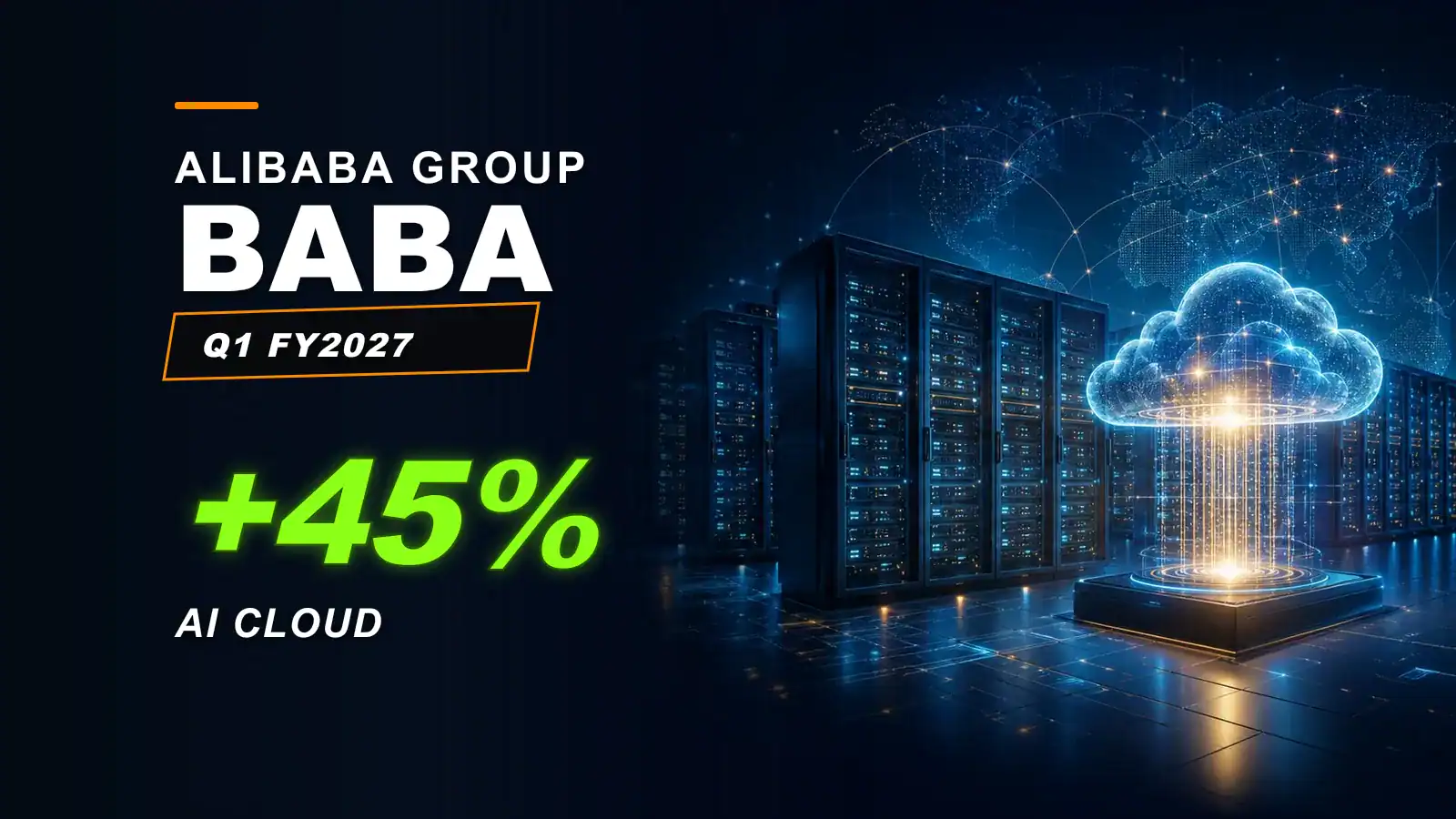
The reversal captured the report’s central tension. Alibaba’s adjusted earnings missed one consistent pre-release consensus, net income fell 75%, and capital expenditures jumped 75%. Nevertheless, AI Cloud and Compute Services revenue accelerated to 45% growth, the segment’s adjusted EBITA increased 133%, and AI-related product revenue delivered a twelfth consecutive quarter of triple-digit growth.
The completed August 20 reaction suggests investors ultimately gave more weight to Alibaba’s accelerating AI commercialization than to the immediate cost of building the infrastructure behind it. Still, the quarter did not eliminate the risk. Alibaba must now prove that cloud profitability can grow fast enough to offset heavy spending, widening AI-application losses, and pressure in parts of its e-commerce business.
Introduction and immediate market reaction
Alibaba reported results for the quarter ended June 30, 2026, before the U.S. market opened on Thursday, August 20. The company also held its earnings call at 7:30 a.m. ET. The June quarter was Alibaba’s fiscal first quarter of 2027.
The first reaction was negative. BABA had closed at $128.90 on August 19, then opened the next morning at $123.47. The opening gap was approximately 4.2%, and the session low of $121.88 represented a decline of about 5.4% from the previous close.
However, the selloff did not hold. BABA recovered about 7.1% from its intraday low and closed at $130.53, just nine cents below the session high. Therefore, the first complete regular-session verdict was a gain of 1.26%, not the premarket decline that dominated early coverage.
| August 20 full-day reaction | BABA price |
|---|---|
| August 19 regular close | $128.90 |
| August 20 open | $123.47 |
| Session low | $121.88 |
| Session high | $130.62 |
| August 20 regular close | $130.53 |
| Close-to-close change | +1.26% |
| Regular-session volume | Approximately 28.1M shares |
The price path matters because it shows a genuine reassessment. Investors initially focused on the earnings shortfall, declining profit, and surging capital spending. As the session progressed, buyers instead emphasized cloud acceleration, improving cloud economics, and management’s expectation that AI and cloud growth can strengthen further.
Educational disclaimer
This article is educational, informational research—not financial advice.
We strive to keep data accurate, but unavoidable errors or omissions may occur. Verify important information with primary sources.
What investors expected before earnings
Before the release, one consistent pre-earnings consensus snapshot expected Alibaba to generate approximately $39.79 billion of revenue and $1.49 in adjusted earnings per American depositary share. Investors also expected AI cloud growth to remain the report’s primary positive catalyst.
Yet the harder question was not whether Alibaba could grow cloud revenue. The company had already reported ten consecutive quarters of triple-digit growth in AI-related product revenue before this quarter. Instead, investors wanted evidence that AI demand could improve the cloud segment’s profitability while Alibaba funded large infrastructure and model investments.
Three additional concerns shaped the setup. First, China e-commerce faced weak transaction activity and intense competition. Second, quick commerce still required significant investment despite improving unit economics. Third, the market needed clarity on whether Alibaba’s three-year AI infrastructure program would generate returns before cash consumption became a larger valuation problem.
Consequently, the earnings bar had two layers: a conventional revenue-and-EPS test and a strategic AI-economics test. Alibaba missed the first on earnings but delivered substantial evidence on the second. That split set up a volatile market reaction.
Reported versus expected scoreboard
Alibaba reported RMB268.953 billion, or $39.639 billion, in revenue. That was approximately $151 million below the cited $39.79 billion expectation, a variance of about 0.4%. Because different services use different currency assumptions and estimate methodologies, the safest characterization is that revenue was essentially in line with this specific pre-release consensus.
Adjusted earnings were weaker. Non-GAAP diluted earnings per ADS came to RMB8.52, or $1.26, compared with the cited $1.49 expectation. That was a $0.23 shortfall, or approximately 15.4%.
| Metric | Reported | Expected | Surprise | Year-over-year |
|---|---|---|---|---|
| Revenue | $39.64B | $39.79B | -$0.15B / -0.4% | +9% |
| Non-GAAP diluted EPS per ADS | $1.26 | $1.49 | -$0.23 / -15.4% | -42% |
The adjusted EPS miss explains the initial selling, but the consolidated figures do not tell the whole story. Alibaba’s fastest-growing AI infrastructure operation also became more profitable, while other investment-heavy businesses absorbed much of that progress.
Revenue segments and AI performance
Alibaba reorganized its segments this quarter. Cloud Intelligence Group and T-Head now form AI Cloud and Compute Services. Its model laboratories, Qwen consumer business, and QwenWork form AI Labs and Applications.
AI Cloud and Compute Services was the clear standout. Revenue reached RMB48.437 billion, or $7.139 billion, and increased 45% from the prior-year quarter. Both total segment revenue and external-customer revenue grew at that rate. Moreover, AI-related product revenue reached RMB12.376 billion, or $1.824 billion, and extended its triple-digit growth streak to twelve quarters.
| Revenue category | Q1 FY2027 | Q1 FY2026 | Change |
|---|---|---|---|
| Alibaba E-commerce Group | RMB205.862B | RMB198.812B | +4% |
| AI Cloud and Compute Services | RMB48.437B | RMB33.418B | +45% |
| AI Labs and Applications | RMB3.338B | RMB2.882B | +16% |
| Consolidated revenue | RMB268.953B | RMB247.652B | +9% |
The cloud result was not only about growth. Segment adjusted EBITA increased 133% to RMB5.628 billion, lifting the margin to approximately 12%. This combination of accelerating revenue and operating leverage is the strongest evidence that Alibaba’s AI infrastructure investment is beginning to monetize.
Alibaba also disclosed broader adoption of its silicon. More than 650 external customers across over 20 industries were using the latest Zhenwu AI processor through Alibaba Cloud. Meanwhile, 250 million users had experienced AI-assisted shopping through Qwen.
However, not every AI line improved economically. AI Labs and Applications revenue grew 16% to RMB3.338 billion, but its adjusted EBITA loss widened to RMB13.861 billion from RMB3.224 billion. Alibaba attributed the increase mainly to investment in AI capabilities and higher inference costs for the Qwen app.
The quarter therefore revealed two different AI stories. Cloud infrastructure achieved both faster growth and better profitability, while consumer and model applications remained expensive. The investment thesis depends on the first story scaling faster than the second consumes cash.
Margins, cash flow, and capital spending
Alibaba’s consolidated profitability weakened despite its cloud progress. Operating margin fell to 6% from 14%, while adjusted EBITA margin declined to 10% from 16%. Net income dropped 75% to RMB10.444 billion, and non-GAAP net income declined 38% to RMB20.715 billion.
| Financial measure | Q1 FY2027 | Q1 FY2026 | Change |
|---|---|---|---|
| Operating margin | 6% | 14% | -8 percentage points |
| Adjusted EBITA margin | 10% | 16% | -6 percentage points |
| Net income | RMB10.444B | RMB42.382B | -75% |
| Operating cash flow | RMB22.945B | RMB20.672B | +11% |
| Free cash flow | -RMB44.670B | -RMB18.815B | Outflow widened RMB25.855B |
| Capital expenditures | RMB67.678B | RMB38.676B | +75% |
The cash-flow contrast is important. Operating cash flow rose 11%, which shows that Alibaba’s underlying operations continued to generate cash. Nevertheless, free cash flow deteriorated because capital expenditures reached almost RMB67.7 billion, or roughly $10.0 billion, during the quarter.
Management tied the capital-spending increase to AI infrastructure demand, the timing of procurement, more CPU compute capacity for AI agents, and higher chip-component prices. Therefore, the negative free cash flow was not evidence of collapsing operations. It was evidence that Alibaba is funding capacity before the associated revenue fully arrives.
That distinction helps explain the stock’s rebound, but it does not remove the risk. Infrastructure investment only creates value if utilization, revenue, and margins eventually justify the upfront cost. Future cash returns remain the decisive test.
Updated guidance
Alibaba did not provide a conventional quantitative revenue or earnings range for Q2 FY2027 or the full fiscal year. Investors therefore cannot compare the next quarter against a company-issued midpoint. The outlook remains directional rather than numerical.
Management instead offered directional guidance. Chief Executive Officer Eddie Wu said Alibaba expects AI and cloud revenue growth to accelerate further as supply ramps, alongside continued improvement in profitability. The company also remains committed to sustained investment in full-stack AI capabilities.
This qualitative outlook is encouraging but less measurable than a formal range. It raises the importance of the next report: investors will need to verify whether cloud growth exceeds 45%, whether segment EBITA continues to expand, and whether capital spending begins producing better consolidated cash returns.
Market expectations
A one-provider, publicly aggregated analyst snapshot as of August 19, 2026 showed a strongly positive 40-analyst cohort. Because ratings and targets can change after earnings, this snapshot should be treated as a record of pre-release expectations rather than an updated verdict.
| Analyst rating | Count |
|---|---|
| Buy | 38 |
| Hold | 1 |
| Sell | 1 |
The same analyst cohort’s price targets provide a broad valuation range relative to BABA’s completed August 20 regular-session close. These changing third-party estimates are not Alibaba guidance, guaranteed outcomes, or investment instructions.
| Price measure | Value |
|---|---|
| Current reference: August 20, 2026 regular close | $130.53 |
| Lowest 12-month target | $92.43 |
| Average 12-month target | $189.55 |
| Highest 12-month target | $242.57 |
The unusually wide range reflects uncertainty about AI returns, Chinese consumer demand, competition, regulation, and the appropriate valuation for Alibaba’s collection of businesses. Post-earnings target revisions will be more informative than the old average alone.
Management commentary
Eddie Wu described the quarter as evidence of improving commercialization across Alibaba’s full-stack AI capabilities. He highlighted 45% external cloud growth, the twelfth consecutive quarter of triple-digit AI-product growth, and new Qwen models spanning language, coding, video, audio, image, and music.
Chief Financial Officer Toby Xu emphasized a second point: cloud growth came with improving operating leverage. AI Cloud and Compute Services generated a roughly 12% adjusted EBITA margin even as Alibaba continued investing in capacity and customer growth.
Alibaba’s strategy now spans the full AI stack. T-Head designs processors and related infrastructure silicon. Alibaba Cloud sells compute and orchestration services. Qwen supplies foundation models and applications. E-commerce provides distribution and real-world use cases.
The strategic logic is credible because each layer can reinforce the others. However, the quarter also showed the cost of owning the full stack. AI Labs and Applications produced a much larger loss, and group-level free cash flow moved deeper into negative territory. Management has demonstrated demand; it has not yet demonstrated that every AI layer will earn attractive returns.
What improved versus what disappointed
- Improved: AI Cloud and Compute Services revenue accelerated to 45% growth.
- Improved: Cloud segment adjusted EBITA increased 133%, taking its margin to roughly 12%.
- Improved: AI-related product revenue delivered triple-digit growth for a twelfth consecutive quarter.
- Disappointed: Adjusted EPS missed the cited consensus by approximately 15.4%.
- Disappointed: Net income fell 75%, while adjusted EBITA margin contracted six percentage points.
- Disappointed: Free-cash-flow outflow widened to RMB44.670 billion as capital spending rose 75%.
Why the stock moved
AIStocksHub’s interpretation is that the full-day reversal occurred in two phases.
- The opening priced in the earnings miss. Adjusted EPS came in below the cited expectation, net income declined sharply, and the scale of capital spending reinforced concern about near-term returns.
- The intraday recovery rewarded AI operating evidence. Cloud revenue grew 45%, cloud adjusted EBITA rose 133%, and management indicated that growth and profitability could improve further as supply expands.
- The report separated productive investment from uncontrolled spending. Operating cash flow increased, suggesting the core business remained cash generative even though infrastructure spending pushed free cash flow negative.
- The stock rejected its deepest discount. BABA recovered 7.1% from the session low and closed near the high on elevated volume. That price path indicates investors materially reconsidered the initial bearish reading.
The close does not mean every concern disappeared. Instead, it suggests the market concluded that the AI-cloud acceleration and improving segment economics deserved more weight than the headline profit decline alone.
Options market reaction
A post-earnings options snapshot supplied for this report showed unusually heavy activity, led by calls.
| Activity measure | Reading | What it means |
|---|---|---|
| Total contracts | 627,254 | Heavy overall participation |
| Call volume | 503,104 / 80.2% | About four calls traded for every put |
| Put volume | 124,150 / 19.8% | Considerably lower than call volume |
| Put/call ratio | 0.247 | Strongly call-dominated volume |
| Total Sizzle Index | 2.452 | Total options volume was 2.45x its five-day average |
| Call Sizzle Index | 2.797 | Call volume was 2.80x its five-day average |
| Put Sizzle Index | 1.536 | Put volume was 1.54x its five-day average |
| Implied volatility | 43.29% | Options still priced meaningful movement |
| IV percentile | 31% | IV was not near the high end of its 52-week range |
The execution location provides a more cautious picture:
| Contract type | At bid or below | At ask or above | Between bid and ask |
|---|---|---|---|
| Calls | 175,398 / 34% | 126,604 / 25% | 201,102 / 39% |
| Puts | 22,029 / 17% | 32,358 / 26% | 69,763 / 56% |
- Bullish evidence: Calls represented 80.2% of volume, and call activity reached 2.80 times its recent average.
- Caution signal: More calls traded near the bid than the ask, which can reflect call selling or position-closing. Meanwhile, more puts traded near the ask than the bid, consistent with demand for downside protection.
- Bottom line: Participation was unusually high and call-dominated, but the execution mix was not uniformly bullish. The aggregate statistics cannot identify whether contracts opened or closed, so they should support—not replace—the price and earnings analysis.
Before versus after earnings thesis
Before Q1 results, the bull case depended on Alibaba converting heavy AI investment into faster cloud growth and stronger margins. The bear case argued that e-commerce pressure, model costs, and infrastructure spending would absorb the benefits before shareholders saw durable cash returns.
After the report, the cloud portion of the bull thesis looks stronger. Revenue accelerated to 45%, adjusted EBITA more than doubled, proprietary AI chips gained external customers, and management described further growth acceleration. These are concrete commercialization signals rather than broad promises.
However, the consolidated thesis remains mixed. Net income and margins fell, free-cash-flow outflow widened, and the AI applications segment became substantially more expensive. Therefore, Alibaba proved that AI demand is real and increasingly monetizable, but it did not prove that the entire AI investment program is economically self-sustaining.
The central question has changed from “Can Alibaba grow an AI cloud business?” to “Can profitable cloud growth outpace the cost of chips, models, applications, and competitive investment?” Future quarters now have a clear standard to meet.
Post earnings bull case
- AI Cloud and Compute Services grew 45%, much faster than the 9% consolidated growth rate.
- Cloud adjusted EBITA increased 133%, showing that rapid growth can produce operating leverage.
- AI-related product revenue has now delivered twelve consecutive quarters of triple-digit growth.
- Alibaba controls several layers of the AI stack, including chips, infrastructure, models, applications, and distribution.
- The August 20 reversal showed that investors were willing to look beyond the initial earnings miss when presented with stronger AI economics.
Post-earnings bear case
- Non-GAAP earnings per ADS fell 42% and missed the cited pre-release expectation.
- Net income fell 75%, while operating and adjusted EBITA margins contracted sharply.
- Capital expenditures rose 75% and pushed free cash flow to a RMB44.670 billion outflow.
- AI Labs and Applications recorded a RMB13.861 billion adjusted EBITA loss, more than four times the prior-year loss.
- Parts of e-commerce remained weak, including an 8% decline in China e-commerce revenue and a 7% decline in customer-management revenue.
What to watch before the next quarter
- Whether AI Cloud and Compute Services revenue growth accelerates beyond 45%.
- Cloud adjusted EBITA and margin after the 133% profit increase this quarter.
- AI-related product revenue after its twelfth consecutive triple-digit-growth quarter.
- Capital expenditures, free cash flow, and evidence that new compute capacity is being utilized.
- The adjusted EBITA loss in AI Labs and Applications and the inference cost of scaling Qwen.
- China e-commerce revenue, customer-management revenue, and quick-commerce unit economics.
- Any quantitative Q2 FY2027 or full-year guidance introduced by management.
Final earnings verdict
Alibaba delivered a mixed headline report but a stronger AI operating report. Revenue was essentially in line with one consistent pre-release expectation, while adjusted EPS missed. Net income, margins, and free cash flow weakened as the company invested heavily across infrastructure and applications.
Yet AI Cloud and Compute Services grew 45%, its adjusted EBITA increased 133%, and AI-product demand maintained a triple-digit growth streak. Those figures gave investors evidence that at least one major layer of Alibaba’s AI strategy is scaling with improving economics.
BABA’s August 20 trading session reflected that debate in real time. The stock opened sharply lower, fell more than 5%, then recovered to close up 1.26% near the session high. The completed reaction was cautiously constructive, but it was not a blank check for unlimited spending.
Alibaba now looks more credible as a vertically integrated AI platform. However, the investment thesis still requires cloud profit growth to outrun infrastructure spending and AI-application losses. The next quarter must convert today’s acceleration into better consolidated margins and cash returns.
Primary Sources
- Alibaba Group June-quarter 2026 earnings release
- Alibaba Group quarterly-results archive
- Alibaba Group fiscal 2026 Form 20-F
- Alibaba Group fiscal 2026 annual report furnished to the SEC
- NYSE market page for Alibaba Group
FAQ
When did Alibaba report Q1 FY2027 earnings?
Alibaba released results for the quarter ended June 30, 2026, before the U.S. market opened on August 20, 2026. The company held its earnings call at 7:30 a.m. ET that morning.
That release covered Alibaba’s fiscal first quarter of 2027.
How did Alibaba stock react to earnings?
BABA initially sold off, opening at $123.47 and falling to $121.88. It then reversed and closed at $130.53, up 1.26% from the previous close and near the session high of $130.62.
The completed session therefore delivered a positive close despite the negative opening reaction.
Did Alibaba beat earnings expectations?
Alibaba’s $39.64 billion of revenue was approximately 0.4% below one consistent $39.79 billion pre-release expectation. Adjusted earnings of $1.26 per ADS missed the same source’s $1.49 expectation by about 15.4%.
The result was essentially in line on revenue but weaker on adjusted earnings.
How fast did Alibaba’s AI cloud business grow?
AI Cloud and Compute Services revenue increased 45% to RMB48.437 billion, or $7.139 billion. The segment’s adjusted EBITA increased 133% to RMB5.628 billion.
Why did profit fall despite strong AI cloud growth?
Alibaba increased investment in AI infrastructure, models, applications, and other technology initiatives. Capital expenditures rose 75%, the AI applications segment’s loss widened, and consolidated adjusted EBITA declined despite improving cloud profitability.
Did Alibaba provide Q2 FY2027 guidance?
Alibaba did not issue a conventional quantitative revenue or earnings range. Management said it expects AI and cloud growth to accelerate further as supply expands, together with continued improvement in profitability.