Why Wolfspeed Stock Fell 9.3% After Q4 FY2026 Earnings
Key Takeaway
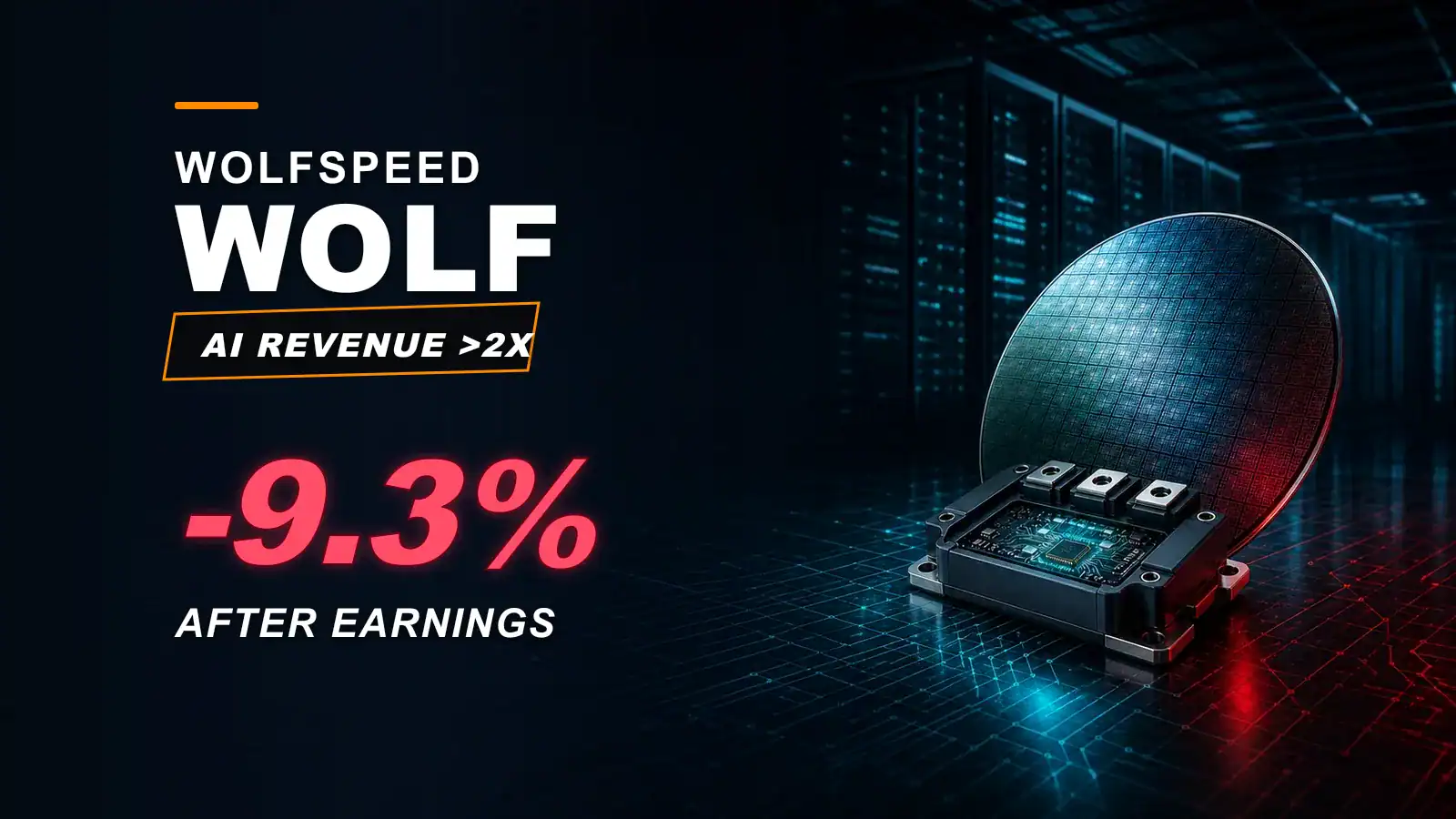
Wolfspeed stock closed at $26.38 on August 20, down 9.32% in the first full trading session after fiscal Q4 2026 earnings. The initial after-hours selloff held almost exactly: WOLF had traded at $26.4254 at 7:59 p.m. ET the previous evening. Approximately 9.73 million shares changed hands, roughly twice the prior 20-session average, while a semiconductor-sector benchmark gained 0.52%.
The completed reaction therefore looks primarily company-specific. Wolfspeed’s AI data-center revenue more than doubled in fiscal 2026, but investors focused on a 24.1% decline in total revenue, negative 25% GAAP gross margin, persistent factory underutilization, and a next-quarter revenue midpoint that implies almost no sequential growth.
Introduction and immediate market reaction
Wolfspeed released fiscal Q4 and full-year 2026 results after the market closed on August 19. That evening, WOLF fell 9.02% in after-hours trading to $26.4254 by 7:59 p.m. ET. Because extended-hours prices can change quickly, that move was only the market’s initial reaction.
The August 20 regular session confirmed the repricing. WOLF opened around $26.50, briefly traded as high as $28.6641, fell to $24.1401 near midday, and recovered to close at $26.38. The closing price was only about 0.2% below the previous evening’s timestamped after-hours quote.
In other words, the overnight selloff neither reversed nor meaningfully intensified by the closing bell. However, the wide intraday range showed that investors strongly disagreed about how to value Wolfspeed’s AI opportunity against its weak near-term economics. Ultimately, the closing auction preserved the market’s initial discount.
Educational disclaimer
This article is educational, informational research—not financial advice.
We strive to keep data accurate, but unavoidable errors or omissions may occur. Verify important information with primary sources.
How Wolfspeed Stock Traded on August 20
| Full-day reaction metric | Value |
|---|---|
| August 19 regular close | $29.09 |
| August 20 opening price | Approximately $26.50 |
| Session high | $28.6641 |
| Session low | $24.1401 |
| August 20 regular close | $26.38 |
| Close-to-close change | -9.32% |
| Regular-session volume | Approximately 9.73M shares |
| Prior 20-session average volume | Approximately 4.85M shares |
| Volume versus baseline | Approximately 2.0x |
The opening price represented an approximate 8.9% gap below the prior close. At the session high, WOLF had recovered to within about 1.5% of the prior close. At the low, it was down approximately 17.0%. The stock then rebounded about 9.3% from the low before the closing bell.
These calculations show a volatile but ultimately decisive session. Buyers rejected the deepest midday decline, yet they could not restore the stock to its pre-earnings level. The closing loss and elevated volume indicate that the market treated the report as a material reassessment rather than routine daily noise.
Did the After-Hours Selloff Hold?
Yes. WOLF’s first full regular-session close after earnings was almost identical to its late after-hours level from August 19.
| Reaction checkpoint | WOLF price |
|---|---|
| August 19 close before earnings | $29.09 |
| August 19 at 7:59 p.m. ET | $26.4254 |
| August 20 regular-session close | $26.38 |
The difference between the late after-hours quote and the next regular close was less than two-tenths of one percent. That is unusually useful evidence: the immediate reaction captured the eventual closing valuation closely, even though the stock traveled through a much wider range during the day.
Was the Decline Part of a Broader Semiconductor Selloff?
Only partly. Broad U.S. equity benchmarks were modestly lower on August 20, but the semiconductor benchmark moved in the opposite direction.
| Market context | August 20 regular-session move |
|---|---|
| WOLF | -9.32% |
| Semiconductor-sector benchmark | +0.52% |
| Nasdaq-100 benchmark | -0.72% |
| Broad U.S. equity benchmark | -0.82% |
WOLF underperformed the semiconductor benchmark by approximately 9.8 percentage points. That gap makes it difficult to explain the decline as a general chip-stock move. Broader market weakness may have affected risk appetite, but the scale and direction of WOLF’s underperformance point mainly to the earnings report, guidance, and Wolfspeed-specific execution concerns.
What investors expected before earnings
Before the release, investors faced three clear tests. Wolfspeed’s own Q4 outlook placed revenue between $140 million and $160 million, making $150 million the midpoint. One consistent pre-release consensus snapshot also expected $150 million of revenue and a non-GAAP loss of $2.45 per share.
However, the larger expectations were operational. Investors wanted evidence that rapid AI data-center demand could offset weakness in other end markets. They also needed progress toward positive gross margin, lower cash consumption, and better utilization of Wolfspeed’s large manufacturing footprint.
The setup was especially sensitive after the company’s 2025 restructuring. Although that process reduced debt, Wolfspeed still needed to prove that its new capital structure and 200-millimeter production assets could support a durable financial recovery. Therefore, investors were evaluating execution as much as the quarterly headline figures.
Reported versus expected scoreboard
Wolfspeed generated $149.6 million of Q4 revenue, down 24.1% from $197.0 million in the prior-year quarter. Revenue was approximately $0.4 million below one consistent $150 million pre-release expectation and matched management’s guidance midpoint closely. Thus, the top line was effectively in line rather than a material miss.
The company reported a non-GAAP diluted loss of $2.26 per share. That was $0.19 narrower than the consistent $2.45 expected loss. The adjusted result was therefore better than expected, while revenue was essentially in line.
| Metric | Reported | Expected | Surprise | Year-over-year |
|---|---|---|---|---|
| Revenue | $149.6M | $150.0M | -$0.4M / -0.3% | -24.1% |
| Non-GAAP diluted EPS | -$2.26 | -$2.45 | $0.19 better | Not comparable after restructuring |
The scoreboard alone does not explain a 9.3% closing decline. The stronger explanation lies in the quality of revenue, negative manufacturing economics, and limited near-term acceleration in guidance.
Fresh-start accounting after Wolfspeed’s 2025 restructuring also makes simple year-over-year per-share comparisons unreliable. The old shares were cancelled, the capital structure changed, and successor-period financial statements are not directly comparable with the predecessor period. For this reason, the adjusted EPS surprise is more useful than a simple year-over-year EPS comparison.
Revenue segments and AI performance
Management said AI data-center revenue more than doubled during fiscal 2026 and increased approximately 20% sequentially in Q4. Wolfspeed also established a dedicated Silicon Valley data-center solutions team and announced a strategic collaboration with LITEON Technology. The opportunity is credible. Silicon-carbide power devices can improve power conversion, efficiency, and thermal performance in increasingly power-dense AI infrastructure. Wolfspeed’s fifth-generation MOSFET platform and large manufacturing footprint give the company a route to participate if demand expands.
However, Wolfspeed did not disclose AI data-center revenue in dollars. It described the category as a moderate but growing opportunity. Investors therefore cannot yet determine how large the business is, how profitable it is, or how quickly it can offset weaker automotive, industrial, and materials demand.
The fiscal 2026 Form 10-K, filed on August 20, added an important caution. Wolfspeed described AI-related demand as an emerging and rapidly evolving opportunity whose timing and magnitude may change significantly. That language does not invalidate the growth rate, but it reinforces why percentage growth without a disclosed revenue base did not carry the entire investment thesis.
Company-wide revenue still contracted
Both disclosed product groups declined from the prior-year quarter.
| Disclosed revenue | Q4 FY2026 | Q4 FY2025 | Change |
|---|---|---|---|
| Power Products | $106.3M | $118.6M | -10.4% |
| Materials Products | $43.3M | $78.4M | -44.8% |
| Total revenue | $149.6M | $197.0M | -24.1% |
Power Products represented approximately 71% of quarterly revenue, but it still declined by double digits. Materials revenue fell much faster. Consequently, the AI data-center growth rate has not yet translated into company-wide expansion.
This is the central scale problem. A fast-growing end market can be strategically important while remaining too small to offset declines elsewhere. The market’s first full-day reaction suggests investors now want evidence that AI growth is becoming financially material, not merely directionally positive.
Margins, cash flow, and capital spending
Wolfspeed’s GAAP gross margin improved sequentially from negative 27% in Q3 to negative 25% in Q4. Nevertheless, it deteriorated from negative 13% in the prior-year quarter. Non-GAAP gross margin was negative 20%, compared with negative 1% a year earlier.
| Metric | Q4 FY2026 | Q4 FY2025 | Change |
|---|---|---|---|
| GAAP gross margin | -25% | -13% | -12 percentage points |
| Non-GAAP gross margin | -20% | -1% | -19 percentage points |
| Operating cash flow | -$54.1M | -$242.5M | Improved $188.4M |
| Net PP&E spending | $5.0M | $210.1M | Down $205.1M |
| Free cash flow | -$60.9M | -$454.0M | Improved $393.1M |
A negative gross margin means reported product costs exceeded revenue before operating expenses, interest, and other costs. That is more consequential than a modest revenue variance against consensus.
The new 10-K connected the margin pressure directly to underutilization at Wolfspeed’s manufacturing facilities. The company said it expects significant underutilization costs to continue until market demand meets or exceeds production capacity. It specifically discussed the ramp of its Mohawk Valley and Siler City facilities and warned that low utilization raises fixed cost per unit.
This disclosure clarifies the market’s concern. Wolfspeed has substantial 200-millimeter manufacturing capacity, but that capacity creates operating leverage only when demand fills it. Until then, the same asset base can weigh on margins.
Cash consumption improved sharply because operating cash use narrowed and property-and-equipment spending fell. Nevertheless, free cash flow remained negative. Thus, Wolfspeed has reduced the speed of its cash burn without yet demonstrating self-funded growth.
Updated guidance
Management guided Q1 FY2027 revenue to $140 million-$160 million. The $150 million midpoint is only about 0.3% above Q4 revenue of $149.6 million.
| Q1 FY2027 outlook | Low | High | Midpoint or direction |
|---|---|---|---|
| Revenue | $140M | $160M | $150M |
| Non-GAAP gross margin | Not quantified | Not quantified | Expected to remain negative |
| Non-GAAP operating expenses | $62M | $66M | $64M midpoint |
The guide does not signal an immediate consolidated rebound. That matters because AI is the fastest-growing end market identified by management. If rapid AI growth still produces approximately flat total revenue, weakness elsewhere remains a large offset.
Investors also did not receive a timetable for positive gross margin. The combination of flat midpoint revenue and another expected negative-margin quarter limits evidence that factory economics are approaching an inflection. Consequently, the guidance supported patience rather than a near-term turnaround call.
Market expectations
A publicly aggregated analyst snapshot as of August 5, 2026, showed a small four-analyst cohort. Because this source snapshot predates the earnings release and the completed August 20 reaction, investors should expect the figures to change as analysts update their models.
| Analyst rating | Count |
|---|---|
| Buy | 1 |
| Hold | 2 |
| Sell | 1 |
The same cohort’s targets provide a valuation range against WOLF’s completed August 20 regular-session close. These changing third-party estimates are neither Wolfspeed guidance nor dependable stock-price forecasts.
| Price measure | Value |
|---|---|
| Current regular-session close, August 20, 2026 | $26.38 |
| Lowest 12-month target | $20.00 |
| Average 12-month target | $25.00 |
| Highest 12-month target | $30.00 |
The old average target sat slightly below the post-earnings close. However, the cohort is too small and too stale to settle the valuation debate. The direction of post-earnings revisions will matter more than the pre-release average.
Management commentary
Chief Executive Officer Robert Feurle emphasized expansion in the device business, AI data-center growth, and the company’s fifth-generation silicon-carbide MOSFET platform. Wolfspeed also established a dedicated Silicon Valley data-center solutions team. Together, those actions support management’s claim that the company can address rising power requirements in AI infrastructure.
However, the 10-K provided essential context. Wolfspeed characterized AI-related demand as emerging and rapidly evolving, with timing and magnitude that could change significantly. It also expects substantial manufacturing underutilization costs until demand catches up with capacity.
Management’s message is therefore credible but incomplete. The technology and market opportunity are visible; the financial conversion is not. Investors still need dollar-based AI revenue, stronger utilization, and improving gross margin to validate the strategy.
Cash Burn Improved, but the Balance Sheet Still Matters
Wolfspeed made substantial progress reducing cash use. Operating cash flow was negative $54.1 million, compared with negative $242.5 million in the prior-year quarter. Free cash flow improved to negative $60.9 million from negative $454.0 million, helped by sharply lower property-and-equipment spending.
The improvement is meaningful, but free cash flow remained negative. Wolfspeed ended the quarter with approximately $1.09 billion of cash, cash equivalents, and short-term investments. It also reported about $931.0 million of long-term debt and $756.5 million of convertible notes.
The August 20 Form 10-K stated that Wolfspeed was in compliance with its debt covenants at June 28. It also said approximately $64.3 million of principal on certain convertible notes had converted into roughly 5.3 million common shares during the successor period. Conversions reduce debt and future interest obligations but can dilute existing shareholders.
Balance-sheet repair is therefore progressing, not finished. For the post-earnings thesis to strengthen, lower cash burn needs to become durable while revenue and margins improve. In addition, investors must monitor future conversions for their dilution effect.
What improved versus what disappointed
- Improved: AI data-center revenue more than doubled during FY2026 and increased about 20% sequentially in Q4.
- Improved: GAAP gross margin improved by two percentage points from Q3, although it remained deeply negative.
- Improved: Free-cash-flow use narrowed to $60.9 million from $454.0 million in the prior-year quarter.
- Disappointed: Total revenue fell 24.1%, including declines in both disclosed product groups.
- Disappointed: GAAP and non-GAAP gross margins remained negative 25% and negative 20%, respectively.
- Disappointed: Q1 FY2027 revenue guidance has a $150 million midpoint, almost flat with Q4.
Why the stock moved
AIStocksHub’s interpretation is that five factors best explain the completed 9.3% decline:
- Revenue did not accelerate. The reported figure essentially matched expectations and management’s midpoint rather than demonstrating a recovery.
- Total revenue fell 24.1%. Rapid AI growth did not offset declines in the broader portfolio.
- Gross margin remained deeply negative. Underutilized factories continue to make the current revenue base economically inefficient.
- Guidance was approximately flat. The next-quarter midpoint offered little evidence of a near-term demand inflection.
- The AI revenue base remains undisclosed. Investors received a strong growth percentage without the dollar context needed to judge materiality.
The stock’s performance against a rising semiconductor benchmark supports this company-specific explanation. The earnings result was not a conventional headline miss; it was a challenge to the speed and economics of the turnaround.
Before-versus-after investment thesis
Before Q4, the bull thesis rested on restructuring, large-scale 200-millimeter manufacturing capacity, lower future capital spending, and exposure to growing AI power requirements. If revenue recovered, that manufacturing base could create significant operating leverage. In that scenario, fixed costs would spread across more production.
After Q4 and the first full trading session, the AI component of the thesis looks stronger, but the consolidated financial thesis remains unproven. Wolfspeed demonstrated participation in AI infrastructure, yet total revenue contracted, gross profit stayed negative, and guidance did not show acceleration. Therefore, the report strengthened the market-opportunity case without proving the earnings case.
The key question has changed from “Can Wolfspeed participate in AI data centers?” to “Can AI demand become large enough, quickly enough, to absorb capacity and repair margins?” That second question now defines the investment debate. It also creates a measurable standard for future quarters.
The 9.3% closing decline does not answer that long-term question permanently. It does show that investors assigned less value to percentage AI growth without corresponding progress in consolidated revenue and gross margin. Ultimately, future results can change that judgment if the operating evidence improves.
Post-earnings bull case
- AI data-center revenue more than doubled in fiscal 2026 and grew about 20% sequentially in Q4.
- Wolfspeed has a large silicon-carbide manufacturing footprint and new products aimed at high-power applications.
- Free-cash-flow use improved by approximately $393 million from the prior-year quarter.
- The company retained approximately $1.09 billion of cash and investments at quarter-end.
- Filling underutilized capacity could eventually create substantial operating leverage.
Post-earnings bear case
- Total revenue fell 24.1%, including declines in both disclosed product groups.
- GAAP gross margin of negative 25% shows that present manufacturing economics remain weak.
- Management expects significant underutilization costs to persist until demand catches up with capacity.
- Q1 revenue guidance is approximately flat at the midpoint, and adjusted gross margin is expected to remain negative.
- Free cash flow remained negative, debt remains substantial, and convertible-note conversions can dilute shareholders.
What to watch before the next quarter
- Revenue against the $140 million-$160 million Q1 FY2027 range.
- Progress from negative gross margin toward zero and eventually positive territory.
- Dollar-based disclosure for AI data-center revenue, design wins, or customer programs.
- Utilization and yield trends at Mohawk Valley and Siler City.
- Power Products and Materials Products revenue after their Q4 declines.
- Operating cash flow, free cash flow, liquidity, debt reduction, and interest expense.
- Whether WOLF can stabilize after a high-volume earnings repricing.
Final earnings verdict
Wolfspeed’s first full trading session after earnings confirmed the market’s initial skepticism. WOLF closed at $26.38, down 9.32%, after trading through a wide range on approximately twice its recent average volume. The close nearly matched the previous evening’s after-hours level, while the semiconductor benchmark finished higher.
The market did not reject Wolfspeed’s AI opportunity. It rejected the idea that rapid AI growth alone is enough to prove the turnaround. Total revenue is still shrinking, factory underutilization is keeping gross margin negative, and near-term guidance does not show a consolidated inflection.
WOLF therefore remains a high-risk AI infrastructure turnaround rather than a demonstrated profitable AI compounder. The next major proof points are measurable AI revenue, higher factory utilization, positive gross margin, and sustained improvement in cash generation.
Primary Sources
- Wolfspeed Q4 FY2026 earnings release filed with the SEC
- Wolfspeed fiscal 2026 Form 10-K
- Wolfspeed earnings Form 8-K
- Wolfspeed restructuring and Chapter 11 emergence release
- Nasdaq WOLF market-data page
- Nasdaq SOXX market-data page
FAQ
How did Wolfspeed stock perform the day after earnings?
WOLF closed at $26.38 on August 20, 2026, down 9.32% from the prior regular-session close. It traded between $24.1401 and $28.6641 on approximately 9.73 million shares, roughly twice its prior 20-session average volume.
Did the initial after-hours decline hold during regular trading?
Yes. WOLF traded at $26.4254 at 7:59 p.m. ET after the earnings release and closed the next regular session at $26.38. The full-day close was less than 0.2% below that timestamped after-hours price.
Why did WOLF stock fall despite strong AI growth?
AI data-center revenue more than doubled during fiscal 2026, but Wolfspeed did not disclose the dollar base. Meanwhile, total revenue fell 24.1%, GAAP gross margin remained negative 25%, and next-quarter revenue guidance was approximately flat at the midpoint.
Was WOLF’s decline caused by the semiconductor sector?
The evidence suggests the move was predominantly company-specific. WOLF fell 9.32% while a semiconductor-sector benchmark gained 0.52%, an underperformance of approximately 9.8 percentage points.
What is the most important financial metric to watch next?
Gross margin is the clearest near-term test. Wolfspeed needs higher factory utilization and lower unit costs to move from negative gross margin toward a sustainable, profitable manufacturing model.
Is Wolfspeed now a profitable AI company?
No. Wolfspeed has credible and rapidly growing AI data-center exposure, but total revenue is declining, gross margin is negative, and free cash flow remains negative. The AI business has not yet been disclosed at a scale that proves it can change overall company economics.