Sandisk Stock 2026: Why SNDK Fell 6.5% After Its AI Rally
Key Takeaway
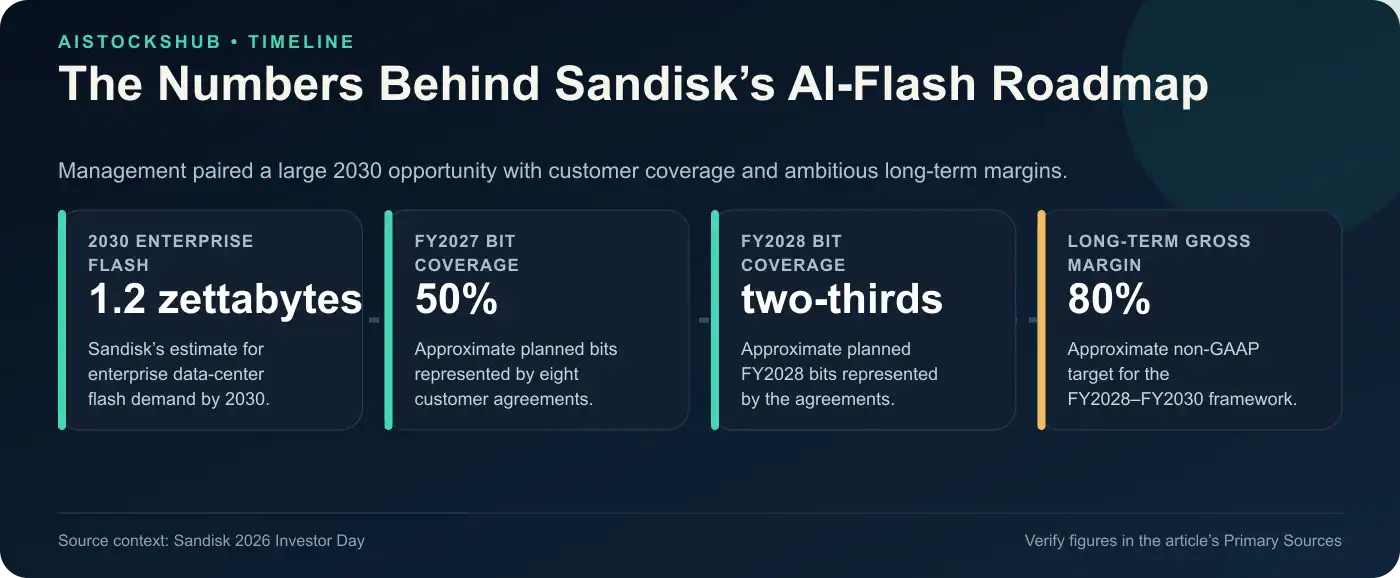
Sandisk’s August 13 Investor Day rally rested on three major claims:
- Enterprise data-center flash demand could reach 1.2 zettabytes by 2030.
- Eight customer agreements covered about 50% of FY2027 bits and two-thirds of FY2028 bits.
- The FY2028–FY2030 model targeted approximately 80% non-GAAP gross margin and 50% adjusted free-cash-flow margin.
However, the latest completed session changed the immediate story. SNDK closed at $1,492.82 on August 24, down 6.47% for the day. That close put the stock 2.3% below its August 13 Investor Day close, meaning the original 13.7% event-day gain had been fully erased.
Introduction and central investment question
Sandisk stock opened August 24 at $1,494.09, fell as low as $1,416.56, and recovered to close at $1,492.82. The final decline was 6.47% from the prior close of $1,596.08. Notably, SNDK ended below the $1,528.11 closing price recorded on Investor Day.
Meanwhile, the selloff coincided with reports that U.S. policy might allow Apple to source memory from Chinese suppliers. Weakness in Samsung Electronics and other memory shares also weighed on sentiment, while the broader technology sector declined. However, neither a policy change nor an Apple sourcing decision was confirmed in the evidence reviewed, so these developments describe market concerns rather than proven lost Sandisk business.
Therefore, the investment question now reaches beyond near-term NAND prices. Investors must decide whether data-center storage, customer contracts, and High Bandwidth Flash can withstand new competitive and policy concerns. If they can, SNDK may deserve more than a cyclical-memory multiple; if they cannot, current profitability may prove unusually difficult to sustain.
Investor disclaimer
This article is educational, informational research—not financial advice.
We strive to keep data accurate, but unavoidable errors or omissions may occur. Verify important information with primary sources.
Company overview
Sandisk Corporation is a vertically integrated semiconductor-memory company listed on Nasdaq under SNDK. Notably, it completed its separation from Western Digital in February 2025. Although the standalone listing is recent, the flash business has more than three decades of operating history.
The company reports revenue across Datacenter, Edge, and Consumer markets. For example, its products include enterprise and client SSDs, embedded flash, removable cards, USB drives, wafers, and components. In addition, Sandisk develops the NAND technology and systems engineering behind those products.
How the company makes money
Sandisk earns revenue by selling NAND-based storage products and components to cloud providers, enterprises, device makers, distributors, and consumers. In particular, product prices, shipment volume, capacity mix, and technology transitions all influence revenue. As a result, small changes in NAND supply and pricing can create large swings in profit.
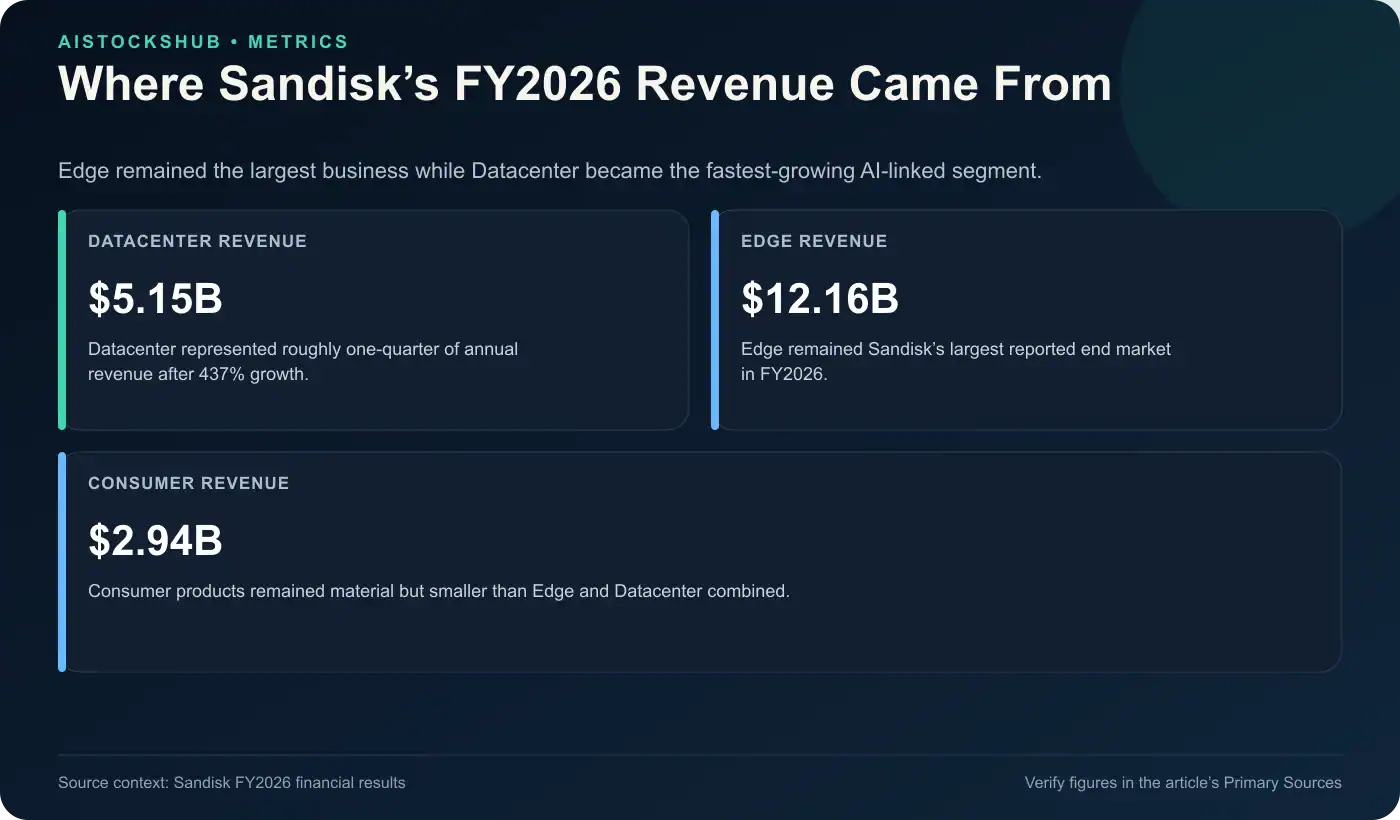
Notably, the mix changed sharply in FY2026. Datacenter revenue rose 437% to $5.15 billion, while Edge produced $12.16 billion and Consumer generated $2.94 billion. Datacenter represented roughly one-quarter of annual revenue, versus about 13% in FY2025.
Why the company matters to AI
Specifically, AI systems need more than processors. They also need storage for training data, model files, retrieval databases, generated content, and inference-related KV cache. Sandisk sells enterprise SSDs and higher-density NAND products for those workloads.
Meanwhile, High Bandwidth Flash, or HBF, adds a more speculative opportunity. HBF aims to place high-capacity NAND-based memory closer to processors for AI inference. It may complement HBM when a system needs much more capacity and persistence, but it has not yet proved large-scale commercial revenue.
This distinction matters because Micron Technology and other memory suppliers have benefited from high-bandwidth memory demand. Sandisk’s proposed advantage comes from NAND capacity and cost economics rather than copying DRAM-based HBM. Consequently, HBF success depends on product qualification, software support, packaging, and customer adoption.
Recent business developments
First, Sandisk reported FY2026 revenue of $20.25 billion, up 175%, and GAAP net income of $11.43 billion. Datacenter revenue increased to $5.15 billion, while pricing and a shift toward higher-value customers supported results. The board also added $14 billion to its repurchase authorization, leaving $15.5 billion available, although authorization does not equal completed buybacks.
Next, Sandisk and SK hynix released an Open Compute Project specification for HBF. Google and Tenstorrent participated in the standards workstream, which strengthens the technology’s ecosystem credentials. Still, a specification does not establish shipment volume, revenue, or profit.
Finally, Sandisk and Kioxia unveiled ninth-generation QLC 3D flash for AI and data-intensive applications. The design combines technologies from different NAND generations to improve performance and manufacturing efficiency. Investor Day then tied these product developments to a longer-term operating model.
Meanwhile, the August 24 market reaction added a separate issue. Specifically, reports about possible Chinese memory sourcing for Apple raised fears of stronger competition and future demand pressure. However, Sandisk did not announce a lost customer, reduced guidance, or a change to its Investor Day framework that day.
Financial performance and revenue trend
By comparison, Sandisk’s three-year history shows how dramatically the current cycle differs from the prior two years. Specifically, FY2024 and FY2025 include carve-out results prepared as though the flash business operated independently before the separation. Additionally, free cash flow below equals operating cash flow minus reported purchases of property, plant, and equipment.
| Fiscal year | Revenue | GAAP net income (loss) | Operating cash flow | Capex / calculated FCF |
|---|---|---|---|---|
| FY2024 | $6.66B | $(0.67)B | $(0.31)B | $0.17B / $(0.48)B |
| FY2025 | $7.36B | $(1.64)B | $0.08B | $0.20B / $(0.12)B |
| FY2026 | $20.25B | $11.43B | $11.67B | $0.18B / $11.49B |
Overall, the FY2026 change was exceptional. Revenue nearly tripled, GAAP gross margin reached 71.5%, and operating cash flow rose above $11.6 billion. However, one powerful year cannot by itself prove that a traditionally cyclical market has become structurally stable.
Growth drivers
The first growth driver is AI data-center storage. Sandisk expects enterprise data-center flash demand to reach 1.2 zettabytes by 2030 as inference and token usage increase. Larger models, retrieval systems, and generated content can expand the amount of data that operators must store and move.
The second driver is product density. Sandisk said BiCS10 QLC improves bit density by 60% compared with BiCS8, while its mixed-generation BiCS9 approach aims to deliver derivatives efficiently. Better density can support capacity growth, cost reductions, and workload-specific products.
The third driver is HBF. An open specification may encourage processor, systems, and software companies to design around a common interface. Nevertheless, the thesis should treat HBF as potential upside until Sandisk reports qualified products, customer deployments, and material revenue.
Customers, contracts, and partnerships
Notably, Sandisk said it had signed New Business Model agreements with eight customers by Investor Day. Those agreements represented about 50% of FY2027 bits and roughly two-thirds of FY2028 bits. Therefore, the company may have better volume and cash-flow visibility than in older NAND cycles.
However, committed volume does not remove every risk. Pricing mechanisms, customer concentration, financial guarantees, demand changes, and contract execution can still affect economics. Investors also lack a complete customer-by-customer view of expected revenue and margins.
In addition, Sandisk’s manufacturing relationship with Kioxia remains strategically important. Meanwhile, the HBF collaboration with SK hynix and participation from other technology companies can broaden adoption. These partnerships improve scale and ecosystem reach, but they also create coordination and dependency risks.
Competitive position
Sandisk competes through NAND design, manufacturing scale, systems knowledge, customer relationships, and a broad product portfolio. Its joint manufacturing model can reduce direct capital intensity compared with owning every fabrication asset alone. In addition, customized NAND derivatives may help it address changing AI workloads faster.
Competition remains intense across NAND, enterprise SSDs, and new memory architectures. Rivals can add supply, improve density, lower prices, or win customer qualifications. Moreover, AI buyers may favor alternative storage tiers or memory technologies if HBF cannot meet performance, software, or cost requirements.
Valuation
At the August 24 regular-session close of $1,492.82, Sandisk traded at about 20.2 times FY2026 GAAP diluted EPS of $73.76. A market capitalization near $218.6 billion equaled roughly 10.8 times FY2026 revenue. These are historical calculations, not estimates of intrinsic value.
The valuation looks very different depending on the cycle assumption. If FY2026 earnings represent a temporary pricing peak, the trailing P/E can understate risk. Conversely, if customer agreements and AI demand sustain high margins, a simple cyclical multiple may understate long-term cash generation.
Investors should also separate authorization from execution. The remaining $15.5 billion repurchase authorization equaled about 7% of the August 24 market capitalization. Still, Sandisk controls the timing and amount, and the authorization does not guarantee purchases or returns.
Market expectations
Source: a publicly aggregated analyst snapshot reviewed through the August 24, 2026 close. Current share price: $1,492.82.
| Rating | Analyst count |
|---|---|
| Buy | 20 |
| Hold | 3 |
| Sell | 1 |
Price targets frame this analyst cohort’s valuation range relative to the displayed share price. However, the unusually wide range also illustrates uncertainty around earnings durability and the NAND cycle.
| Price expectation | Displayed value |
|---|---|
| Current share price | $1,492.82 |
| Lowest price target | $1,000.00 |
| Highest price target | $3,600.00 |
| Consensus/average target | $2,126.17 |
Analyst ratings and price targets are changing third-party estimates. They are not facts reported by Sandisk, guarantees of future value, or investment instructions. Notably, the $2,600 spread between the lowest and highest targets makes the disagreement more useful than the average alone.
Risks
NAND remains cyclical. Supply additions, weaker end demand, inventory corrections, or lower prices could compress margins quickly. Therefore, investors should not assume that FY2026’s 71.5% GAAP gross margin represents a permanent floor.
The FY2028–FY2030 model is also ambitious. Management targets mid-to-high-teens revenue growth, approximately 80% non-GAAP gross margin, approximately 75% non-GAAP operating margin, and about 50% adjusted free-cash-flow margin. These forward-looking non-GAAP goals depend on favorable pricing, disciplined supply, product execution, and customer demand.
HBF brings additional risk because the ecosystem remains early. Technical standards, prototypes, and partnerships can precede commercial adoption by years. Other risks include Kioxia dependence, customer concentration, Chinese memory competition, trade-policy changes, technology-transition problems, currency movements, cybersecurity, and extreme share-price volatility.
Bull case
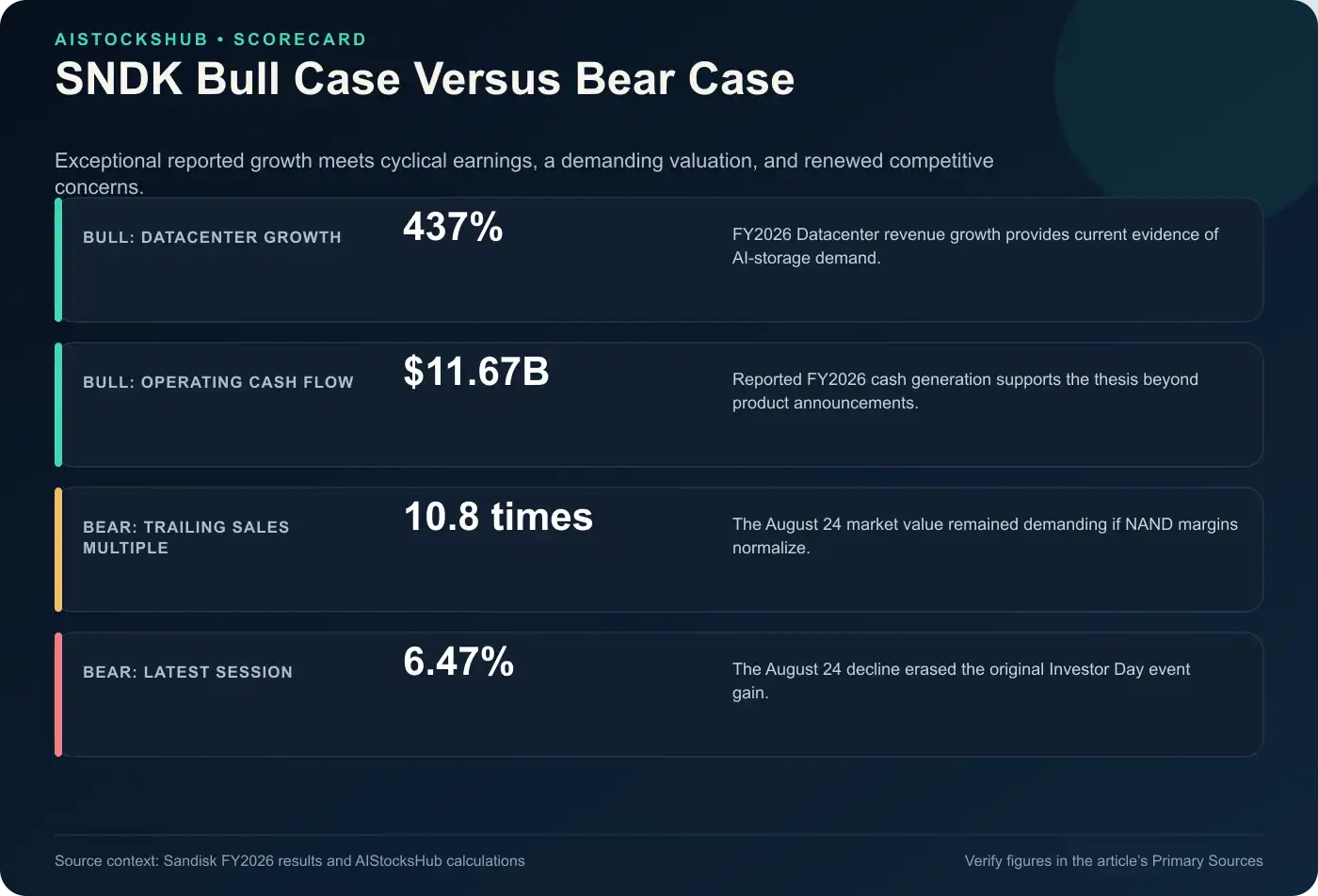
The bull case begins with reported results rather than HBF speculation. FY2026 revenue grew 175%, datacenter revenue grew 437%, and operating cash flow reached $11.67 billion. Those figures show that AI-related storage demand and NAND pricing already affect the business.
Next, the customer agreements may reduce volume uncertainty. Coverage of about half of FY2027 bits and two-thirds of FY2028 bits could support planning and cash-flow visibility. If Sandisk also delivers HBF and higher-density QLC products, AI inference may extend growth beyond the current pricing cycle.
Finally, the long-term framework points to substantial capital returns. Management plans to return excess cash after funding the business. The bullish thesis therefore depends on contract durability, disciplined industry supply, and execution against those targets.
Bear case
The bear case starts with the same financial history. Sandisk lost money in FY2024 and FY2025 before earning $11.43 billion in FY2026. Such a rapid swing may signal exceptional cycle conditions rather than a permanently transformed business.
Furthermore, customer agreements can create obligations as well as visibility. If demand, technology, or pricing changes, fixed commitments may become less attractive. A slowdown in AI capital spending could also reduce enterprise storage demand while competitors add capacity.
Valuation adds another concern. Even after the August 24 pullback, Sandisk carried a market value above $200 billion and traded around 10.8 times trailing sales. If margins normalize sharply, both earnings and the valuation multiple could contract together.
Investment scorecard
| Dimension | Evidence-based assessment | Main watch item |
|---|---|---|
| AI exposure | Strong and growing | Datacenter revenue and enterprise SSD mix |
| Financial momentum | Exceptional | Whether FY2027 sustains pricing and cash flow |
| Demand visibility | Improved but incomplete | NBM economics and customer concentration |
| HBF opportunity | Promising, unproven | Qualification, deployments, and revenue |
| Capital returns | Significant authorization | Actual repurchase pace and price paid |
| Cyclicality | High risk | NAND supply, pricing, and inventory |
| Valuation | Depends on durability | Normalized earnings across a full cycle |
The scorecard supports a high-growth, high-uncertainty classification rather than a simple buy or sell label. Sandisk has strong current evidence and unusually ambitious targets. Yet the stock requires confidence that customer agreements and AI storage can change the duration of the earnings cycle.
Final outlook
Sandisk’s Investor Day rally was understandable. Management combined a large AI-storage demand estimate with customer coverage, product innovation, high margin targets, and capital returns. Few semiconductor-memory stories offer that combination of reported cash generation and potential inference upside.
However, the August 24 close provides a useful warning. SNDK finished 6.47% lower for the day and 2.3% below its Investor Day close. Consequently, the market now appears to be weighing Sandisk’s AI roadmap against competition, trade-policy uncertainty, memory-sector volatility, and valuation risk.
The best conclusion is conditional. Sandisk can become a durable AI-infrastructure compounder if its agreements stabilize economics and its technology expands the addressable market. Until several quarters confirm that change, investors should treat the 2030 model as a measurable roadmap—not a guaranteed destination.
Primary Sources
- Sandisk 2026 Investor Day announcement
- Sandisk FY2026 financial results
- Sandisk FY2026 Form 10-K filing page
- Sandisk and SK hynix HBF specification announcement
- Sandisk and Kioxia ninth-generation QLC announcement
- Sandisk 2026 Investor Day event page
FAQ
Why did Sandisk stock fall 6.5% on August 24, 2026?
The decline coincided with reports about possible Apple sourcing from Chinese memory suppliers, weakness in memory shares, and broader technology pressure. The evidence reviewed did not confirm a final sourcing decision, policy change, or loss of Sandisk business.
Why did Sandisk stock previously jump 13.7% on August 13?
SNDK rose after Investor Day outlined a large AI data-center flash opportunity, customer agreements covering planned bit output, a FY2028–FY2030 financial model, and a plan to return excess cash. The reaction used here is the completed regular-session move.
What is Sandisk’s High Bandwidth Flash technology?
HBF is a NAND-based memory concept designed to combine high capacity with high bandwidth near AI processors. Sandisk positions it for inference workloads, but large-scale commercial revenue remains unproven.
How much did Sandisk earn in FY2026?
Sandisk reported FY2026 revenue of $20.25 billion and GAAP net income of $11.43 billion. It also generated $11.67 billion in operating cash flow.
What are Sandisk’s FY2028–FY2030 targets?
Management targets mid-to-high-teens revenue growth, approximately 80% non-GAAP gross margin, approximately 75% non-GAAP operating margin, and about 50% adjusted free-cash-flow margin. These are forward-looking targets rather than reported results.
What is the biggest risk for SNDK stock?
The central risk is that current NAND pricing and margins reflect a cyclical peak. Other major risks include customer concentration, HBF execution, manufacturing dependencies, competing supply, and share-price volatility.