
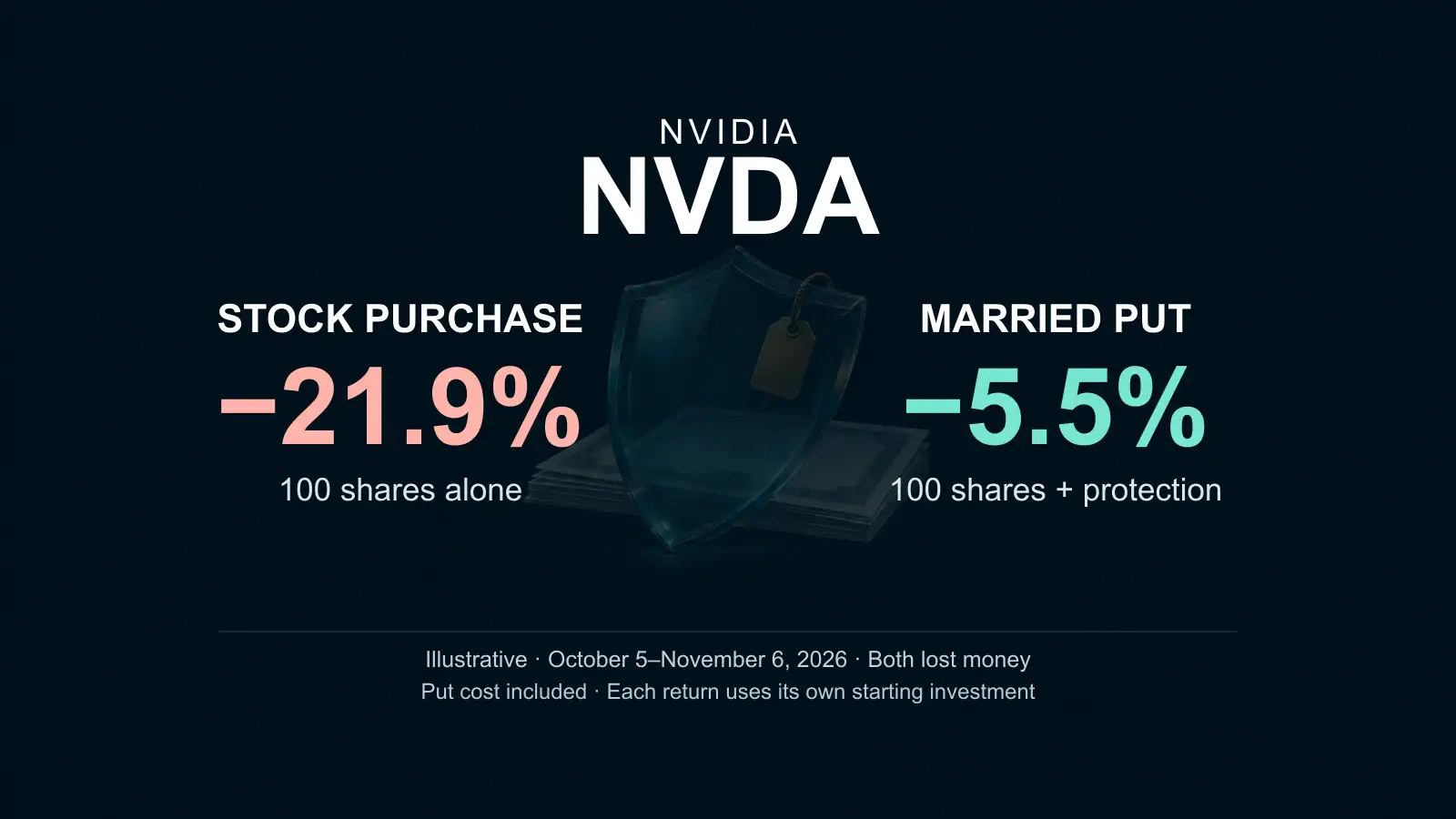
NVDA Married Put: How a $1,613 Hedge Could Cut a $5,226 Loss
We followed 100 NVIDIA shares and nine put options through the October–November 2026 selloff. Here is what the hedge cost, what it saved, and how to choose one without overthinking it.
Prices as of the November 6, 2026 close. A hypothetical example for education, not financial advice.
Provisional illustration: October 5 option entries are assumed historical daily closes, not verified midpoints or actual fills. November 6 option values use saved closing-time quote midpoints. Each return uses its own starting investment; protection required extra capital.
Loss on 100 NVDA shares, October 5 to November 6, 2026
The second figure already includes the $1,613 the put cost.
Key takeaway
From October 5 to November 6, 2026, 100 NVIDIA shares lost $5,226, or 21.9%. The same shares paired with a $240 put option expiring January 15, 2027 lost $1,409, or 5.5%, after paying $1,613 for the put. On November 6 the put was worth $3,817 more than it cost.
The price of that cushion is real: if NVDA had risen, the $1,613 would have come straight out of the gain. In the theoretical expiration calculation, the combined loss is limited to $1,503, before costs, however far the shares fall.
This article is educational, informational research—not financial advice.
We strive to keep data accurate, but unavoidable errors or omissions may occur. Verify important information with primary sources.
- New to options? Read “A married put in 60 seconds” next.
- Already trade options? Jump to “Keep it simple: pick your worst case first.”
The result at a glance
| 100 shares only | Shares plus January 15 $240 put | |
|---|---|---|
| Money put in | $23,890 | $25,503 |
| Value on November 6 | $18,664 | $24,094 |
| Profit or loss | −$5,226 | −$1,409 |
| Return | −21.9% | −5.5% |
Each return is measured against the money that position needed, so dollars are the cleaner comparison. Both positions lost money. A married put softens a fall; it doesn’t prevent one.
This is one selected historical window, not evidence that the same hedge will work equally well at another time. See risks and limits.
A married put in 60 seconds
What a put option is
A put option is a contract that gives you the right, not the obligation, to sell 100 shares at a fixed price any time before it expires. You pay for that right up front. Think of it as insurance on your shares: you pay a premium, and if the price falls below the fixed price, the contract makes up the difference.
A married put is simply owning the shares and buying that put together, at the same time.
The three terms to know
- Strike: the fixed price you can sell at. Here, $240.
- Premium: what the put costs. Here, $16.13 per share, which is $1,613 for one contract, because a contract covers 100 shares.
- Expiration: when the right ends. Here, January 15, 2027.
Why the put gained value
On November 6, NVDA closed at $186.64. A contract that lets you sell at $240 is worth at least $53.36 per share ($240 − $186.64), and its saved quote midpoint was $54.30, the midpoint of a $53.85 bid and a $54.75 ask. The extra $0.94 is time value, because the contract still had more than two months to run. Per contract, that’s $5,430 against the $1,613 paid.
How −21.9% became −5.5%
| Paid | Worth on Nov 6 | Profit or loss | |
|---|---|---|---|
| 100 shares | $23,890 | $18,664 | −$5,226 |
| 1 put contract | $1,613 | $5,430 | +$3,817 |
| Combined | $25,503 | $24,094 | −$1,409 |
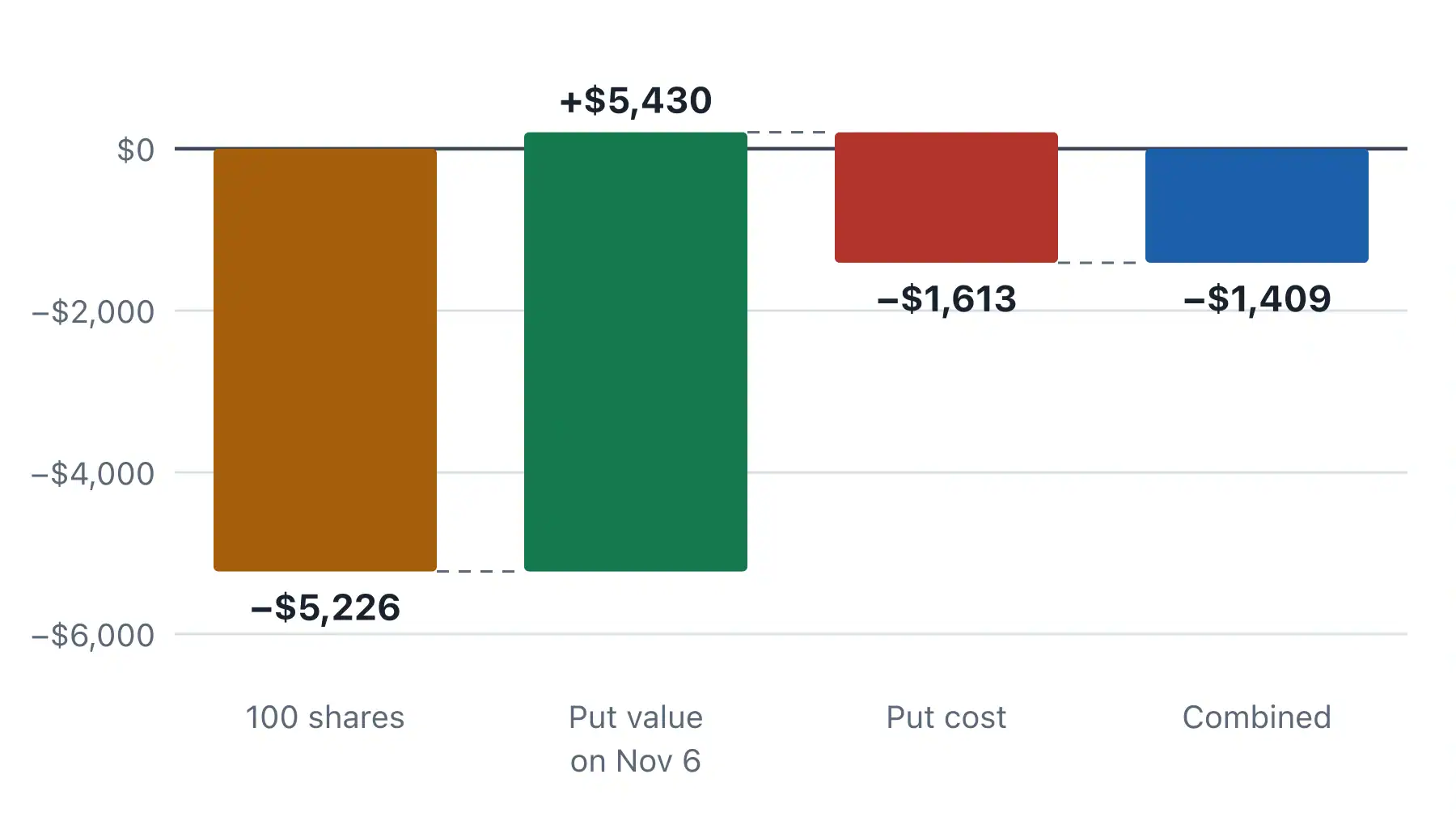
Those put values use the midpoint of the bid and ask. Valued at the bid, a more conservative sale-value illustration, the combined result is −$1,454, or −5.7%.
The floor: your worst case is set on day one
At expiration, below the strike, every dollar the shares lose is offset by another dollar of put payoff. The combined expiration result therefore stays the same below $240. Before expiration, the quote also includes time value and can fluctuate. You can calculate the theoretical expiration limit before you buy:
For the January $240 put: ($240 − $238.90 − $16.13) × 100 = −$1,503, which is −5.9% of the $25,503 invested.
That’s why the January position shows −5.9% whether NVDA ends 10% lower, flat, or 50% lower. On November 6 it stood at −$1,409, slightly better than the −$1,503 floor, because the put still had $0.94 per share of time value left.
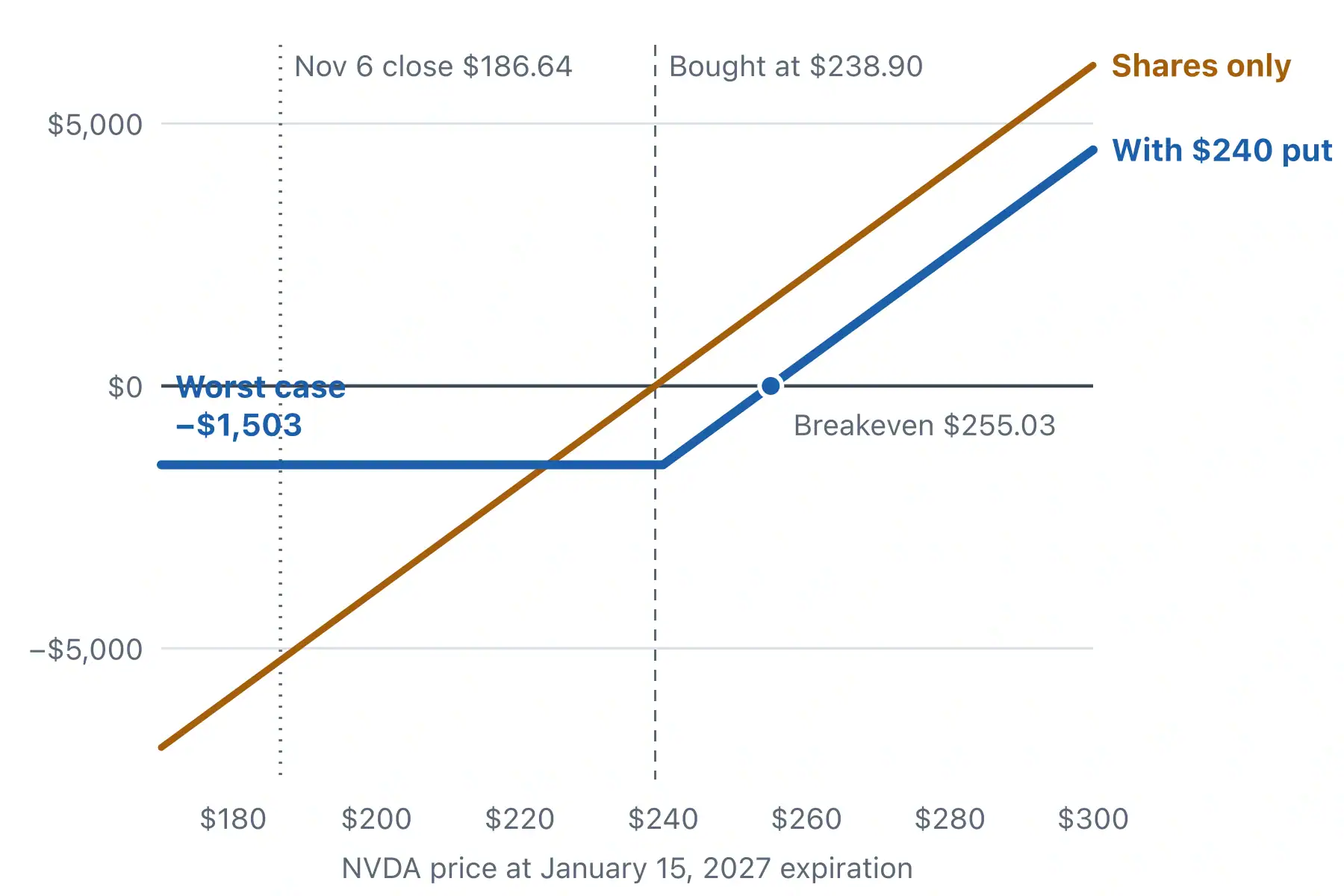
Two limits apply. The floor holds only until the put expires, and it assumes you hold the put to expiration or can sell it for its intrinsic value. On the other side, to come out ahead at expiration NVDA needs to finish above $255.03: the $238.90 you paid plus the $16.13 premium, a rise of 6.8%.
What it costs when NVDA rises or stays flat
Protection isn’t free. When the shares finish above the strike, the put expires worthless, and your profit is the shares’ profit minus the premium. A 20% rise made $4,778 on the shares alone, but $3,165 with the January put. The difference, $1,613, is the premium. The upside isn’t capped; it’s just smaller by the cost of the hedge.
And if nothing happens, you still pay. With NVDA flat, the January position loses $1,503 (−5.9%) while the shares break even.
| NVDA at expiration | Shares only | Jan 15 put | Apr 16 put | Sep 17 put |
|---|---|---|---|---|
| Down 10% ($215.01) | −10.0% | −5.9% | −8.2% | −10.4% |
| Flat ($238.90) | 0.0% | −5.9% | −8.2% | −10.4% |
| Up 10% ($262.79) | +10.0% | +3.0% | +0.5% | −1.9% |
| Up 20% ($286.68) | +20.0% | +12.4% | +9.7% | +7.1% |
Keep it simple: pick your worst case first
If you already run options strategies, the whole decision fits in one sentence: you are choosing a worst case and paying for it. Here is the order that keeps it simple.
- Decide the loss you can live with, as a percentage of the money you’re putting to work.
- Pick the strike that gets you there. Use the formula above. A higher strike means a smaller worst case and a higher premium.
- Check the breakeven (share price plus premium). If NVDA has to rise 13% just to break even, that is the real price of a tight floor.
- Choose the expiration by how long you want coverage. More time costs more.
- Size it: one contract per 100 shares. Buy fewer to hedge only part of a position.
Here are the three January strikes next to shares alone. A put is out of the money when its strike is below the share price, at the money when it’s near it, and in the money when it’s above.
| Strike | Put cost | Worst case | Breakeven price | If NVDA +20% | Nov 6 result |
|---|---|---|---|---|---|
| $215 (out of the money) | $695 | −$3,085 (−12.5%) | $245.85 (+2.9%) | +16.6% | −10.7% |
| $240 (at the money) | $1,613 | −$1,503 (−5.9%) | $255.03 (+6.8%) | +12.4% | −5.5% |
| $265 (in the money) | $3,140 | −$530 (−2.0%) | $270.30 (+13.1%) | +6.1% | −1.9% |
| Shares only | none | −$23,890 (−100%) | $238.90 | +20.0% | −21.9% |
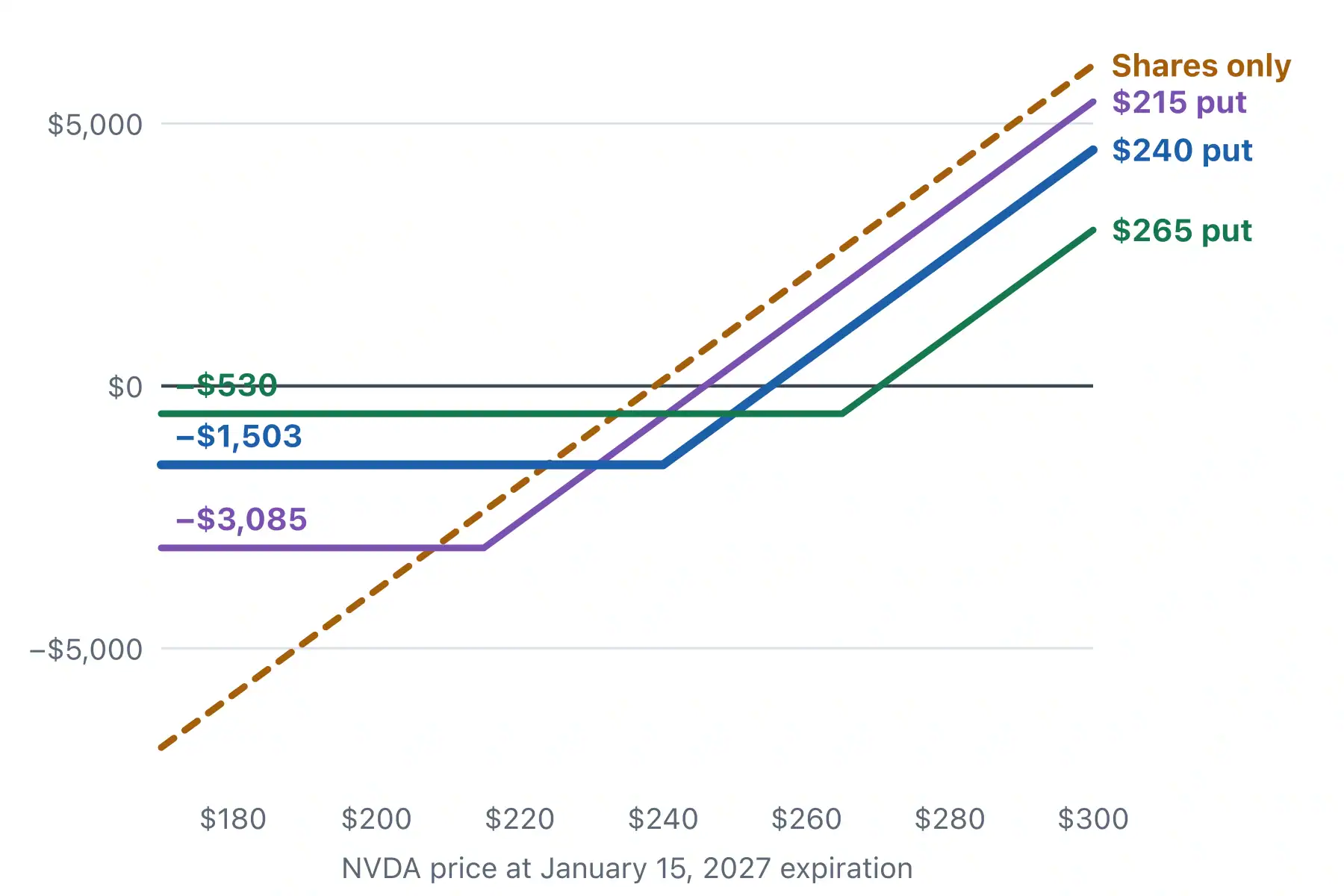
Look at what the $265 put does. You pay $31.40 per share for the right to sell at $265, only $26.10 above your $238.90 purchase price. The right costs more than that gap, so the floor sits below zero, at −$530. In exchange, NVDA could fall 10%, stay flat, or rise 10% (to $262.79) and the January result would be the same −2.0%. It only makes money above $270.30.
The $215 put goes the other way. It costs $695, breaks even after a 2.9% rise, and keeps most of the upside, but the loss can reach −$3,085. It works like insurance with a big deductible.
Expiration follows the same logic. For the same $240 strike, the worst case grows from −5.9% in January to −8.2% in April and −10.4% in September. The extra money buys time, not a better outcome.
Questions to ask before you buy one
- Would I really hold through a drop like this, or would I sell anyway?
- Is the premium (6.8% of the share price for 102 days of coverage here) small next to the loss I’m worried about?
- Am I comfortable giving that premium up if nothing bad happens?
Married put vs. the alternatives
A stop-loss order
A stop-loss costs nothing up front, but it isn’t a guarantee. If a stock gaps down overnight, the order can fill well below your stop price, and once it sells you have no exposure left if the stock rebounds. A put fixes the selling price in advance and lets you keep the shares.
A collar
A collar adds a second trade: you sell a call option and use that income to offset the put’s cost. It can make the hedge cheap or even free, but it caps your gains above the call’s strike. A married put leaves the upside open, and you pay for that openness.
Selling the shares
Selling removes the risk and any further gain, and it can trigger a tax bill. A married put keeps you invested at a known cost.
Risks and limits
- One window, chosen in hindsight. This case study uses a selected October 5–November 6 window in which the shares fell sharply. That is the kind of window that makes a hedge look good. Bought at another time, the same put could have expired worthless and simply cost money.
- The cost repeats. Hedging again every few months means paying premiums again. The January put cost 6.8% of the share price for 102 days of coverage.
- A put’s price depends on more than the share price. Time left and the volatility the market expects both matter, and time value erodes as expiration nears.
- Protection ends at expiration. After January 15, the January put protects nothing.
- Real trades differ from this example. See how we calculated this.
All nine puts compared
Show the full comparison
| Expiration | Strike | Put cost | Worst case | Breakeven price | Nov 6 result |
|---|---|---|---|---|---|
| Jan 15, 2027 | $215 | $695 | −$3,085 (−12.5%) | $245.85 (+2.9%) | −10.7% |
| Jan 15, 2027 | $240 | $1,613 | −$1,503 (−5.9%) | $255.03 (+6.8%) | −5.5% |
| Jan 15, 2027 | $265 | $3,140 | −$530 (−2.0%) | $270.30 (+13.1%) | −1.9% |
| Apr 16, 2027 | $215 | $1,255 | −$3,645 (−14.5%) | $251.45 (+5.3%) | −10.8% |
| Apr 16, 2027 | $240 | $2,253 | −$2,143 (−8.2%) | $261.43 (+9.4%) | −6.8% |
| Apr 16, 2027 | $265 | $3,723 | −$1,113 (−4.0%) | $276.13 (+15.6%) | −3.7% |
| Sep 17, 2027 | $215 | $1,940 | −$4,330 (−16.8%) | $258.30 (+8.1%) | −11.1% |
| Sep 17, 2027 | $240 | $2,888 | −$2,778 (−10.4%) | $267.78 (+12.1%) | −7.6% |
| Sep 17, 2027 | $265 | $4,300 | −$1,690 (−6.0%) | $281.90 (+18.0%) | −4.9% |
How we calculated this
This is a hypothetical purchase of 100 NVDA shares and one put contract on October 5, 2026, valued on November 6, 2026. It isn’t a record of real trades.
- Shares: bought at the October 5 close of $238.90 and valued at the November 6 regular-session daily-bar close of $186.64, independently cross-checked. The retrieved official-close field still referred to November 5.
- Put purchase price: the assumed Robinhood historical daily close on October 5, not a verified midpoint or actual fill. Entry bid and ask were unavailable, so the executable purchase price is unknown. Each extra $1 per share paid for the January $240 put would make its result about 0.4 percentage points worse, roughly −5.9% instead of −5.5%.
- Put value on November 6: the midpoint of the bid and ask at approximately 3:59:59 PM ET. For the January $240 put that was $54.30, from a $53.85 bid and a $54.75 ask. At the bid, the result is −$1,454 (−5.7%).
- Returns: profit or loss divided by the money each position needed: $23,890 for shares alone, $25,503 for shares plus the January $240 put.
- Expiration scenarios: each put is valued at expiration as its strike minus the share price, or zero, with no time value left, and measured from the October 5 purchase.
- Left out: commissions, slippage, taxes, dividends, and interest. The November 6 comparison marks the positions without assuming execution. Expiration scenarios use theoretical intrinsic payoff, not November 6 market value; realizing that payoff requires selling or exercising the contract as applicable.
- Data: Robinhood historical prices for the shares and puts, with the October 5 and November 6 share closes cross-checked against a second source.
Primary Sources
- Options Industry Council: Protective Put (Married Put)
- SEC: Introduction to Options
- OCC: Characteristics and Risks of Standardized Options
Frequently asked questions
What is a married put?
A married put means buying shares and a put option on the same day. The put gives you the right to sell the shares at a fixed price, the strike, until it expires, which puts a floor under your loss. It’s the same position as a protective put; the “married” label just signals that both were bought together.
How much does a married put cost?
In this example, one put contract covering 100 NVDA shares cost $1,613 for a January 15, 2027 put with a $240 strike, $2,253 for April 16, and $2,888 for September 17. That’s 6.8%, 9.4%, and 12.1% of the $238.90 share price. The price depends on the strike, the time to expiration, and how much volatility the market expects.
Does a married put cap my profit?
No. If the shares rise above the strike, the put expires worthless and you keep the share gain minus the premium you paid. In the example, a 20% rise produced a $4,778 share gain, or $3,165 after the $1,613 premium, and there is no upper limit.
Does a married put protect against every loss?
No. It limits the loss; it doesn’t remove it. The January $240 position still lost $1,409 on November 6, and its worst case if held to expiration is $1,503 including the premium. The protection also ends when the put expires.
Can I sell the put before it expires?
Yes, if there is a buyer. Its price before expiration depends on the share price, the time left, and volatility. The November 6 values in this article use the midpoint between the bid and ask, and an actual sale may differ from that midpoint; the bid is a more conservative illustration.
This article is educational and is not financial advice. Options involve risk and aren’t suitable for every investor. The figures come from a hypothetical, historical example, and past results don’t predict future ones. Verify important details with primary sources before making decisions.