7 Under-the-Radar AI Infrastructure Stocks Wall Street Isn’t Talking About Yet
NVIDIA has become the face of the AI trade. But behind every H200 and Blackwell GPU sits a supply chain most investors have never heard of — companies quietly assembling the servers, cooling the chips, wiring the racks, and pulling the megawatts from the grid.
These are the "picks and shovels" of the AI boom. And in 2026, with hyperscaler capex on track to top $500 billion, they may offer a better risk/reward setup than the mega-caps everyone already owns.
Here are seven under-the-radar AI infrastructure stocks worth knowing before Wall Street catches up.
TL;DR: The AI trade has moved past chips. The real bottleneck is now power, cooling, and networking. These 7 mid-caps sit right at that choke point — and most still trade below Wall Street's average price targets.
Why "Boring" AI Infrastructure Is the Smarter Bet in 2026
For the last three years, the AI narrative has been a single-stock story: NVIDIA. But under the surface, the bottleneck has moved.
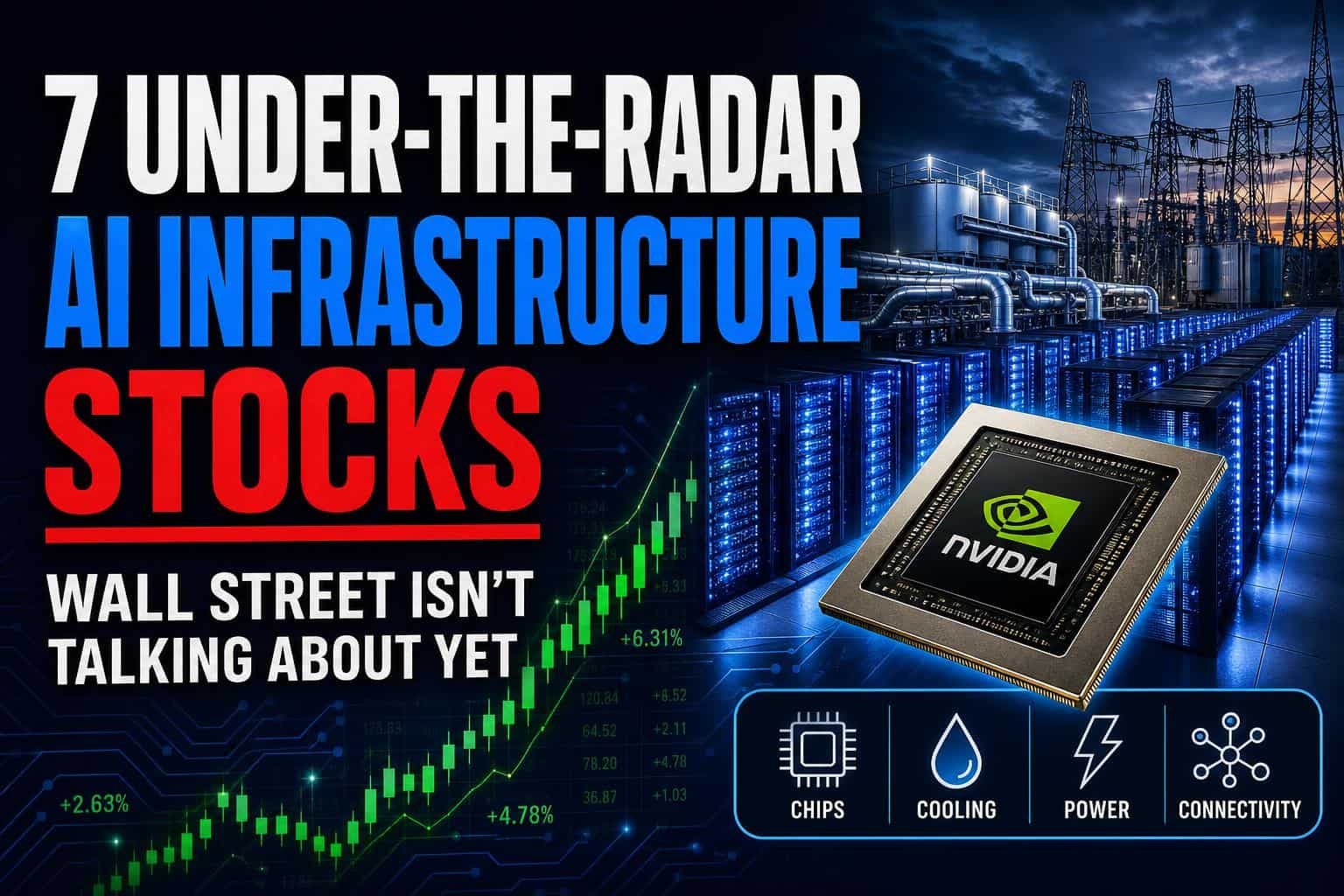
Building an AI data center in 2026 requires four things:
- Compute — GPUs and custom silicon (owned by NVDA, AMD, AVGO)
- Networking — the wiring that connects thousands of GPUs into one cluster
- Power — substations, transformers, backup generators
- Cooling — because a single AI rack now draws 100+ kW of heat
Everyone owns #1. Almost nobody owns #2, #3, and #4 — and that's where the next leg of the AI trade is quietly playing out.

Hyperscalers can't build fast enough. Microsoft, Meta, Google, Amazon, and Oracle collectively guided to ~$500B in AI-related capex in 2026 — up from roughly $220B in 2024. That money doesn't just go to NVIDIA. It fans out to dozens of specialized vendors who suddenly find themselves capacity-constrained for the first time in a decade.
That's the setup. Now here are the seven names.
The 7 Stocks
1. Vertiv Holdings (NYSE: VRT) — The Cooling & Power King
What they do: Vertiv designs the power and thermal management systems that keep hyperscale data centers running. Their liquid cooling units — the CoolChip and Liebert lines — are among the few certified to handle NVIDIA's GB200 NVL72 racks.
Why it's an AI play: When a single rack burns 100–130 kW, air cooling physically stops working. Liquid cooling isn't optional anymore — it's the only path forward. Vertiv is the market leader.
Recent momentum: Backlog crossed $8B, and management has repeatedly raised guidance. Organic growth is running well above 25% YoY.
Key risk: Valuation is no longer cheap. If hyperscaler capex ever hiccups, VRT trades like a high-beta name.
Bull case in one line: The pure-play beneficiary of the shift from air to liquid cooling.
2. Celestica (NYSE: CLS) — The Quiet AI Server Beast
What they do: Celestica is a contract manufacturer that assembles custom AI servers and networking switches for hyperscalers — often designed to the customer's exact spec.
Why it's an AI play: Their CCS (Connectivity & Cloud Solutions) segment is now dominated by hyperscale AI wins. Two of the top three US cloud providers are believed to be anchor customers.
Recent momentum: Stock is up multi-fold over the past 24 months but still trades at a lower multiple than most named AI plays. Management keeps raising guidance every quarter.
Key risk: Customer concentration — a large chunk of revenue comes from a handful of hyperscalers.
Bull case in one line: The lowest-multiple way to own the AI server buildout.
3. Astera Labs (NASDAQ: ALAB) — The GPU-to-GPU Plumbing

What they do: Astera makes connectivity chips — retimers, smart cable modules, and fabric switches — that move data between GPUs, CPUs, and memory at very high speed.
Why it's an AI play: A modern AI cluster is only as fast as its slowest link. Astera's Aries and Taurus product lines sit right in that plumbing layer, and they're designed into most next-gen NVIDIA and AMD reference architectures.
Recent momentum: Revenue is growing at triple-digit percentages, and gross margins are running above 75% — semiconductor economics with software-like margins.
Key risk: Small-cap volatility, and NVIDIA could always vertically integrate more of this stack.
Bull case in one line: Every AI rack ships with more Astera silicon than the year before.
4. Credo Technology (NASDAQ: CRDO) — Active Electrical Cables for AI
What they do: Credo makes Active Electrical Cables (AECs) — a cheaper, lower-power alternative to optical cables for the short-to-medium links inside AI clusters.
Why it's an AI play: As GPU clusters scale to 100,000+ chips, cabling becomes a real cost and power line item. Credo's AECs are being adopted by multiple hyperscalers as the standard for top-of-rack connections.
Recent momentum: Guidance has been raised in consecutive quarters. Customer concentration is moving from one hyperscaler to several, which the market has rewarded.
Key risk: Fierce competition from Marvell and Broadcom in the same category.
Bull case in one line: The best pure-play on AI networking cabling.
5. Comfort Systems USA (NYSE: FIX) — The Mechanical Contractor for Data Center Builds
What they do: Comfort Systems is a mechanical, electrical, and HVAC contractor. Sounds boring — until you realize they physically build the guts of new data centers.
Why it's an AI play: Their "Technology" vertical (data centers, chip fabs, biotech clean rooms) has ballooned to more than 35% of revenue. Backlog just hit a record above $8B.
Recent momentum: Free cash flow is exploding, and the company has been quietly compounding at 30%+ EPS growth for two years while flying under Wall Street's radar.
Key risk: Cyclical construction business — a hyperscaler pause would be felt immediately.
Bull case in one line: Every new AI data center in the US needs a contractor like FIX to bend the pipe.
6. Powell Industries (NASDAQ: POWL) — The Grid Behind the Boom

What they do: Powell makes custom-engineered electrical equipment — switchgear, control rooms, and substation packages — for utilities and industrial customers.
Why it's an AI play: Data centers are pulling so much power that utilities are running out of substation capacity. Powell builds those substations. It's a genuine grid-bottleneck story.
Recent momentum: Backlog has more than doubled in two years, and management has said data center demand is a top-three growth driver.
Key risk: Lumpy order flow. A quarter without a big project win can spook the stock.
Bull case in one line: You can't have AI compute without the substation to power it.
7. nVent Electric (NYSE: NVT) — Enclosures, Cooling, and Connections
What they do: nVent makes electrical enclosures, thermal management systems, and connection products. They also own Schroff and Hoffman — brands that ship inside a huge share of enterprise and hyperscale racks.
Why it's an AI play: Their liquid cooling and busway products go straight into AI data center builds. Management now openly calls data centers their fastest-growing end market.
Recent momentum: After divesting the slower thermal-management business, nVent is now a cleaner, more focused electrical-infrastructure story. Growth is accelerating.
Key risk: Broader industrial exposure means the stock doesn't trade purely on AI headlines.
Bull case in one line: A more defensive, dividend-paying way to own the same theme.
How to Think About Position Sizing These Names
A few honest notes before you start clicking Buy:
- These are volatile. Most of the names above are mid-caps. On a NVDA earnings miss or a "hyperscaler capex pause" headline, they can drop 15–25% in a week.
- A basket beats a single pick. Because each name has different exposure (cooling vs. power vs. networking vs. build-out), owning 3–5 tends to smooth the ride and preserve the theme.
- They're highly correlated to NVDA. Don't kid yourself — if NVIDIA guides down, this whole group re-rates. Size accordingly.
- The alpha is timing entry. These stocks tend to sell off harder than NVDA on bad news but recover almost as fast. Pullbacks have historically been the friend.
The Bottom Line
The obvious AI trade — NVIDIA, Microsoft, Meta — is well understood. The less obvious trade is the infrastructure that makes it all possible: the cooling loops, the substations, the AECs, the switchgear.
If we had to start with two names today, they'd be Vertiv (VRT) for the pure cooling thesis and Celestica (CLS) for the cheapest exposure to the actual server build. Powell (POWL) is a strong number-three for anyone who wants the grid angle.
Wall Street will eventually catch up to all of these. The question is whether you own them before, or after, that happens.
Frequently Asked Questions
Are under-the-radar AI stocks safer than NVIDIA?
No — they're generally more volatile than NVIDIA on a daily basis, because they're smaller and less liquid. What they offer is a different risk profile: less dependence on GPU pricing power and more on total data center buildout volume.
What's the difference between AI hardware and AI infrastructure stocks?
"AI hardware" usually means the chips themselves (NVDA, AMD, AVGO). "AI infrastructure" means everything else needed to deploy those chips at scale — servers, cooling, networking, power, and physical construction.
Which AI ETFs hold these names?
Several of the stocks above appear in broader tech and infrastructure ETFs such as SMH, XLK, and thematic AI/data-center funds like AIQ, GRID, and DTCR. Weightings vary, so always check the fund's top holdings before assuming exposure.
Is it too late to buy AI infrastructure stocks?
The multi-year buildout is expected to run at least through 2027–2028. Individual stocks are always at risk of pullbacks, but the underlying capex cycle is not close to being complete.