XYZ (Block) Unusual Options Alert: A $2.56M Call Write Bets Against a Post-Earnings Rally
Disclaimer: This is not financial advice. Everything below is a read of publicly reported options flow for educational purposes only. Options trading — especially selling calls — can lose more than you put in. Do your own research before acting on any of it.
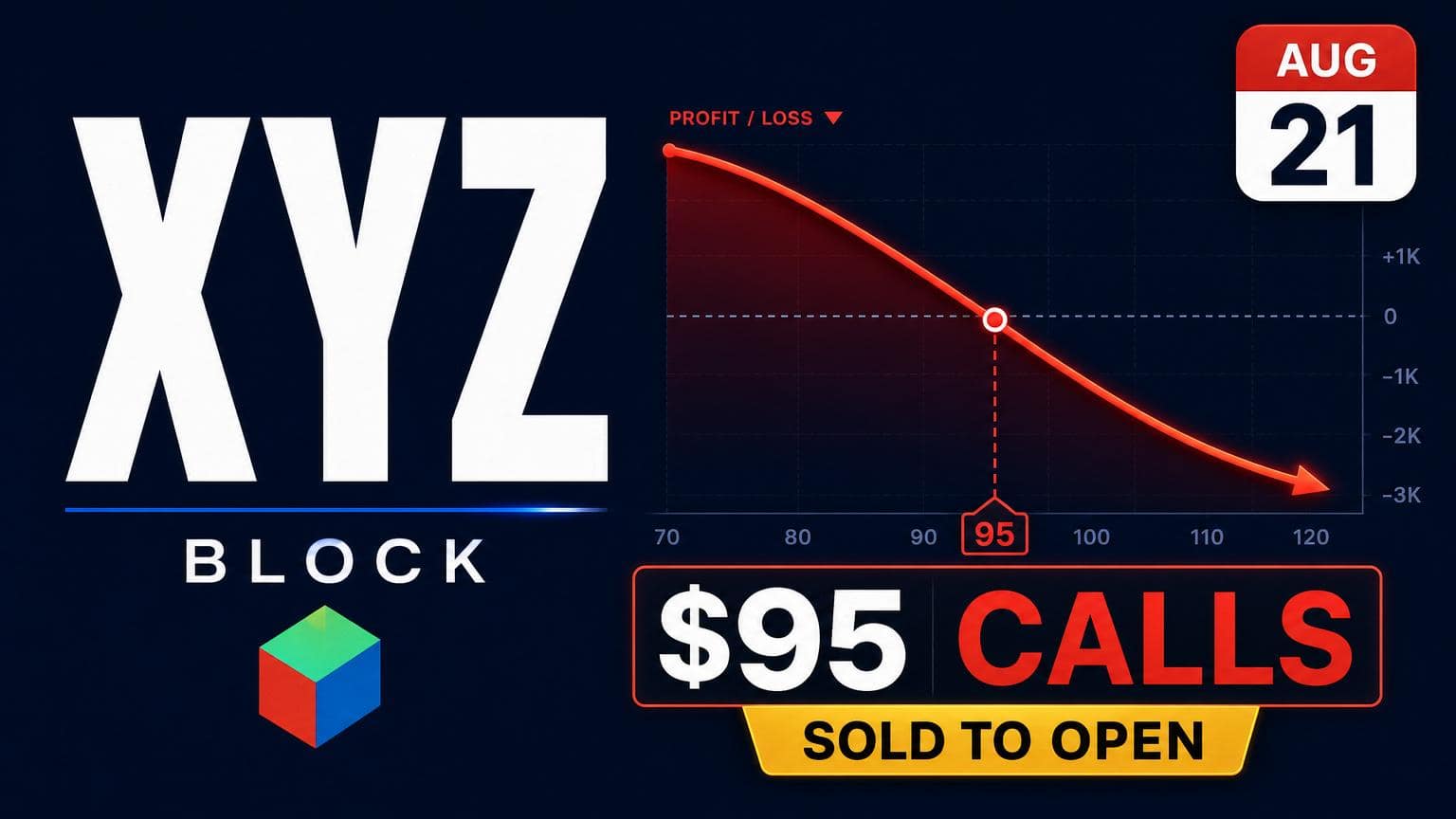
On July 15, 2026, the loudest print on the Block (NYSE: XYZ) options tape wasn’t a bullish sweep — it was a sale. A single 14,000-contract block of August 21, 2026 $95 calls hit the bid at $1.83, marked SLFT / SellToOpen. That’s roughly $2.56 million in premium collected in one trade, against just 353 contracts of prior open interest at the strike.
By the close, cumulative volume on the Aug 21 $95 call reached 16,845 contracts — a ~48x volume-to-OI ratio at that single strike. Nearly every large print on the ticker came in on the bid or at the mid, and the SLFT tag on the headline trade is the tape’s way of saying the seller was the one initiating the flow.
A trader sold ~14,000 XYZ Aug 21 $95 calls at $1.83 to open — collecting $2.56M in premium. That’s a bet the stock stays under $95 through the August 5 earnings report… OR it’s a covered call: a long-stock holder selling upside for income. From the tape alone, we can’t tell which.
What the Options Print Actually Shows
Here are the most unusual XYZ contracts from the July 15 session, ranked by premium:
- Aug 21 2026 $95 Call — 14,000 contracts · OI 353 · Vol/OI ~46x · Premium $2.56M · SellToOpen at bid (SLFT) · Delta 0.23 · IV 56.4%
- Aug 21 2026 $95 Call — 935 contract follow-on at bid · Premium $171K
- Aug 21 2026 $95 Call — 700 contracts at bid · Premium $136K
Total XYZ options premium in the alert set was roughly $3.4M, and about 75% of it sat in a single upside strike being sold.
Reading the Structure
At a $1.83 credit, the seller keeps the full premium if XYZ closes at or below $95 on August 21. Break-even sits at $96.83 — roughly 18.6% above the $81.65 spot price. Above that, losses are theoretically uncapped on a naked write; on a covered basis (calls sold against long stock), the trade simply caps upside at $96.83 and monetizes the elevated IV.
The 56% implied volatility on the strike is rich — a direct reflection of the August 5 earnings event embedded in the contract’s life. Whoever sold these calls is selling into that elevated event vol.
The Binary Event: Q2 2026 Earnings on August 5
The single most important context for this trade is the calendar. Block confirmed on July 2 that it will report Q2 2026 results after the close on August 5, 2026 — exactly 16 days before this $95 call expires. That earnings print is the binary event the entire options chain is pricing around.
The August 21 expiry was almost certainly chosen because it is the first monthly expiration that fully captures the earnings move. Selling upside calls with rich earnings IV, then letting that vol collapse the morning after the report, is one of the oldest institutional plays in the book.
The News Backdrop
XYZ has been on a run. The stock is up roughly 27% year-to-date and about 13% in the last 30 days. Mizuho reaffirmed its Outperform rating and $100 price target on July 9, citing Cash App engagement trends. Block also disclosed that Cash App Borrow originated more than $27 billion in the trailing year across 15 million active accounts — headlines that reinforce the bull case going into the print.
What This Flow Is NOT
A few things this trade is clearly not — so we can throw them out and focus on what it might actually be:
- NOT a whale buying upside. It printed on the bid with a SellToOpen tag. The initiator was the seller, not a buyer.
- NOT a screaming bearish bet. A short call caps profit at the premium collected ($2.56M). A real bearish whale would buy puts, where the payoff is uncapped.
- NOT part of a call spread. There was no matching call buy in size at a higher strike ($100 / $110 / $120) — so this is a standalone sale, not the short leg of a bull spread.
- NOT a hedge for a big put position. The only put activity was a small 269-lot buy of the $70 put — nowhere near the size to pair with 14,000 short calls.
The Two Real Possibilities
That leaves two plausible readings, and from the tape alone we cannot tell them apart:
- COVERED CALL (mildly bullish / income). A fund that already owns XYZ shares is selling the $95 call to collect $2.56M in premium. They keep the premium AND any stock gains up to $95. This is a boring, common institutional trade — not a bet against Block.
- NAKED SHORT CALL (neutral to bearish). A trader with no stock is selling the $95 call outright, betting XYZ stays under $95 through August 21. Max gain is the premium; losses above $96.83 are theoretically unlimited.
Given the size, the rich earnings-week IV, and the fact that XYZ has already rallied 27% YTD, the covered-call interpretation is arguably the more likely one. Either way, the message is the same: someone with size does not expect XYZ to blow through $95 in the next 37 days.
What Would Confirm the Thesis
You don’t have to guess. The tape will tell you over the next few sessions. Watch for:
- Open interest on the Aug 21 $95 call jumps from 353 to 15,000+ tomorrow. → Confirms the calls were opened and held, not day-traded.
- No large upside call BUYS appear at $100 / $110 / $120 in the same expiry. → Confirms it is a standalone sale, not part of a spread.
- Implied volatility on the Aug 21 chain drifts lower without the stock moving much. → Confirms sellers, not buyers, are driving the chain.
- XYZ trades in a $80–$92 range into the August 5 earnings print. → Confirms the seller’s view is playing out.
What Would Break the Thesis
- A large upside call BUY shows up above $95 in the same expiry. → The $95 call was probably the short leg of a bull call spread all along.
- XYZ gaps sharply higher before August 5 on a guidance leak or pre-announcement. → The short call goes deep in the money; the seller is losing on it.
- Q2 earnings beat and raise on August 5 pushes XYZ above $97 by August 21. → The trade is a loser and the tape read was wrong.
How to Think About Trading Around This
Unusual options activity is a signal, not a recipe. A few reminders before acting on it:
- Selling naked calls is not a beginner trade. On this position, a $10 move above the strike is a $14 million mark-to-market loss on 14,000 contracts. Institutions can post the margin; most retail accounts cannot.
- Covered calls are the retail-friendly version of the same view. Owning 100 shares of XYZ and writing a single Aug 21 $95 call collects the same $1.83 credit per contract with capped downside from stock ownership.
- Earnings vol is priced for a reason. If Block beats and raises, XYZ has room to gap through $95 on the open. The seller is explicitly taking that risk in exchange for the premium.
- Do not chase the seller. A 46x volume-to-OI print at a single strike often marks the local ceiling participants are pricing in — it is a data point about positioning, not a trade signal to short the stock.
The Bottom Line
The XYZ options tape on July 15 was defined by a single, one-sided decision: sell 14,000 August 21 $95 calls into the bid, collect $2.56 million in premium, and let earnings-week volatility do the work. It sits directly on top of a confirmed binary event — Block’s Q2 2026 earnings on August 5 — and is priced against a stock that has already rallied roughly 27% year-to-date on rising Cash App engagement.
Whether this is a fund overwriting long stock or a discretionary seller fading the recent run, the message from the tape is the same: someone with size is betting Block’s next 37 days do not include a break above $95. That’s a specific, testable view — and the kind of print worth having on your radar before the August 5 report, either as a data point for your own thesis or as a warning about how positioning is skewed into the event.
Frequently Asked Questions
What does SellToOpen mean on an options print?
SellToOpen means the trader opened a new short position by selling contracts they did not previously own. Combined with a trade printing at the bid, it tells you the seller was the aggressor — they wanted out of the contracts badly enough to accept the bid price rather than wait for a buyer at the ask.
Is a large call sale bearish for the stock?
Not necessarily. A naked call sale is a neutral-to-bearish bet that the stock stays below the strike. But the same trade can be a covered call, where a long-stock holder is simply capping upside to collect premium — a mildly bullish, income-oriented position, not a bet against the company.
Why does the August 21 expiry matter?
Block reports Q2 2026 earnings on August 5, 2026. August 21 is the first monthly expiration that fully captures the earnings move. Selling calls with the earnings event embedded in the price is a textbook way to monetize the elevated implied volatility that always sits on the front-month contract before a binary event.
What is the maximum loss on a naked short call?
Theoretically unlimited. If XYZ were to trade to $150 by August 21, the $95 call would be worth $55 intrinsic value — roughly $77 million of losses across 14,000 contracts, offset by the $2.56M premium collected. That is why naked call selling is only appropriate for accounts with the margin and risk framework to size it.