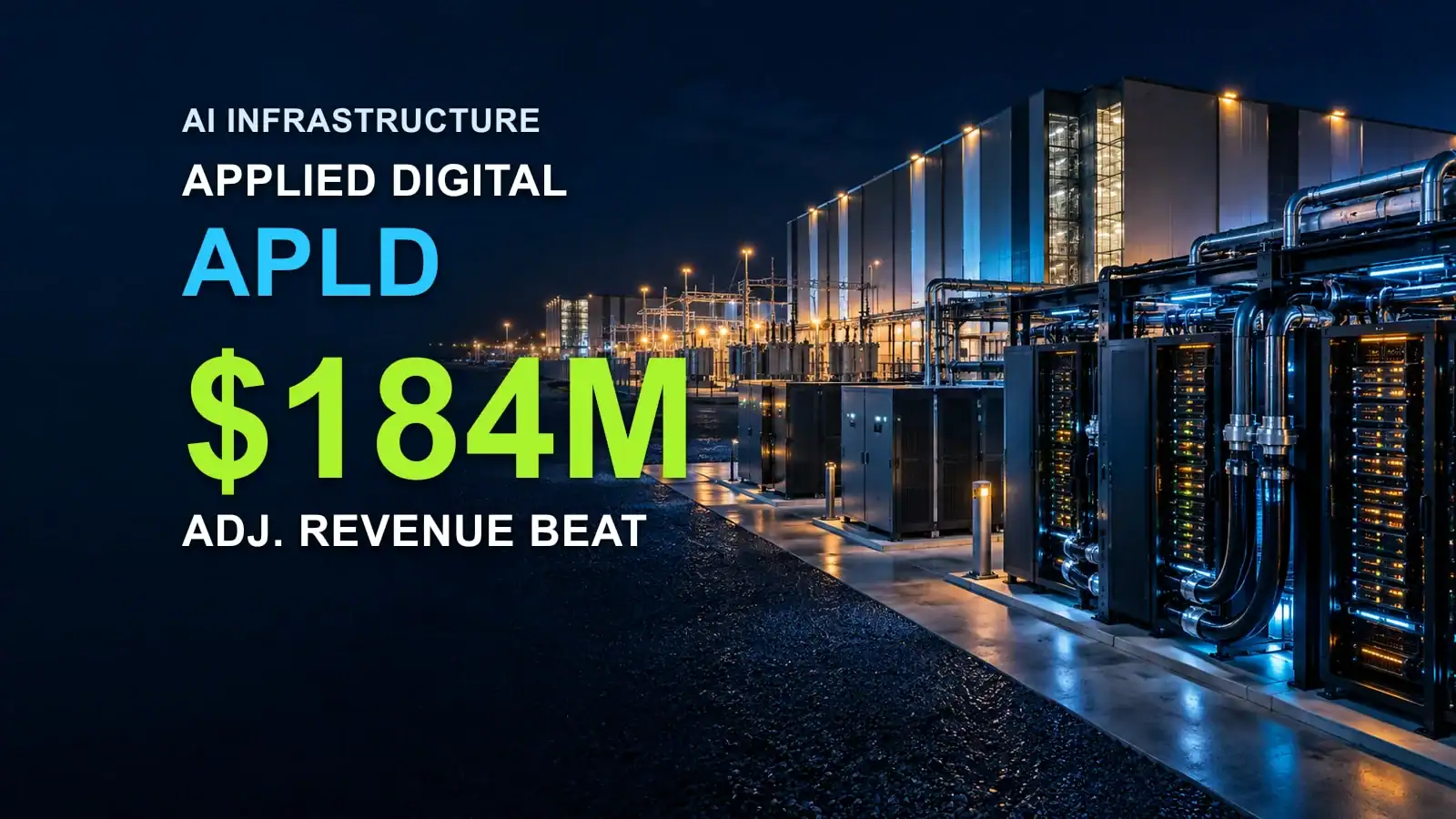
Applied Digital APLD Q1 FY2027 Earnings: $184M Adjusted Revenue Beat
By AIStocksHub Research Desk | October 10, 2026
Key Takeaway
Applied Digital (NASDAQ: APLD) closed October 8 at $23.16, down 2.73% from its October 7 regular-session close of $23.81, after reporting fiscal first-quarter 2027 adjusted revenue of $300.4 million and an adjusted loss of $0.01 per diluted share. Both cleared a pre-release Wall Street consensus snapshot. The completed-session reaction nevertheless left the stock lower as investors weighed a sharply larger buildout: the company spent $2.07 billion on property, equipment and other assets during the quarter while reporting $63.9 million of operating cash flow. The next test is whether new capacity converts into recurring base rent without a comparable step-up in financing pressure.
Introduction and completed market reaction
Applied Digital released Q1 FY2027 results after the October 7 regular-session close. In the first complete regular session afterward, APLD opened at $24.36, traded from $22.63 to $24.43, and closed October 8 at $23.16. The 2.73% decline is calculated from the October 7 regular-session close of $23.81. Regular-session volume was about 44.1 million shares.
The reaction landed in a weak technology session: the Nasdaq Composite fell 1.3%. APLD’s decline was therefore not an isolated verdict on the earnings release. Still, shares closed below the prior session’s close despite the adjusted beat, indicating that the reported execution did not remove investors’ questions about capital intensity, recurring revenue mix, and funding.
Educational disclaimer
This article is educational, informational research—not financial advice.
We strive to keep data accurate, but unavoidable errors or omissions may occur. Verify important information with primary sources.
The earnings findings that matter
- The adjusted results exceeded the pre-release snapshot. Adjusted revenue was $300.4 million, compared with a $116.29 million consensus snapshot, while adjusted loss per diluted share was $0.01 versus a $0.30 loss expected in the same snapshot.
- GAAP results remained deeply negative. Consolidated revenue was $341.9 million, but net loss attributable to common stockholders was $221.0 million, or $0.76 per basic and diluted share.
- HPC revenue was not all recurring rent. The HPC Hosting segment reported $262.6 million of revenue: $65.8 million of base rent, $183.5 million of tenant fit-out services, and $13.3 million of tenant recoveries.
- Construction spending dwarfed operating cash flow. Operating cash flow was $63.9 million, while purchases of property, equipment and other assets were $2.075 billion. That $2.011 billion gap is an AIStocksHub calculation, not company guidance.
- Contracted capacity is substantial but long dated. The company reported 1,410 MW of contracted critical IT load and $35.731 billion of base-term minimum contracted payments. Those payments run across many years and are not the same as current revenue.
What investors expected before earnings
Before the release, a publicly aggregated Wall Street consensus snapshot called for approximately $116.29 million of adjusted revenue and a $0.30 adjusted loss per share. Applied Digital reported $300.4 million of adjusted revenue and a $0.01 adjusted loss per diluted share.
The comparison uses adjusted measures because the available pre-release snapshot did not align with the company’s consolidated GAAP reporting. Applied Digital excludes the results of its majority-owned ChronoScale subsidiary from the adjusted measures. These estimates are third-party inputs, not company guidance, and their metric definitions can vary.
Reported versus expected scoreboard
| Metric | Reported Q1 FY2027 | Expected | Surprise | Year-over-year |
|---|---|---|---|---|
| Adjusted revenue (non-GAAP) | $300.4M | $116.29M | +$184.11M / +158.3% | +368% |
| Adjusted EPS (non-GAAP loss per diluted share) | -$0.01 | -$0.30 | +$0.29 | Improved from -$0.03 |
| Consolidated revenue (GAAP) | $341.9M | Unavailable on a comparable basis | Unavailable | +322% |
| GAAP loss per basic and diluted share | -$0.76 | Unavailable on a comparable basis | Unavailable | Worsened from -$0.07 |
Consensus comparisons and percentages are AIStocksHub calculations using the pre-release snapshot described above. Non-GAAP measures are company-defined and exclude ChronoScale; they should be read with the company’s reconciliation.
Results across the last three quarters
The revenue path has accelerated as HPC capacity enters service. But GAAP losses have also remained large, and the reported non-GAAP history changes in comparability following the ChronoScale separation. The table therefore keeps GAAP revenue and GAAP loss per share visible alongside the company’s adjusted measures.
| Metric | Q2 FY2026 | Q3 FY2026 | Q4 FY2026 | Q1 FY2027 |
|---|---|---|---|---|
| Consolidated revenue | $126.6M | $126.6M | $258.7M | $341.9M |
| GAAP loss per share | -$0.11 | -$0.36 | -$0.39 | -$0.76 |
| Adjusted revenue | Not separately reported | $108.6M | $240.4M | $300.4M |
| Adjusted EPS | $0.00 | $0.09 | $0.04 | -$0.01 |
| Adjusted EBITDA | $20.2M | $44.1M | $42.4M | $64.4M |
The sequential revenue increase partly reflects services performed for tenants as campuses are built. It should not be treated as a one-for-one run rate for long-term base rent. Q1’s $65.8 million of HPC base rent is the more direct recurring-revenue indicator within the segment, though it can still change as capacity is accepted and energized.
Revenue segments and AI performance
Applied Digital reports two core operating segments. HPC Hosting is the direct AI-factory and high-performance-computing exposure. Data Center Hosting supplies energized space to crypto-mining customers and is not interchangeable with the HPC business.
| Q1 FY2027 segment | Revenue | Year-over-year change | Segment operating profit |
|---|---|---|---|
| HPC Hosting | $262.6M | +899% | $33.4M |
| Data Center Hosting | $37.8M | -0.4% | $13.3M |
| Core segments, total | $300.4M | +368% | $46.8M |
Within HPC Hosting, $183.5 million came from tenant fit-out services and $13.3 million from tenant recoveries. Those items demonstrate construction and customer activity, but they are economically different from the $65.8 million of base rent. The important operating question is whether the expanding installed capacity grows the latter over time.
The company reported that the first 100 MW Polaris Forge 1 building was already operating. The second 150 MW building was delivered in two 75 MW phases; the first was ready for service on July 1 and the second on October 1, after quarter-end. It also reported leases for approximately 1.41 GW across five campuses. The largest disclosed tenant relationship is CoreWeave, which leases Polaris Forge 1.
Margins, cash flow, and capital spending
The contrast in this quarter is clear: operating cash flow turned positive, but the amount was small relative to the construction program. Purchases of property, equipment and other assets were $2.075 billion. The cash-flow statement also shows $1.649 billion of long-term-debt borrowings, an $82.4 million revolver draw, and $275.0 million of preferred-stock proceeds during the quarter.
| Operating and funding measure | Q1 FY2027 | Q4 FY2026 | Q1 FY2026 |
|---|---|---|---|
| Operating cash flow | $63.9M | Not comparable in this report | -$81.5M |
| Purchases of property, equipment and other assets | $2.075B | Not comparable in this report | $249.9M |
| Adjusted EBITDA | $64.4M | $42.4M | $0.5M |
| Long-term debt at period end | $6.264B | $4.960B | Not comparable in this report |
| Stock-based compensation in operating cash flow reconciliation | $66.5M | Not comparable in this report | $15.5M |
The GAAP loss cannot be reduced to capex alone. The Q1 filing also recorded $77.4 million of interest expense, $59.4 million of stock-based compensation in the operating reconciliation, $49.5 million of fair-value derivative loss, and $11.4 million of investment fair-value loss. These items have different cash and recurrence characteristics, but together they explain why an adjusted near-breakeven loss and a $221.0 million GAAP loss can coexist.
Long-term debt was $6.264 billion at August 31, with another $112.6 million classified as current debt. The company had $2.9 billion of unrestricted cash and cash equivalents plus $728.0 million of restricted cash. Liquidity supports the buildout, but it does not eliminate refinancing, interest-cost, preferred-equity, dilution, or delivery risk.
Earnings announcement decoded
The release answers one important question: APLD can recognize material revenue as its first AI campuses are delivered and fitted out. It does not yet prove that the full 1.41 GW contract portfolio will become recurring, high-return rental revenue on the schedule investors expect.
The key distinction is revenue quality. Base rent reflects operational capacity being leased; tenant fit-out services and recoveries can raise reported quarterly revenue while carrying different margin and recurrence characteristics. Meanwhile, the financing cash flows show the current phase is a buildout financed with debt, preferred capital and customer-related cash flows, rather than a mature free-cash-flow phase.
The lease footnote makes the long-duration opportunity more concrete. It lists $468.0 million of minimum contracted payments for FY2027, $1.580 billion for FY2028, and $35.731 billion in total across the disclosed base terms. These are minimum contractual payments and exclude certain variable items; they are not a promise that each year’s accounting revenue will equal the schedule.
Updated guidance
Applied Digital did not issue formal fiscal-2027 revenue, EPS, EBITDA, or capital-expenditure guidance in its Q1 release. That absence matters: contracted capacity and construction milestones should not be recast as a company financial forecast.
Management did provide operational timing targets and contract disclosures that investors can measure against:
| Disclosed operating milestone | Company disclosure |
|---|---|
| Polaris Forge 1 Building 3 | 150 MW; full ready-for-service expected in calendar 2027 |
| Polaris Forge 2 | 300 MW aggregate; initial ready-for-service expected in H2 2026 and full capacity in early 2027 |
| Polaris Forge 3 | 300 MW aggregate; initial ready-for-service expected in H2 2027 and full capacity in H2 2028 |
| Delta Forge 1 | 300 MW aggregate; initial ready-for-service expected in H1 2027 and full capacity in early 2028 |
| Delta Forge 2 | 210 MW; expected delivery in H1 2028 |
These timelines are management expectations, not earnings guidance. Construction, power availability, financing, tenant acceptance and other execution variables can change them.
Market expectations
APLD closed October 9 at $23.68. A publicly aggregated analyst snapshot checked on October 10 showed a Moderate Buy consensus from 19 ratings: 15 Buy, two Hold, and two Sell. The same snapshot’s 12-month price-target range is shown below. Ratings and targets are third-party opinions, not company guidance or AIStocksHub price predictions.
| Analyst ratings as of October 10, 2026 | Count |
|---|---|
| Buy (including Strong Buy) | 15 |
| Hold | 2 |
| Sell | 2 |
| Total | 19 |
| October 10 snapshot | Value | Difference from October 9 close |
|---|---|---|
| Current regular-session close | $23.68 | — |
| Lowest analyst target | $22.00 | -7.1% |
| Average analyst target | $62.25 | +162.9% |
| Highest analyst target | $90.00 | +280.1% |
The unusually wide range reinforces the central earnings question: the debate is not whether APLD has contracted AI demand, but what financing, delivery timing, rent conversion, and per-share economics that demand will require. The snapshot can change as analysts incorporate the Q1 results.
What improved versus what disappointed
Improved: adjusted revenue rose to $300.4 million, adjusted EBITDA reached $64.4 million, the HPC segment generated $33.4 million of operating profit, and Polaris Forge 1 reached 250 MW of live capacity after quarter-end. The company also reported 1.41 GW of contracted critical IT load across five campuses.
Still unresolved: GAAP loss attributable to common stockholders rose to $221.0 million; capital spending was $2.075 billion in one quarter; debt expanded; and just one-quarter of HPC revenue was identified as base rent. APLD’s $36 billion base-term contracted-revenue figure is substantial, but it is a multi-year contract measure—not a near-term revenue or cash-flow result.
What to watch next quarter
- Base-rent conversion: Whether HPC base rent rises as delivered capacity becomes operational, rather than growth relying predominantly on fit-out services and recoveries.
- Polaris Forge 2 execution: Whether the company meets its stated second-half 2026 initial ready-for-service target.
- Capex and funding: Whether the gap between construction spending and operating cash flow narrows, and how much incremental debt, preferred capital, or common-share dilution is needed.
- Interest expense and GAAP loss: Whether debt-funded growth pushes financing costs faster than rental income.
- Contracted-payment realization: Whether delivery schedules support the FY2027 minimum lease-payment amount disclosed in the lease footnote.
Final earnings verdict
APLD’s completed 2.73% post-earnings decline was not a rejection of the quarter’s operating progress. Adjusted revenue and adjusted EPS beat the available pre-release snapshot, while the company added operational capacity and maintained a large contracted portfolio.
But the market was being asked to value that progress alongside $2.075 billion of quarterly capital spending, $6.264 billion of long-term debt, and an HPC revenue mix in which tenant fit-out services exceeded base rent. The next earnings report should therefore be judged less by another headline revenue increase than by recurring-rent conversion, delivered megawatts, funding terms, and cash generation.
Primary Sources
- Applied Digital Q1 FY2027 financial results
- Applied Digital Form 10-Q for the quarter ended August 31, 2026
- Applied Digital Q4 and full-year FY2026 financial results
- Applied Digital Q3 FY2026 financial results
- Applied Digital Q2 FY2026 financial results
FAQ
Why did APLD stock fall 2.7% after Q1 FY2027 earnings?
APLD closed October 8 at $23.16, down 2.73% from the October 7 regular-session close after the after-market earnings release. The company reported an adjusted revenue and adjusted-EPS beat, but investors also faced $2.075 billion of quarterly capital spending, large debt balances, and a revenue mix where tenant fit-out services exceeded recurring base rent. The Nasdaq Composite also fell 1.3% that day.
Did Applied Digital beat earnings estimates?
Against a pre-release consensus snapshot, Applied Digital reported $300.4 million of adjusted revenue versus $116.29 million expected and an adjusted loss of $0.01 per diluted share versus a $0.30 loss expected. These are non-GAAP comparisons and the percentages are AIStocksHub calculations.
How much of Applied Digital’s Q1 HPC revenue was recurring base rent?
HPC Hosting revenue was $262.6 million. It included $65.8 million of base rent, $183.5 million of tenant fit-out services, and $13.3 million of tenant recoveries. Base rent represented about 25.1% of HPC revenue by AIStocksHub calculation.
How much AI capacity has Applied Digital contracted?
As of August 31, 2026, the company reported approximately 1.41 GW of contracted critical IT load across five campuses. Its lease footnote listed $35.731 billion of base-term minimum contracted payments, a multi-year contract amount rather than current revenue.
What is the key risk to watch after Applied Digital’s Q1 FY2027 earnings?
Capital intensity and delivery. The company spent $2.075 billion on property, equipment and other assets during the quarter while generating $63.9 million of operating cash flow. Investors can track recurring base rent, campus ready-for-service milestones, debt and preferred financing, interest expense, and dilution in the next report.