Amazon’s $2.4B Generator Deal: The Stock Behind It in 2026
Key Takeaway
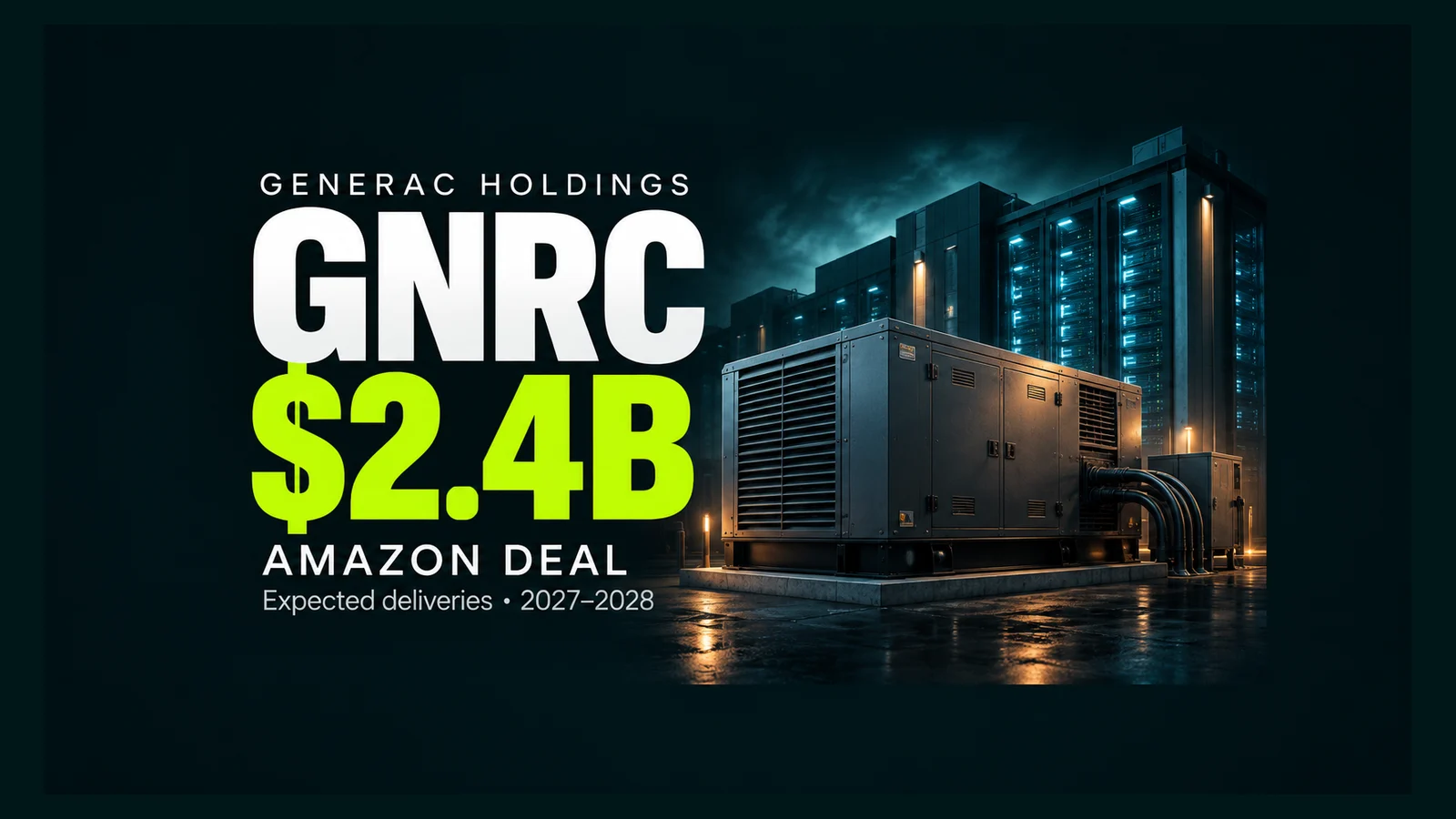
Generac Holdings (NYSE: GNRC) expects $2.4 billion of initial Amazon deliveries across 2027–2028 under a new supply agreement. That creates a substantial data-center opportunity. However, investors must weigh execution costs, potential warrant dilution, and earnings that benefited from tariff refunds. The investment case depends on profitable deliveries and cash generation, beyond the headline contract value.
Introduction and central investment question
A company best known for backup generators now has a multibillion-dollar connection to Amazon. On September 16, 2026, Generac disclosed its new supply agreement and expected initial deliveries. That makes this a fresh business development, rather than a recycled earnings announcement.
The central question is straightforward: can Generac turn this demand into durable earnings for shareholders? A large customer can change a manufacturer’s growth path. However, capacity spending, delivery timing, and contract economics determine how much value reaches investors.
Investor disclaimer
This article is educational, informational research—not financial advice.
We strive to keep data accurate, but unavoidable errors or omissions may occur. Verify important information with primary sources.
Company overview
Generac sells power equipment for homes, businesses, and industrial customers. Its range includes standby generators, portable products, and energy technology. Therefore, shareholders own a diversified power-equipment business with several demand drivers.
AI infrastructure adds another potential growth engine. Yet residential demand still matters to company performance. Investors should assess both businesses when deciding what multiple the stock deserves.
How the company makes money
Equipment sales form the foundation of Generac’s business. Distribution, installation relationships, and support help connect those products with customers. Larger industrial projects can bring different purchasing cycles and working-capital needs than household equipment.
For example, a manufacturer may buy components before it collects payment for a finished generator. Revenue growth can consequently consume cash during an expansion. Investors need to track inventory, receivables, and capital spending alongside sales.
Why the company matters to AI
Generac offers exposure to the physical infrastructure supporting data centers. Backup power helps facilities maintain operations during interruptions. That gives the company an indirect connection to expanding computing capacity.
However, a data-center customer does not make every associated dollar pure AI revenue. The disclosed agreement does not provide an AI-workload revenue split. This report therefore treats Generac as an infrastructure supplier with AI-related demand exposure.
Recent business developments
The September agreement calls for initial Amazon deliveries expected to total $2.4 billion across 2027 and 2028. For scale, that equals roughly 57% of Generac’s $4.21 billion in 2025 revenue. This compares a two-year delivery expectation with one historical year; it does not imply 57% annual growth.
The timing also matters. Generac reported second-quarter earnings on July 29, before this agreement. Consequently, investors should not describe July guidance as a forecast updated for September’s announcement.
The latest quarterly release also discussed industrial capacity expansion and the Enercon acquisition. These developments support the manufacturing story. Still, more capacity creates value only when utilization and returns justify the investment.
Financial performance and revenue trend
The latest three completed fiscal years show uneven results. Revenue recovered in 2024, then slipped in 2025. Operating cash flow also fell sharply in 2025, giving investors a useful baseline for judging the next expansion.
| Fiscal year ended December 31 | Revenue ($bn) | GAAP net income attributable to Generac ($m) | Operating cash flow ($m) | Capital expenditures ($m) |
|---|---|---|---|---|
| 2023 | 4.02 | 215 | 522 | 129 |
| 2024 | 4.30 | 316 | 741 | 137 |
| 2025 | 4.21 | 160 | 438 | 170 |
Figures are rounded from company filings. In 2025, a $104.5 million legal settlement provision affected reported results. Adjusted EPS of $6.34 therefore differed substantially from GAAP EPS of $2.69.
More recently, Q2 2026 revenue grew 11% to $1.174 billion. Commercial and industrial sales rose 29%, while residential sales fell 2%. GAAP EPS reached $2.40, and adjusted EPS reached $2.91.
However, roughly $71 million of pretax tariff refunds boosted quarterly earnings, including adjusted results. The quarter’s $121 million operating cash flow and $63 million company-defined free cash flow offer another perspective. Investors should separate recurring operating improvement from refund benefits before extrapolating profits.
Growth drivers
The first driver is execution against the expected Amazon deliveries. Successful production could spread factory costs across more units. However, the company must protect margins while meeting demanding schedules.
A second driver is broader commercial and industrial demand. Additional customers could reduce dependence on any single deployment program. Meanwhile, residential performance can either support the expansion or offset part of its gains.
Management’s July outlook called for mid-to-high-teens revenue growth in 2026. It also projected a 20%–21% adjusted EBITDA margin, including roughly 1.5 percentage points from tariff refunds. That guidance provides a dated baseline, rather than proof of recurring margins at that level.
Customers, contracts, and partnerships
The Amazon relationship includes an equity incentive. Generac issued an Amazon subsidiary warrants covering up to 1,693,745 shares, with 307,954 immediately vested. The remaining vesting depends on qualifying payments under the agreement.
The filing ties full vesting to an $8 billion payment threshold. That threshold does not establish an $8 billion confirmed order. Investors should keep the delivery expectation, payment milestone, and potential equity issuance separate.
The warrant exercise price is approximately $200.93, and the instrument expires in September 2033. Exercise could dilute existing shareholders, subject to its terms and settlement method. However, the maximum share count does not mean all those shares have already entered circulation.
The public disclosure does not establish the contract’s profit margin or a complete shipment schedule. Earlier quarterly commentary also discussed hyperscale business. Without a reconciliation, adding those earlier figures to the Amazon total could double-count demand.
Competitive position
A large customer relationship gives Generac a chance to demonstrate delivery capability at scale. In our assessment, repeat performance could strengthen its standing in demanding industrial applications. However, one contract alone does not establish an enduring competitive advantage.
Investors should look for repeat orders, service quality, and attractive returns on added capacity. Pricing discipline matters as much as winning volume. A supplier that grows sales while sacrificing returns may create less shareholder value than the headline suggests.
Valuation
GNRC closed at $207.44 on September 18, 2026, at 4 p.m. Eastern. Dividing that price by 2025 GAAP EPS gives approximately 77.1 times earnings. Using 2025 adjusted EPS instead produces about 32.7 times.
A publicly aggregated FY2026 adjusted EPS estimate of $9.75 implies approximately 21.3 times earnings. These calculations use different earnings periods and accounting bases. Therefore, investors should not compare them as interchangeable measures of cheapness.
The forward figure depends on forecasts that can change. It also uses adjusted earnings, which can retain unusual benefits such as tariff refunds. Our assessment is that the valuation requires scrutiny of sustainable earnings and cash conversion, rather than a single headline multiple.
Market expectations
As of September 18, one publicly aggregated analyst snapshot covered 21 analysts. Its underlying consensus showed a September 17 update. Buy combines Strong Buy and Buy; Sell combines Sell and Strong Sell.
| Analyst rating | Count |
|---|---|
| Buy | 14 |
| Hold | 7 |
| Sell | 0 |
Price targets frame that cohort’s valuation range against the current share price. They represent changing third-party estimates, rather than company guidance or investment instructions. In particular, the snapshot does not establish that every analyst has incorporated the new agreement.
| Price measure | USD |
|---|---|
| Current share price: September 18 regular-session close | $207.44 |
| Lowest 12-month target | $215.00 |
| Average 12-month target | $292.38 |
| Highest 12-month target | $375.00 |
The target range reflects differing assumptions about earnings and valuation. Even the lowest published target does not establish a floor under the stock. Investors should test their own assumptions instead of treating consensus as protection against losses.
Risks
Execution comes first. Component shortages, delayed installations, or manufacturing problems could shift deliveries and cash receipts. Meanwhile, expansion spending may arrive before related revenue.
Customer concentration creates another concern. A large agreement can make one customer’s deployment schedule more influential. The public figures do not remove uncertainty around timing or profitability.
Finally, shareholders face potential warrant dilution and earnings-quality questions. A tariff refund can improve reported profit without establishing a repeatable operating trend. Residential weakness could also offset some industrial gains.
Bull case
The optimistic case assumes Generac delivers the expected equipment, earns attractive margins, and converts earnings into cash. Industrial growth then becomes a larger contributor to the business. Meanwhile, stable residential demand could help fund expansion.
Under that scenario, successful execution could lead to repeat business. Investors might then place more weight on durable industrial earnings. That outcome requires evidence from shipments, margins, and cash flow over time.
Bear case
The pessimistic case assumes deliveries slip or carry weaker economics than investors expect. Inventory and capital spending could absorb cash while expansion costs weigh on earnings. Meanwhile, fading refund benefits could expose slower underlying profit growth.
In that scenario, a large contract would coexist with disappointing shareholder returns. Potential dilution could add pressure to per-share results. A lower valuation multiple could compound an earnings shortfall.
Investment scorecard
Our editorial rating is ★★★☆☆ — 3/5 overall, based on the evidence reviewed on September 18, 2026. The scale runs from 1 (weak) through 2 (below average), 3 (mixed), 4 (strong), and 5 (exceptional). Higher scores mean a more favorable investment assessment of each area; these subjective judgments are not analyst consensus or a return forecast.
| Area | Rating | Reason for rating | Evidence that could improve the score |
|---|---|---|---|
| Demand visibility | ★★★★☆ 4/5 | The Amazon agreement strengthens the delivery outlook, but execution remains ahead. | Confirmed shipment progress |
| AI exposure | ★★★☆☆ 3/5 | Data-center power offers relevant exposure, but the AI-specific revenue mix remains unclear. | Clearer workload and customer mix |
| Earnings quality | ★★☆☆☆ 2/5 | Tariff refunds boosted even adjusted earnings, complicating assessment of recurring profits. | Strong margins without refund benefits |
| Cash generation | ★★★☆☆ 3/5 | Operating cash flow remains positive, but it declined in 2025 as capital spending increased. | Strong cash conversion after expansion spending |
| Valuation | ★★★☆☆ 3/5 | The forward multiple depends on forecast adjusted earnings and sustained growth. | Sustainable per-share profit growth that supports the multiple |
| Shareholder economics | ★★★☆☆ 3/5 | The customer relationship creates opportunity, while warrants introduce potential dilution. | Profitable deliveries that outweigh dilution costs |
The overall score is the equally weighted average of these six ratings: 18 points out of 30, or 3/5. Demand visibility earns the strongest score, while earnings quality needs the most scrutiny. Therefore, the score reflects a promising opportunity with material execution questions, rather than a buy or sell instruction.
Final outlook
Generac now offers a concrete way to study the power equipment behind expanding data-center capacity. The Amazon agreement strengthens the demand case. However, the business must still demonstrate what those deliveries earn for shareholders.
The next reports should clarify shipment timing, industrial margins, and capacity spending. Investors should also track cash conversion and warrant developments. Our assessment remains evidence-led: profitable execution would strengthen the thesis; revenue growth without adequate cash returns would weaken it.
Primary Sources
- Generac September 2026 Form 8-K: Amazon agreement
- Generac warrant agreement filed with the SEC
- Generac Q2 2026 results and guidance
- Generac 2025 Form 10-K
- Generac full-year 2025 earnings release
FAQ
Which stock is behind Amazon’s $2.4 billion generator agreement?
Generac Holdings trades on the NYSE as GNRC. The company disclosed the agreement on September 16, 2026.
Does Generac expect $2.4 billion every year?
No. The figure covers expected initial deliveries across 2027 and 2028 combined.
Is the $8 billion warrant threshold a confirmed order?
No. It is a qualifying-payment threshold for full warrant vesting. It should not replace the disclosed delivery expectation.
Why did adjusted earnings also benefit from tariff refunds?
Generac included the roughly $71 million pretax refund benefit in its Q2 2026 adjusted results. Therefore, adjusted EPS alone does not isolate recurring operating performance.
Is Generac a pure AI stock?
Generac sells power equipment across residential and industrial markets. Data centers provide indirect AI-related exposure, but the company has not disclosed an AI-workload split for this agreement.