Marvell Stock Report 2026: Can AI Growth Lift MRVL Again?
Key Takeaway
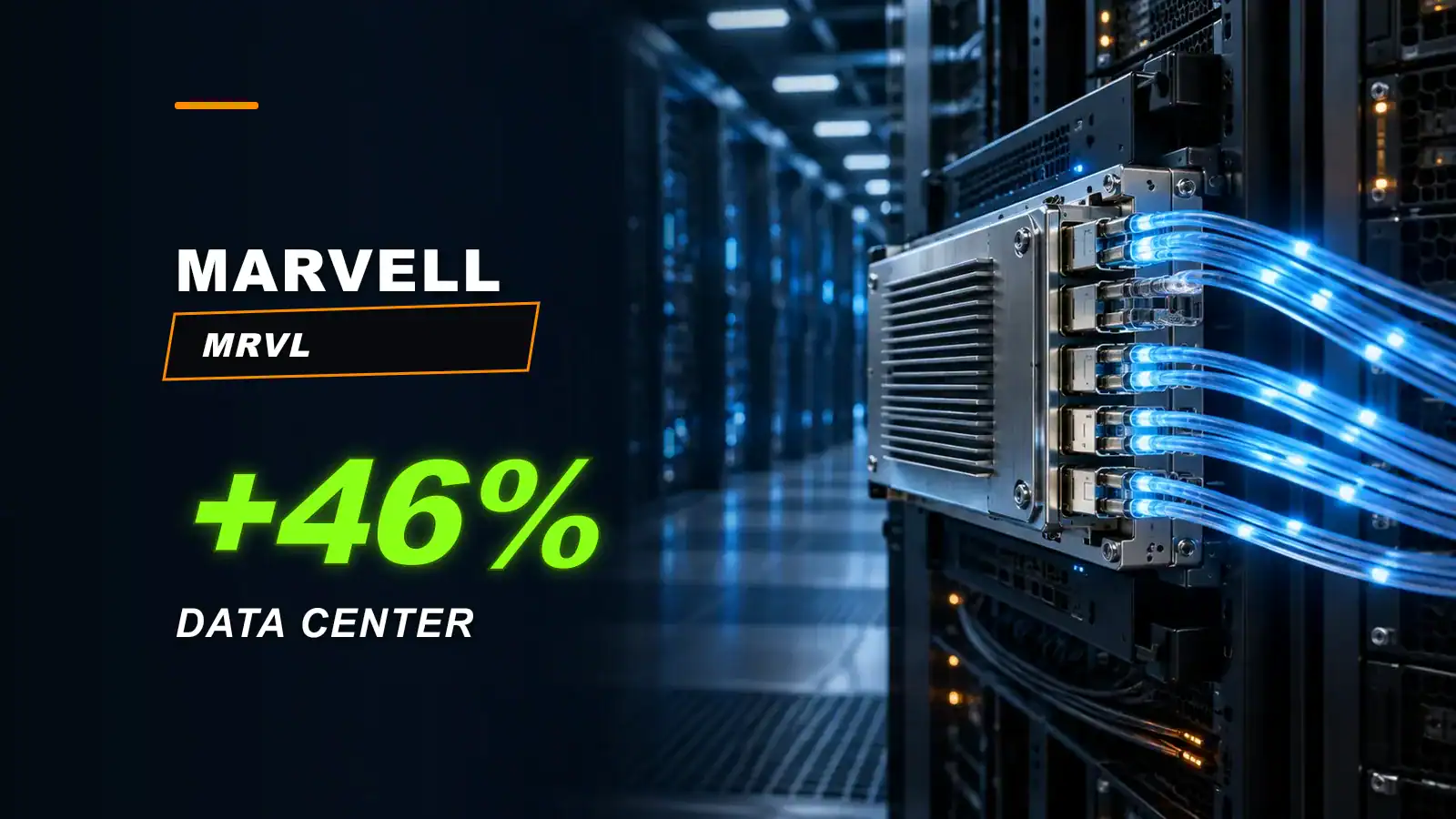
Marvell is no longer simply an AI-adjacent semiconductor company. Its Data Center business produced $2.172 billion in the latest reported quarter, grew 46% year over year, and accounted for 79% of revenue. The company expects another step up to $3.150 billion of total revenue at the midpoint of Q3 FY2027 guidance. That scale makes execution in AI infrastructure central to the stock case.
The central investment question is whether Marvell can convert that demand into a larger and more durable earnings path. The answer depends on Custom-silicon execution, optical and interconnect growth, margin mix, customer concentration, advanced-node supply, and the integration of its newest acquisitions. These factors will determine whether revenue momentum becomes enduring earnings power.
MRVL’s 10.3% decline in the first full session after its August earnings report is useful context, but it is no longer the story. The report showed that high expectations can overwhelm a good quarter. The current stock case rests on what comes next: whether management can make the expected second-half Custom acceleration visible in reported revenue and profit.
Introduction and central investment question
Marvell Technology designs semiconductor products for data centers, carrier infrastructure, enterprise networking, and storage. The company’s AI relevance comes from the connections around compute: electro-optics, switching, storage, Custom silicon, PCIe/CXL technology, and related data movement inside large data centers. These products help determine how efficiently large AI systems can scale beyond individual accelerators.
The stock’s recent path captures the debate. Marvell reported record $2.739 billion revenue on August 27, including 46% Data Center growth, but MRVL fell 10.3% in the next completed regular session. That market reaction has now settled. The more useful question for a current stock report is whether the company has enough evidence and catalysts to turn its AI position into a stronger forward earnings trajectory.
This report uses the latest reported quarter as a foundation, not as an earnings reaction recap. It assesses Marvell’s business model, AI exposure, financial position, growth drivers, valuation context, catalysts, and risks through September 8, 2026. The emphasis remains on the conditions that can change the company’s future earnings power.
Investor disclaimer
This article is educational, informational research—not financial advice.
We strive to keep data accurate, but unavoidable errors or omissions may occur. Verify important information with primary sources.
Company overview
Marvell operates across two reported revenue categories:
- Data Center
- Communications and Other
The Data Center category includes products that help systems process and move data, including electro-optics, switching, storage, and Custom solutions. Communications and Other covers carrier, enterprise, and other infrastructure markets. The Data Center category has become the financial center of gravity: its $2.172 billion of Q2 FY2027 revenue was nearly four times the $568 million produced by Communications and Other.
| Revenue category | Q2 FY2027 revenue | Share of total revenue | Year-over-year change |
|---|---|---|---|
| Data Center | $2.172B | 79% | +46% |
| Communications and Other | $568M | 21% | +10% |
| Total | $2.739B | 100% | +37% |
Reported figures for the quarter ended August 1, 2026.
How the company makes money
Marvell sells semiconductor products and technology to equipment makers, cloud and data-center customers, carrier-infrastructure customers, and enterprise customers. Revenue is tied to chips and related technology embedded in network equipment, servers, storage systems, optical modules, and increasingly specialized AI data-center architectures.
The company’s AI opportunity has several layers. A data center needs accelerators, but it also needs high-speed electrical and optical connections, switching, storage, and a fabric that can move information among an expanding number of compute elements. Marvell is pursuing those supporting layers rather than competing only in general-purpose AI accelerators.
That positioning can be valuable because infrastructure content can increase as clusters scale. It also makes revenue dependent on complex customer architecture choices, long design cycles, and deployment schedules that may not appear evenly in each quarter.
Why the company matters to AI
Marvell says AI-related demand in electro-optics, Custom silicon, storage, and switching drove the 46% year-over-year increase in Data Center revenue. These are complementary parts of the AI infrastructure stack:
- Electro-optics moves high volumes of data within and between data-center systems.
- Custom silicon lets a customer develop an application-specific compute design rather than using a standard processor alone.
- Switching and PCIe/CXL technology connect compute, memory, and storage resources.
- Storage supports the datasets and inference workloads used by AI systems.
The company expanded this position through two fiscal-2027 acquisitions. It acquired Celestial AI, which brings photonic-fabric technology intended for scale-up connectivity, and XConn Technologies, which adds PCIe/CXL switching capabilities. The strategic logic is clear: future AI systems may need more bandwidth and denser connections, not merely more compute chips. Whether the acquisitions create enough revenue and margin to justify their cost is an execution question that remains open.
Recent business developments
Several disclosed developments define Marvell’s current setup:
- August 27, 2026: Marvell reported record Q2 FY2027 revenue of $2.739 billion and Data Center revenue of $2.172 billion.
- Q3 FY2027 outlook: Management guided to $3.150 billion of revenue at the midpoint, plus or minus 5%.
- Second half of FY2027: Management expects a significant acceleration in Custom revenue.
- October 6, 2026: Marvell plans to hold an Investor Day, providing a defined near-term catalyst for product-roadmap and long-range-target updates.
- NVIDIA relationship: Marvell disclosed a March 2026 strategic transaction in which NVIDIA purchased $2.0 billion of Series A Convertible Preferred Stock. Marvell also described a partnership to connect custom XPUs and compatible scale-up networking with NVIDIA AI infrastructure.
The NVIDIA transaction is strategically meaningful, but it is not the same as a guaranteed revenue contract. It may validate Marvell’s role in an expanding AI ecosystem, while the preferred-stock conversion and related customer-warrant arrangements can also create dilution considerations for current shareholders.
Financial performance and revenue trend
Marvell’s annual history shows a sharp shift toward Data Center demand. Fiscal 2026 revenue rose 42% to $8.195 billion, following a more modest 5% increase in fiscal 2025. GAAP earnings require careful reading: fiscal 2026 net income included a $1.8 billion pre-tax gain on the sale of the automotive ethernet business, so it is not a clean measure of recurring operating earnings.
| Fiscal year | Revenue | GAAP net income (loss) | Operating cash flow | Capital expenditures |
|---|---|---|---|---|
| FY2026 | $8.195B | $2.670B* | $1.751B | $354M |
| FY2025 | $5.767B | ($885M) | $1.681B | $285M |
| FY2024 | $5.508B | ($933M) | $1.371B | $336M |
*FY2026 GAAP net income included the disclosed gain on sale of Marvell’s automotive ethernet business. Reported annual figures are from Marvell’s fiscal 2026 Form 10-K.
The latest quarter shows that the annual growth inflection continued. Q2 FY2027 revenue reached $2.739 billion, up 37% year over year, while Data Center revenue rose 46% to $2.172 billion. GAAP gross margin was 53.1% and non-GAAP gross margin was 58.9%. Q3 guidance puts the non-GAAP gross-margin midpoint at 58.0%, below Q2’s result. That does not prove a structural margin problem, but it makes product mix an important watch item as the highest-growth AI products scale.
Growth drivers
Data Center connectivity and electro-optics
More AI compute requires more data movement. Marvell’s electro-optics and connectivity products address that need, and the company identifies these areas as contributors to current Data Center growth. The opportunity can persist even as the mix of accelerators evolves, because systems still need to connect chips, memory, racks, and data centers.
Custom-silicon acceleration
Custom silicon is the clearest upside catalyst and the clearest timing risk. Management said Custom revenue should accelerate significantly in the second half of FY2027. If that transition is visible in Q3 and Q4 results, it could materially strengthen the growth case. Until then, it remains a management forecast rather than reported revenue.
Photonic fabric and PCIe/CXL expansion
Celestial AI and XConn broaden Marvell’s potential role in the interconnect layer. Photonic fabric targets high-bandwidth scale-up connectivity, while PCIe/CXL switching supports connections among computing, memory, and storage resources. These technologies could increase Marvell’s content per AI system if adoption grows. They also introduce integration, commercialization, and purchase-price risk.
AI ecosystem alignment
The disclosed NVIDIA partnership could make it easier for customers to combine custom compute and compatible networking with NVIDIA AI infrastructure. The relationship is strategically relevant, yet investors should distinguish technological collaboration and a preferred-stock investment from disclosed customer purchases, backlog, or revenue commitments.
Customers, contracts, and partnerships
Marvell does not disclose a complete customer-by-customer revenue map. Its filings make clear, however, that it faces meaningful customer concentration and design-win risk. Large data-center programs can create significant revenue, but their timing and scale depend on a relatively small group of sophisticated customers and their deployment plans.
The company has also disclosed a customer warrant covering up to 59 million shares, subject to revenue and time conditions. This arrangement can align incentives around future revenue, but it can also dilute shareholders if its conditions are met. Investors should read such arrangements as evidence of both potential business opportunity and a more complicated capital structure.
The most visible partnership disclosure is NVIDIA’s investment and the companies’ stated work on custom XPUs and compatible scale-up networking. There are no public terms in the cited filings that establish a fixed revenue amount, minimum purchasing commitment, or delivery schedule from that relationship. Investors should therefore treat the partnership as strategic context rather than booked-revenue evidence.
Competitive position
Marvell’s competitive advantage, if it executes, is its position across several networking and connectivity layers. A customer that adopts Marvell components for Custom silicon, optics, switching, or storage may have incentives to use a broader Marvell architecture. The acquired photonic-fabric and PCIe/CXL capabilities could reinforce that position.
The competitive challenge is equally important. Semiconductor technology changes quickly, and major customers may choose alternatives, delay deployments, design more components internally, or favor rival architectures. Marvell’s value is therefore tied not only to AI capital spending, but also to whether its technologies remain technically and economically compelling across successive data-center designs.
Valuation
At the September 8, 2026 research cut-off, an independently checked market-data snapshot placed MRVL near $225 per share, with a market capitalization around $198 billion. The shares remained below their $241.45 pre-report close but above the $216.62 close from the first full post-earnings session. Market prices and vendor valuation measures change continuously, so this is context rather than a target price.
| Valuation context at September 8, 2026 | Approximate value | Limitation |
|---|---|---|
| MRVL share price | $225 | Changes during every market session |
| Market capitalization | $198B | Depends on current share count and market price |
| Trailing P/E | About 76x | Depends on provider methodology and trailing earnings definition |
| Forward P/E | About 41x | Depends on estimates that may change |
| 52-week share-price range | $63–$330 | Historical range, not a valuation conclusion |
The valuation question is therefore not whether Marvell is statistically cheap on trailing earnings. It is whether Data Center growth, the Custom ramp, and its interconnect portfolio can produce the future earnings scale implied by a premium multiple. A high multiple can be justified by sustained growth; it can also leave little room for timing slips, margin pressure, or a smaller-than-expected Custom opportunity. That is why the next two quarters matter more than a single reported beat.
Market expectations
A publicly aggregated analyst snapshot checked on September 8, 2026 classified MRVL as a Moderate Buy. The following counts reflect the provider’s most recent rating from each analyst during the prior 12 months. They are third-party estimates, not Marvell-reported facts and not investment instructions.
| Rating | Analyst count |
|---|---|
| Buy and Strong Buy | 32 |
| Hold | 7 |
| Sell | 0 |
Price targets frame the range of views within that analyst cohort relative to the same September 8 regular-session closing price. The $105 lowest target is below the $225.41 current share price, while the $400 highest target is above it. They can change at any time and are not predictions made or endorsed by AIStocksHub.
| Market-data measure | Value |
|---|---|
| MRVL closing price, September 8 | $225.41 |
| Lowest 12-month target | $105.00 |
| Average 12-month target | $265.76 |
| Highest 12-month target | $400.00 |
Risks
Customer and product concentration
Data Center was 79% of latest quarterly revenue. That focus drives growth but also raises the impact of a delayed design win, altered customer architecture, inventory correction, or paused AI buildout.
Custom-silicon timing
Management’s expectation of second-half acceleration creates a measurable milestone. If product ramps move later, investors may revise the earnings path even if total demand remains healthy.
Margin mix
Q3 non-GAAP gross-margin guidance implies a modest decline from Q2. A greater mix of Custom or system-level products could add revenue while changing gross-margin economics. Investors should track revenue and margin together.
Supply and manufacturing exposure
Marvell identifies advanced-node availability and semiconductor supply-chain conditions as risks. Strong customer demand does not by itself guarantee that products can be manufactured and delivered on schedule.
Acquisitions, debt, and dilution
Marvell ended Q2 with $3.933 billion in cash and cash equivalents and about $5.0 billion of principal long-term debt. Acquisitions can broaden the technology portfolio, but they create integration and return-on-investment risk. The NVIDIA preferred-stock transaction and customer warrant also warrant attention as potential dilution sources.
Bull case
The bullish evidence is centered on the fact that Marvell is already seeing AI-infrastructure demand in reported results.
- Data Center growth is real: $2.172 billion of revenue, up 46% year over year, is a substantial business rather than a small emerging line.
- The next-quarter setup remains strong: the $3.150 billion Q3 revenue midpoint implies another material sequential step up.
- The portfolio can gain content: optics, switching, storage, Custom silicon, photonic fabric, and PCIe/CXL address several points in the system architecture.
- The Custom catalyst is defined: management expects significant second-half acceleration, creating a near-term test with potential upside.
- Investor Day may improve visibility: October 6 could provide material detail on long-range revenue, technology, and execution priorities.
Bear case
The bear case is about the distance between current performance and market expectations.
- Expectations are high: the post-earnings decline showed that good numbers are not automatically enough for MRVL shareholders.
- The Custom ramp is still forward-looking: it must become reported revenue before investors can assign full value to it.
- Margins require monitoring: Q3 non-GAAP gross-margin guidance is below Q2’s result.
- Revenue is increasingly concentrated: Data Center demand, customer programs, and design wins carry more weight in the overall company result.
- Valuation leaves less room for errors: a premium multiple makes timing, supply, customer, or product-mix disappointments more consequential.
Investment scorecard
Methodology: Editorial assessment based on disclosed evidence available through September 8, 2026. Scores are not investment recommendations, price targets, or predictions.
| Category | Score | Evidence-based assessment |
|---|---|---|
| AI infrastructure relevance | 5/5 | Data Center revenue, optics, switching, Custom silicon, and interconnect technologies create direct AI exposure. |
| Revenue momentum | 5/5 | Total revenue grew 37% and Data Center revenue 46% year over year in Q2 FY2027. |
| Profitability and cash generation | 4/5 | Profitable and cash-generative, though mix and non-GAAP margin trends need monitoring. |
| Product breadth | 4/5 | Broad connectivity and data-movement portfolio; acquisition execution remains unproven. |
| Customer concentration | 2/5 | Large customer programs and design wins can cause revenue volatility. |
| Balance-sheet flexibility | 3/5 | Significant liquidity, offset by roughly $5.0B of principal long-term debt and acquisition commitments. |
| Valuation visibility | 2/5 | Premium valuation relies on future Custom and interconnect growth becoming visible in earnings. |
| Overall evidence balance | — | Strong demand and clear catalysts paired with high expectations and execution risk. |
Final outlook
Marvell enters the next phase with a stronger operating base than the stock’s immediate post-earnings reaction suggested. Data Center revenue grew 46% year over year and now supplies nearly four-fifths of the company’s sales. The $3.150 billion Q3 guide supports the view that AI data-center demand remains active.
The stock case from here is more demanding than a simple earnings beat. Investors need proof that the Custom-silicon acceleration arrives on schedule, connectivity growth remains broad, margins stay resilient, and the Celestial AI and XConn acquisitions add commercially meaningful capabilities. The October 6 Investor Day is the next major opportunity to assess that path.
MRVL’s upside case is credible because its AI business is already large. Its risk is that investors have already priced in a sizable share of the future. The next reports must turn promising architecture and guidance into reported earnings power.
Primary Sources
- Marvell Q2 FY2027 financial results
- Marvell Form 10-Q for the quarter ended August 1, 2026
- Marvell financial results and earnings-call materials
- Marvell Q1 FY2027 financial results
- Marvell fiscal 2026 Form 10-K
- Nasdaq historical data for Marvell common stock
FAQ
What does Marvell sell into AI data centers?
Marvell identifies electro-optics, Custom silicon, switching, storage, and related interconnect technologies as AI-related Data Center opportunities. These products help move data among compute, memory, storage, racks, and data centers.
How important is Data Center revenue to Marvell?
Data Center generated $2.172 billion in Q2 FY2027, or 79% of Marvell’s $2.739 billion total revenue. The segment rose 46% year over year and 18% sequentially.
What is the next major catalyst for MRVL stock?
Marvell’s October 6, 2026 Investor Day is the next defined catalyst. Investors will also watch Q3 results for evidence that management’s expected second-half Custom-silicon acceleration is occurring.
Why did MRVL fall after its latest earnings report?
MRVL fell 10.3% in the first full session after the August 27 report even though reported results were strong. The market reaction was consistent with investors expecting a larger near-term upside surprise from a stock with elevated AI-growth expectations.
What are the biggest risks to the Marvell stock thesis?
Key risks include customer and Data Center concentration, Custom-silicon timing, margin mix, advanced-node supply, competition, acquisitions, debt, and potential dilution from disclosed equity-linked arrangements.